
On Tuesday, April 14, the Philadelphia Gas Commission — the government body that oversees the City-owned Philadelphia Gas Works — did something highly unusual. It voted to table a vote on PGW’s 2027 capital budget, basically postponing a routine step until a later date. “I was very surprised that the Commission did not make a decision,” says Robert Ballenger, an attorney with Community Legal Services, which is contracted to represent the interests of PGW ratepayers as the utility’s public advocate.
Commissioner and City Council member Mike Driscoll asked that they table the decision to allow for more time to gather information about PGW’s request for $182 million to buy a new liquefier for its Port Richmond liquefied natural gas (LNG) plant. “This is a complex issue deserving more study,” Driscoll said in the April meeting.
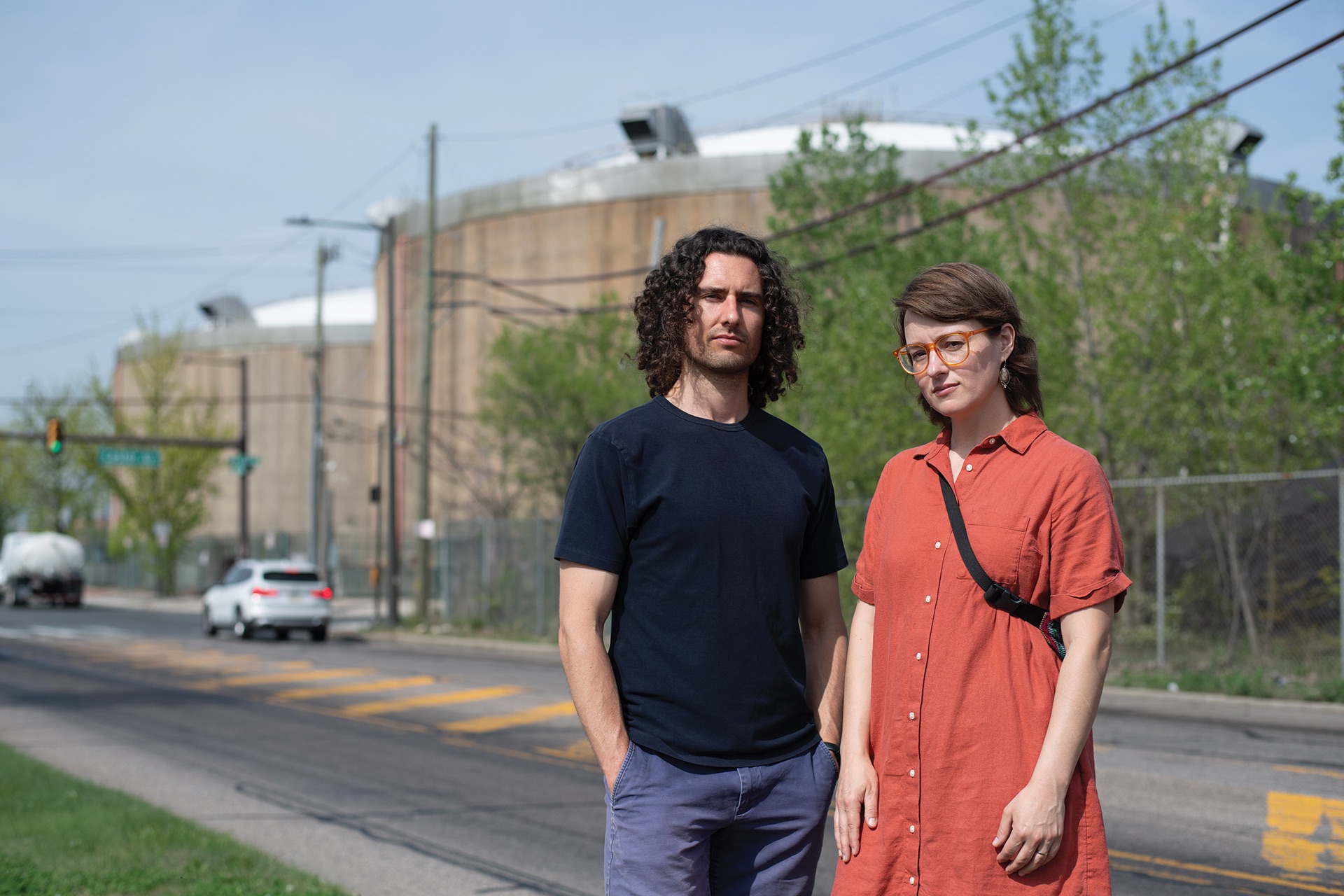
The issue revolves around the plant in Port Richmond, where two 12-story tanks loom over Delaware Avenue. They fit in with the industrial landscape, sitting across the street from the Tioga Marine Terminal and next door to a water department sewage treatment plant.
Those tanks can hold four billion cubic feet of LNG, enough to get PGW’s customers through the coldest winter PGW can imagine.
Behind those tanks, a complex jumble of pipes feeds gas into equipment that cools the hydrocarbons to 270 degrees below zero, at which point they condense into a liquid that takes up about 1/600th of the space, making it more efficient to store and transport.
What is harder to see is the gas, invisible to the naked eye, that leaks out or is intentionally vented to maintain the correct pressure in the tanks and the liquefying equipment. But filmed with an optical gas imaging camera like the one Physicians for Social Responsibility Pennsylvania has, the invisible gases pop into view on a video the group posted to YouTube. “You can point it at the facility and see,” says Linnea Bond, the group’s environment and health education director. “You can see this is a cloud of hydrocarbons.”
As Philadelphia winters warm due to climate change, and as the City attempts to meet its emissions reduction goals, Port Richmond residents Eric Stowers and Sara Baier are not convinced that the new liquefier would be a good purchase.
Baier and Stowers have not seen PGW reach out to the neighborhood around the facility, which led them and a group of other Port Richmond residents to organize. “For me, it has a lot to do with PGW not being transparent with residents that live in our neighborhood,” Baier says.
“What doesn’t make sense is building a brand new plant that’ll be ready by 2030 and has the ability to produce more LNG that we might not need,” Stowers says.
If PGW builds a plant that’s larger than it needs, then customers are maybe paying more than they should be paying.”
— Robert Ballenger, attorney, Community Legal Services
Along with Bond’s concerns about air pollution from plant operations, she says the new, scaled-up liquefier would be a step back in the City’s path towards its stated goal of going carbon neutral by 2050. “We’ve got the question of investing in infrastructure for a system that we don’t want and that the city is sort of, at least in principle, supposed to be moving away from,” Bond says
Devin McDougall, supervising senior attorney with Earthjustice, agrees.
“I think it’s concerning that PGW is proposing to make such a large investment in expanding fossil fuel infrastructure without analyzing its climate impacts or explaining how such an investment can be reconciled with the City of Philadelphia’s commitment to net zero greenhouse gas emissions by 2050,” McDougall says.
A 2021 study of options for PGW to decarbonize pointed to geothermal heating and cooling as a low-emissions service the utility is well-suited to provide. PGW has been slow to roll out a pilot, however, as Grid has reported. PGW’s representative wrote that the utility expects this spring to be able to announce the results of a feasibility study of a geothermal pilot at the John F. McCloskey Elementary School and the adjacent Dorothy Emanuel Recreation Center. PGW also plans to hold community meetings about long-term greenhouse gas reductions before October, though it has not set the dates.
PGW says the primary purpose of its LNG plant is to ensure reliability through what the utility calls “peak shaving,” a form of price arbitrage. Gas reaches Philadelphia through a network of pipelines. The price of the gas depends on demand, so it is relatively expensive in the winter, when millions of buildings across North America use it for heating. PGW buys extra gas off the pipeline in the spring and fall when the price is low and stores it as a liquid. Then, in the winter, PGW can convert it back to a gas for its customers to use.
PGW doesn’t only use LNG to save money. The utility stores gas for the winter based on its estimate of the most it could need — its “design winter.” The worst thing that can happen is to run out of supply during a freak cold snap, leaving customers without heat when they need it most. That means that virtually every year, PGW ends up with leftover LNG, which it sells to regional buyers who truck it away.
The current liquefier dates back to 2002, and PGW says it is nearing the end of its life. “PGW is proactively seeking to replace the system before the current system fails to avoid severe service disruptions to customers and increased costs,” a PGW representative wrote in reply to Grid’s request for comment.
The proposed liquefier would be able to operate year-round (not just spring and fall as is now the case), which would also increase PGW’s capacity to liquefy gas from 2.2 billion cubic feet per year to 3.3 billion cubic feet per year, as Ballenger points out.
Complicating its request for a new liquefier is PGW’s search for a public-private partnership with an outside entity that might provide financing for a new gas liquefier, as PGW explains in its capital budget proposal. “If an agreement is reached, PGW will no longer need the funding requested herein for this liquefier project.”
The potential public- private partnership adds more uncertainty for Stowers. “It’s not clear what their role is,” he says.
Along with expressing concerns that the new liquefier doesn’t align with the City’s sustainability goals, Ballenger thinks it is oversized and disagrees with PGW’s estimate of when they’ll need to replace the current one. PGW would likely need to borrow money to pay for a $182 million purchase, he says, and the payments on that debt would be passed along to customers. “If PGW builds a plant that’s larger than it needs, then customers are maybe paying more than they should be paying.”
As for the new liquefier, the Commission will have to make a decision on PGW’s fiscal year 2027 capital budget, which, according to Ballenger, will likely be presented at the May 12 meeting, or at a special session. Members of the public have the opportunity to weigh in at the upcoming meeting.