
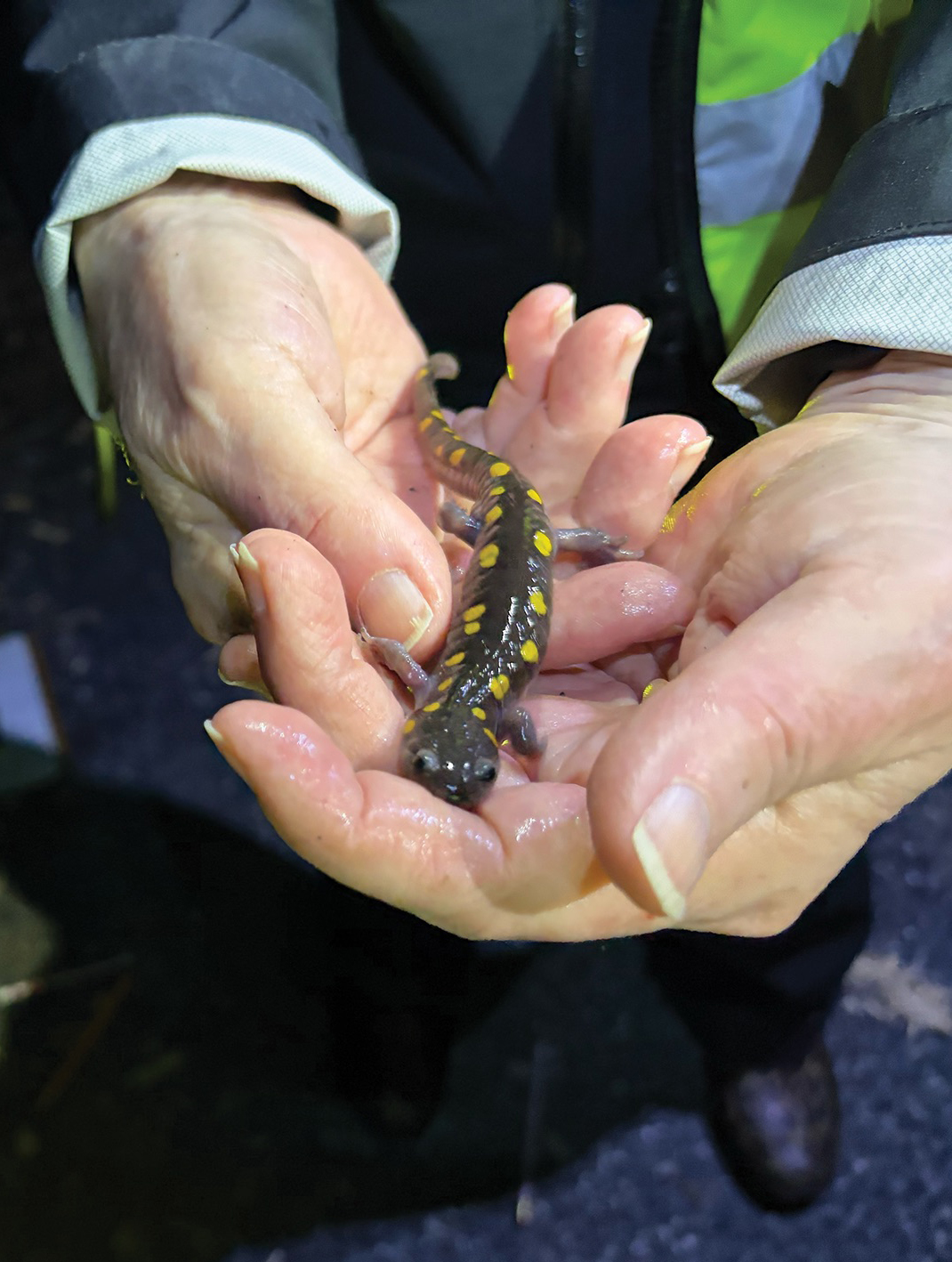
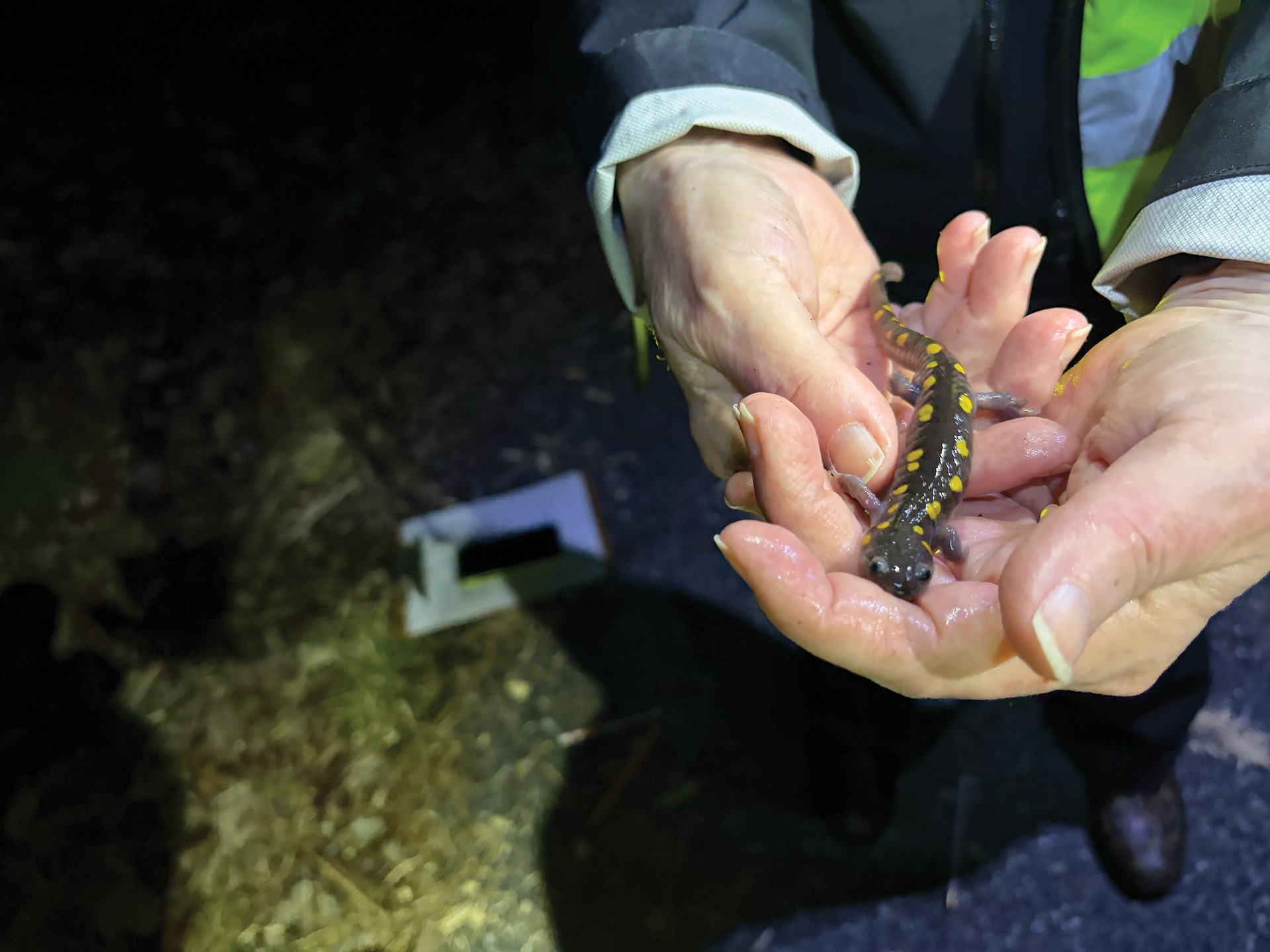
On a late winter-early spring evening, with a warm rain falling and temperatures above 45 degrees, volunteers with the Sourlands Conservancy in central New Jersey take up posts along nine roadways in Hopewell Township that frogs and salamanders need to cross while en route to the vernal ponds where they breed. The conditions have to be just right to coax the amphibians from the uplands where they have been hibernating, and the warm, dampness of the night makes for a perfect match.
Yvonne Selander, a librarian from Flemington, and six others, wearing reflective vests and headlamps, wait along one country road. They slow or stop vehicles on the roadway if the amphibians are crossing. If necessary, the volunteers carry them toward a nearby vernal pond. Selander has helped protect the amphibians from traffic for the last six years: “Having 10 to 12 salamanders cross the road and trying to figure out where they were, keeping track of them and hoping that a car didn’t come and thankfully, at that point, they didn’t.”
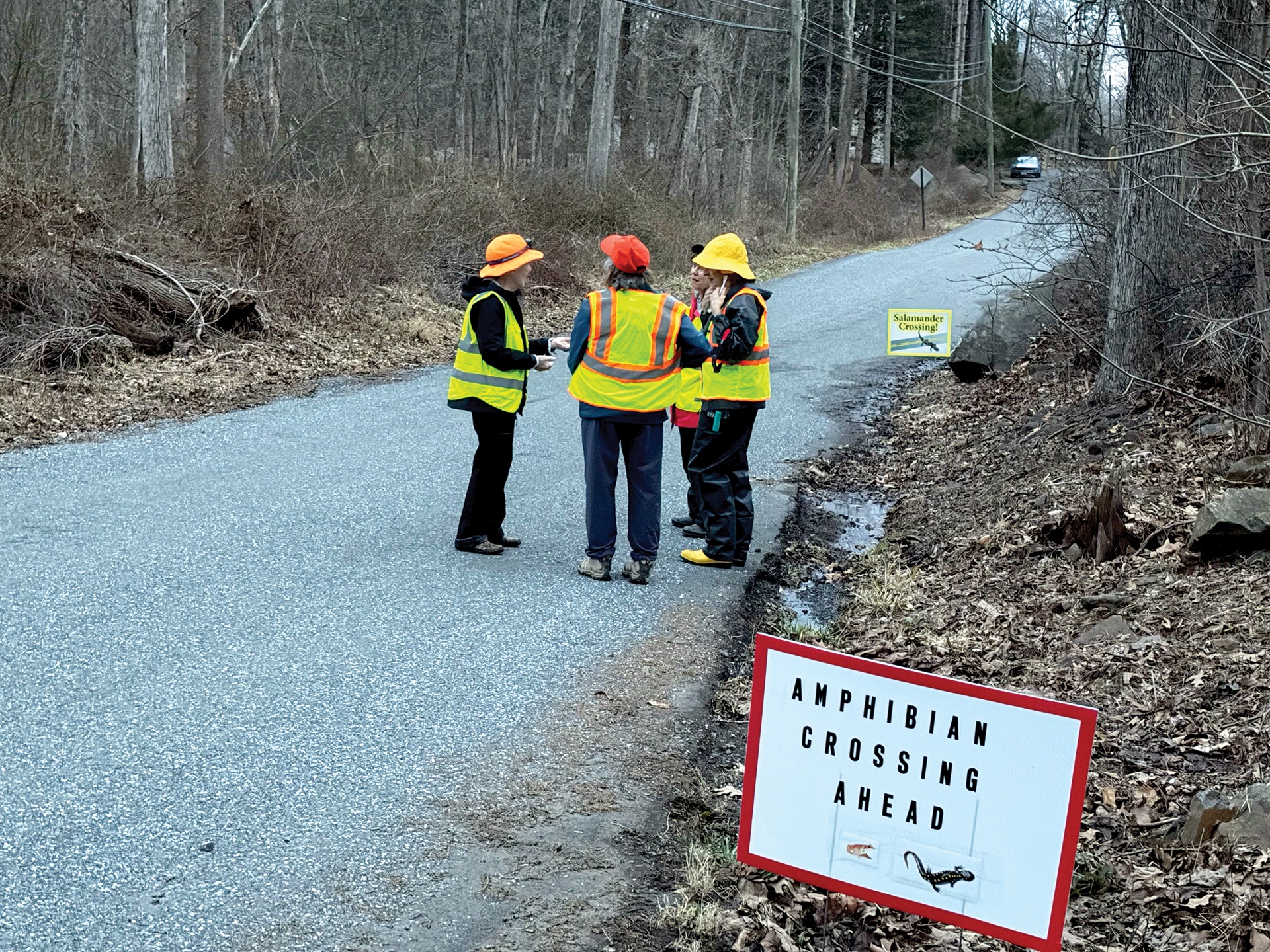
The mating calls from wood frogs and spring peepers fill the air. The wood frogs sound a little like ducks quacking. The peepers merge their songs into a deafening, high-pitched chorus. The resulting tadpoles are safe from predatory fish because the vernal pools dry up during the summer. Robert Aluck, stewardship director for the Sourlands Conservancy, says wood frogs, spring peepers and spotted salamanders are the three species that are normally seen here.
“The past couple years, we’ve seen less than we’ve liked because of droughts at prime times of the year,” Aluck says. “So the vernal pools don’t fill up with the snow melt as much as we’d like.” The U.S. Drought Monitor shows much of the Delaware River watershed has been experiencing abnormally dry or drought conditions. This winter’s snowfall has provided some relief and increased the number of amphibians counted. “We’re expecting it to be a bigger year because of all the snow outside that’s currently melting and filling up the reservoirs,” Aluck says.
In one night, 55 spotted salamanders, 38 wood frogs and six spring peepers are recorded moving across the road to a pond. One week later, volunteers count nine wood frogs, 12 spring peepers and 11 spotted salamanders. New Jersey lists spotted salamanders as a species of special concern because of habitat loss.
Meanwhile in southern Delaware County, a group of volunteers are monitoring a series of three vernal ponds that were discovered five years ago in an industrialized and developed section of the Marcus Hook watershed. Meagan Hopkins-Doerr of the Delaware County Master Watershed Stewards says isolated wetlands such as this are sensitive to nearby development. “This is a pretty urban environment. I was so happy one of our volunteers found it,“ she says.
An apartment/condominium development, a large parking lot and a busy roadway surround the area. Wood frogs have already migrated to the ponds. Some of their egg masses are visible on logs in the pools. “There’s a whole bunch of naturally-occurring spring ephemerals here. Wood frogs are an indicator species,” Hopkins-Doerr says. Amphibian counts from the roadside efforts are sent to state environmental officials to assist with future land use decisions.
A number of steps are underway to improve conditions. Volunteers have removed multiflora rose bushes and other invasive species from around the pools. “They can crowd out the native species that complement what’s living in the vernal pool,” according to John Ferri, who works with the Penn State Master Watershed Stewards program.
Volunteers have also planted native trees around the buffer of the ponds. Hopkins-Doerr says the monitoring has been ongoing for three years. Volunteers have also found a box turtle, green frogs and a DeKay’s brown snake.





Great article ed!