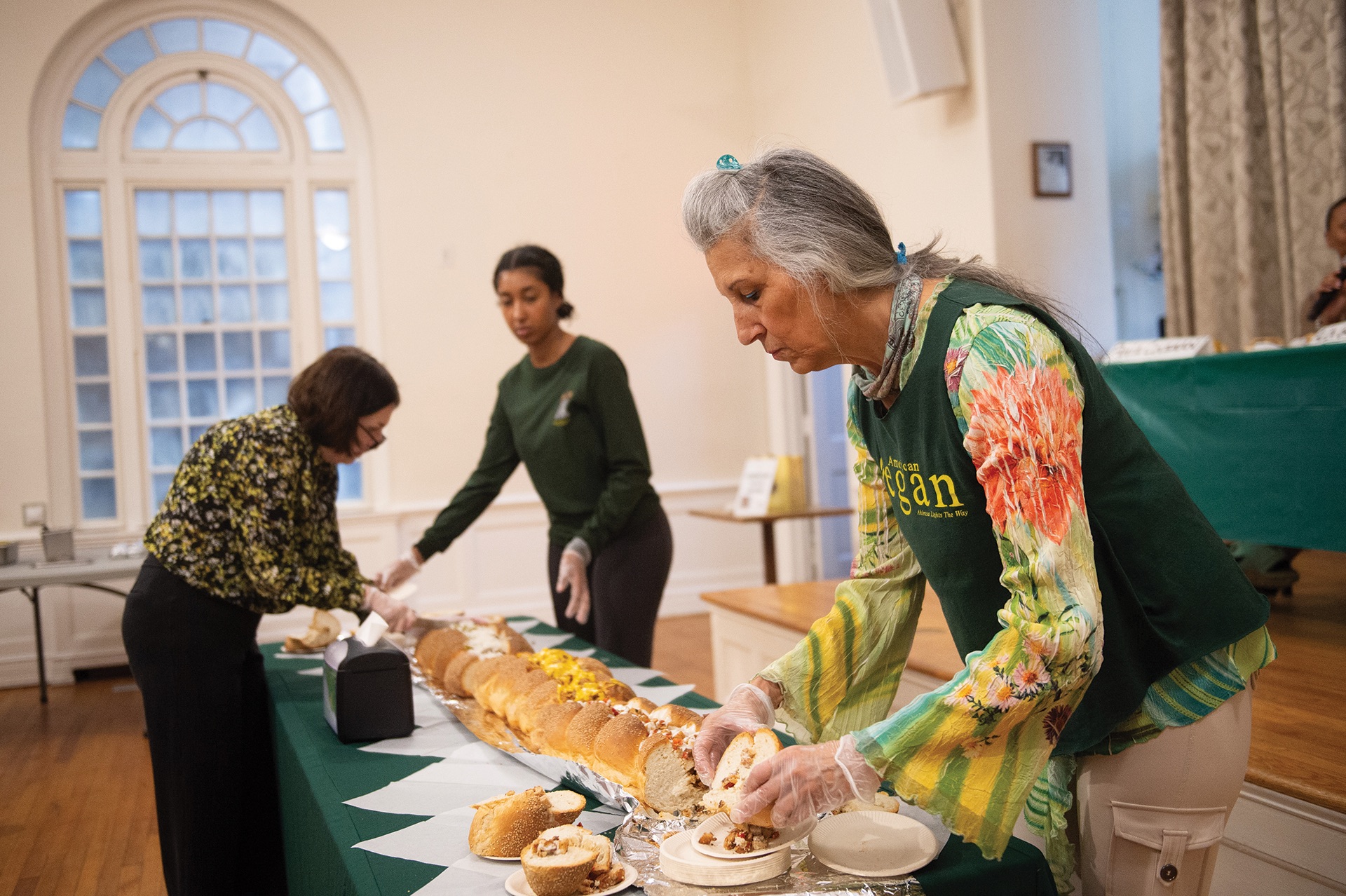
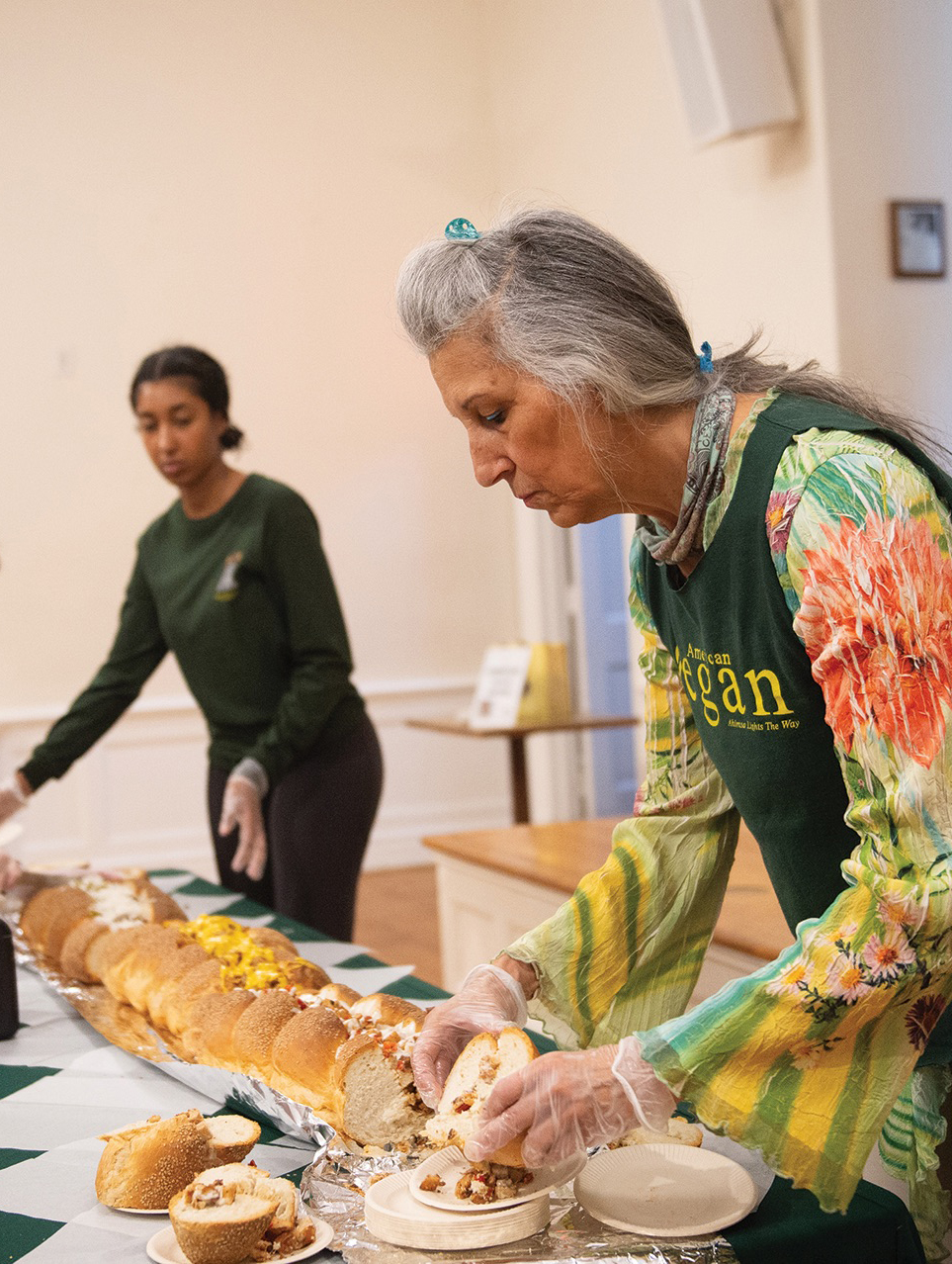
On April 13, the day Mayor Cherelle Parker declared Vegan Cheesesteak Day, the American Vegan Center, headquartered in Old City, held its annual vegan cheesesteak contest, but with a record-breaking challenge: create the longest vegan cheesesteak, totaling 76 inches as a tribute to the revolutionary year of 1776.
Vegetarianism and Philadelphia may seem like odd bedfellows, but they are intertwined, says Vance Lehmkuhl, director of the American Vegan Center. According to his latest book, “Revolutionary Peace: How Philadelphia Launched the U.S. Vegetarian and Vegan Movement,” vegetarianism is as old as the nation.
Bernard Unti, a native Philadelphian and historian of animal protection, concurs.
“Vegetarianism in Philadelphia predates the cheesesteak by at least a century and a half,” Unti says.
Lehmkuhl explains, “The cheesesteak has two significant parts, and neither is vegan. It seems like [a vegan cheesesteak] contradicts itself.” But it fits into the framework of Philadelphia as a hotbed for revolutionary, abolitionist and vegetarian activity throughout its history.
Notable vegetarians in 18th-century Philadelphia include abolitionists Benjamin Lay and Anthony Benezet, as well as part-time vegetarian Benjamin Franklin.
The cheesesteak came into the food lexicon in the early 1940s and is largely credited to Pat’s Steaks. What some may see as a greasy meat sandwich for which there can be no plant-based equivalent, others embrace the culinary challenge of flipping the cheesesteak on its head.
Lehmkuhl describes the cheesesteak as “such an elemental food icon for Philadelphia … But also, here’s this variation that you can do, expressing your own creativity.”
Past winners include Haverford’s Boardwalk Vegan and South Philly’s Triangle Tavern and use various kinds of nut- or veggie-based “cheeses” and meatless fillings from seitan to tofu to mushrooms.
This year, the top three restaurants brought their vegan cheesesteak creations to jointly construct the largest vegan cheesesteak. A panel of four judges were given blind samples of the three vegan cheesesteaks.
Judge Pamia Coleman is the cofounder of Black Girls With Green Thumbs, a nonprofit that teaches how to grow healthy food in urban areas. “We do a lot of plant-based cooking with fresh ingredients that we grow right in our own community gardens,” Coleman says. She appreciated the inclusion of whole foods like peppers and mushrooms.
Judge Lisa Tynes is an accomplished food innovator and is the daughter of Alfoncie B. Austin, who operated Basic 4 Vegetarian in the Reading Terminal Market. Her mother, Austin, is credited with developing the first fully vegan cheesesteak in 1999.
The newest restaurant to Philly’s vegan scene, Say She Ate — a playful take on the word satiate — opened in October 2025 and finished with the most votes in the public voting portion of the contest. Located on South Street, Say She Ate is a vegan restaurant creating “Indian-inspired Philadelphia cuisine.” Owners Shrinathji Raval and Keshava Mair grew up vegetarian and saw an opportunity to bring the plant-based food they are passionate about to the community.
Rounding out the top three were Sabrina’s Café and Boardwalk Vegan, which, with its signature house-made “wiz,” composed of carrots and potatoes, won for the third consecutive year.
“The path to today’s thriving veggie scene in Philly was set by the early Quaker exponents of ethical diet, the young Ben Franklin, who thrived on meatless cuisine, and the English nonconformist Protestants who organized the first vegetarian church, the first vegetarian newspaper and the first vegetarian organization in the United States,” Unti says. “In the trust of their contemporary successors, this legacy continues, and vegetarianism is arguably one of the most enduring of Philly firsts.”