In 2022, a pipe failed at the liquefied natural gas (LNG) export terminal in Freeport, Texas, causing an explosion and fire. The conflagration took place entirely within the facility, built on a barrier island along the Gulf of Mexico. The nearest residential area sits more than a mile away from the plant, adding a buffer from what is known as the blast zone. No one was injured inside or outside the plant.
There isn’t as much room for a natural gas explosion in Eddystone, where developers may be in negotiations with borough leaders to site a plant along the densely populated Delaware County waterfront, according to the Delaware Riverkeeper Network.
They would knock down 150 residents’ houses where the facility would go.”
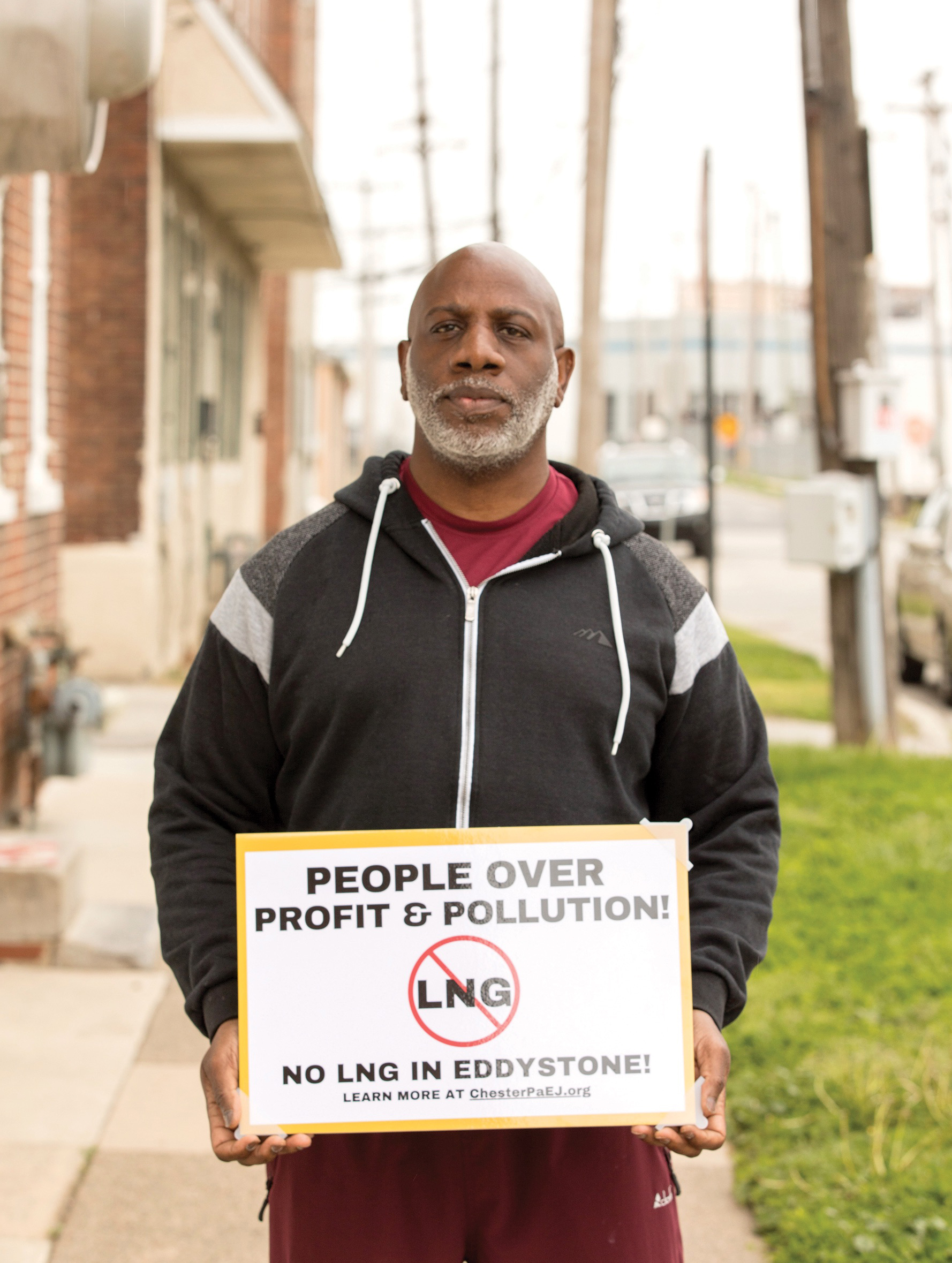
— Eugene Wylie, Eddystone resident
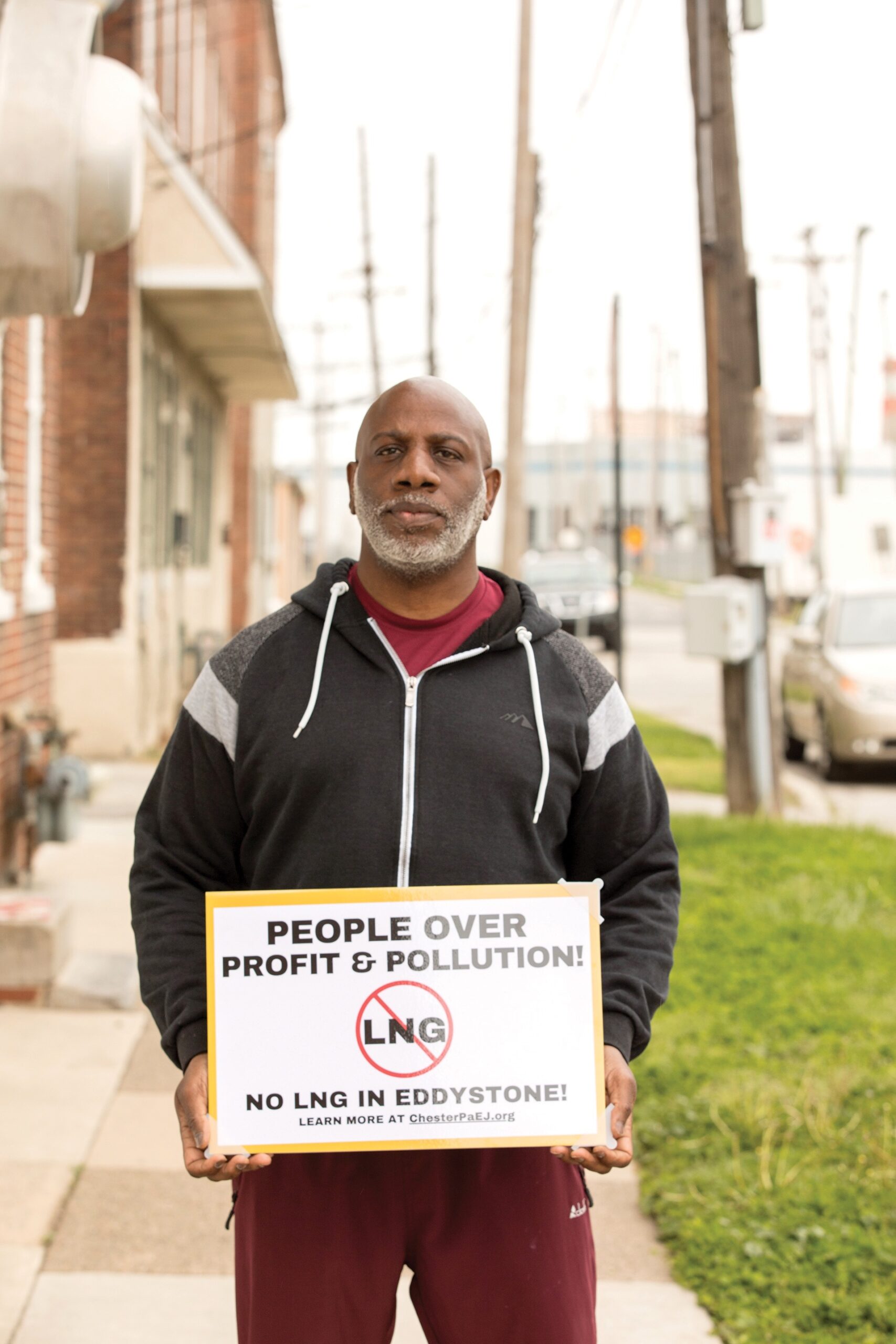
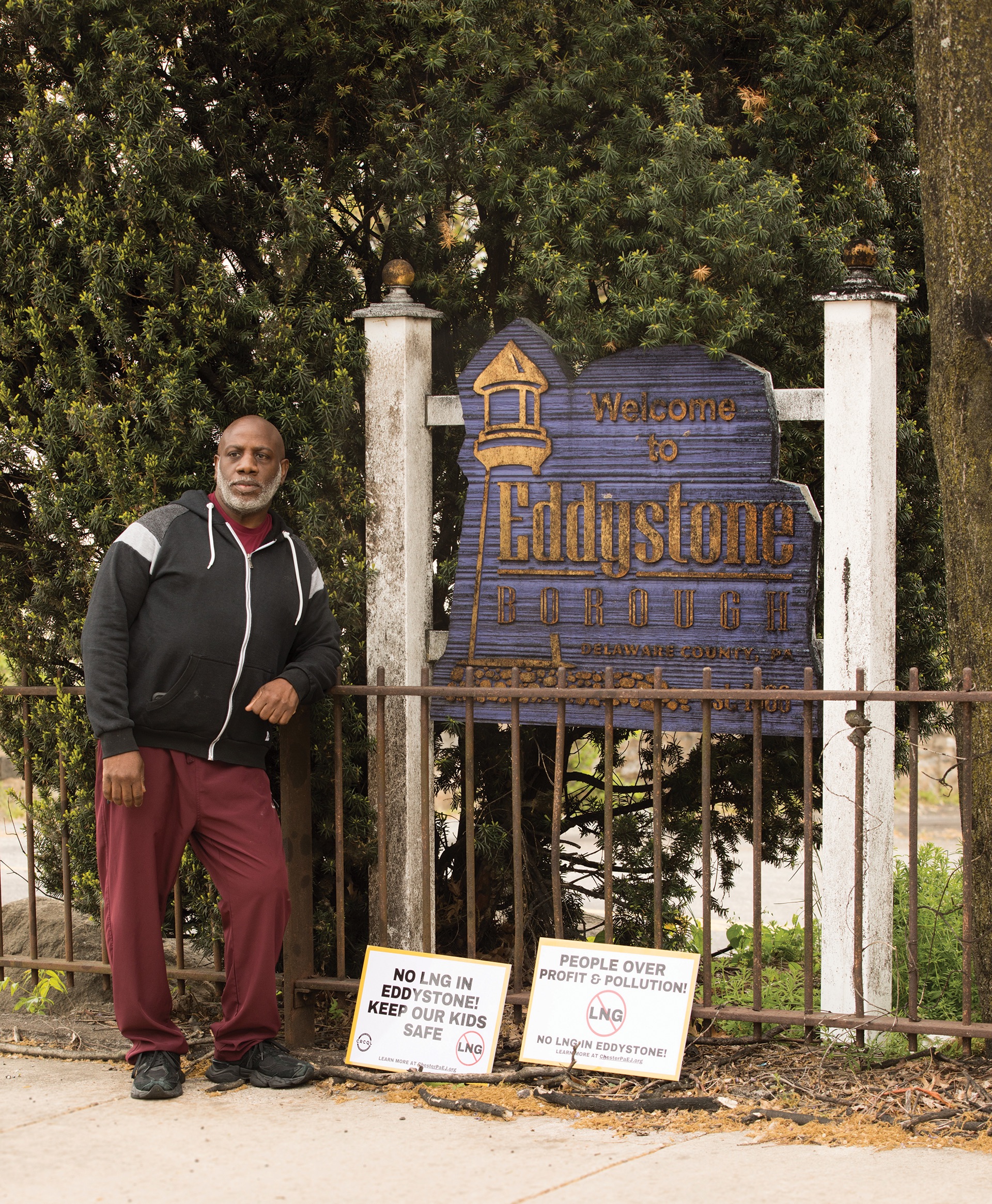
The potential for an explosion is only one of the reasons Eddystone resident Eugene Wylie opposes an LNG plant in his backyard. The lack of open industrial space in the tiny municipality (about 1.5 square miles, a third of which is water) is another. Assuming the facility would be similar in size to the 1,000-acre Cove Point LNG export terminal in Maryland, “They would knock down 150 residents’ houses where the facility would go. If they need to knock down three blocks of houses, that’s one bad thing,” Wylie says.
He heard about the possible Eddystone plant from canvassers with Chester Residents Concerned for Quality Living (CRCQL), which has been fighting industrial pollution next door to Eddystone for more than 30 years. Before the Eddystone development came to light last year, CRCQL had organized against an earlier proposal for an LNG export terminal based in Chester.
The road to Eddystone
The Chester proposal had been advanced by Penn America Energy, whose CEO, Franc James, began discussing the idea of an export terminal with elected state officials in 2016, according to reporting by State Impact Pennsylvania in 2022 that brought the Chester proposal to light.
It was in 2016 that the United States started exporting LNG, after longstanding restrictions on shipping the fuel abroad from the contiguous U.S. New hydraulic fracturing technologies that allowed drillers to free up fossil gas trapped in shale resulted in a production boom, turning the U.S. from a net fossil fuel importer to an exporter, according to the U.S. Energy Information Administration. LNG import terminals, such as those at Cove Point and Freeport, were retooled to reverse the flow.
Today, the United States exports more LNG than any other country, at more than 14 billion cubic feet per day, according to the U.S. Energy Information Administration. Initially, Asian countries took in the largest portion of American gas, but after Russia invaded Ukraine in 2022, exports shifted more towards Europe.
Cove Point is the nearest LNG export terminal to Pennsylvania, and the only one close to the wells tapping the Marcellus Shale. Another terminal operates at Elba Island in Georgia, while five more, including Freeport, are clustered along the Gulf Coast in Louisiana and Texas.
But with a glut of gas flowing from Pennsylvania wells (only Texas produces more gas than Pennsylvania), local political leaders, labor unions and entrepreneurs want to see an export outlet closer to home.
In 2022, Northeast Philly state Sen. Martina White, R-Pa., introduced legislation to create a Philadelphia LNG Export Task Force, which passed the state House and was signed into law by then-Gov. Tom Wolf, a Democrat. The task force’s members and its hearings were dominated by industry and labor, as reported in Grid #170. In the task force’s final report, local environmental justice concerns were addressed only in a rebuttal written by task force member Rep. Joe Hohenstein.
The report promoted gas as a clean alternative to coal, stating that “Natural gas has the potential to mitigate the risks associated with climate change by significantly reducing global carbon emissions. By transitioning away from carbon-intensive fossil fuels, the United States can be a global leader in reducing greenhouse gas emissions.”
But carbon dioxide produced from burning methane, the principal fossil gas pumped from the ground, makes up only about 34% of the total emissions generated from getting it from the well to the final consumer overseas, according to a 2024 analysis by a Cornell University researcher.
Methane is itself a powerful greenhouse gas, and when leaks at every step of the process are considered, along with the energy it takes to transport and liquefy it, total lifecycle emissions exceed those from coal by 33%.
Nonetheless, Republican Sen. Dave McCormick is a vocal booster of Pennsylvania’s fossil fuel industry. In an April 2025 Washington Times op-ed titled “The Road to Energy Dominance Runs Through Pennsylvania,” McCormick wrote about planned LNG export projects: “Philadelphia Gas Works [PGW] is working to export LNG through the Port of Philadelphia. Penn America Energy and the Pennsylvania Building Trades are collaborating on a $7 billion project to build a new LNG export terminal along the Delaware River in Eddystone.”
That Eddystone proposal was news to the Delaware Riverkeeper Network, which files monthly right-to-know requests with the state government to keep an eye on any new developments, according to Tracy Carluccio, the network’s deputy director. “We immediately added that to our right-to-know request.” Those requests turned up mention of an entity called Eddystone Energy LLC, which was incorporated in Delaware in May 2025, apparently taking the place of Penn America. Over the next few months, more documents came to light, making clear that Eddystone Energy was communicating with state and local officials, but both the Pennsylvania Department of Community & Economic Development and Eddystone Borough claimed that a nondisclosure agreement prevents them from sharing additional information through right-to-know requests, Carluccio says.
Carluccio says that the Riverkeeper Network is currently in mediation with the borough to sort out what documents are actually protected by the nondisclosure agreement. Grid has reached out to Eddystone’s mayor and borough manager, but has not received a response.
Button-lipped
“Every person is staying button-lipped,” Wylie says. “I sent emails to council members, the mayor, the manager. No one replied.”
At a Nov. 5, 2025, meeting of the Pennsylvania House committee on Environmental & Natural Resource Protection, held in Chester, speakers objected to siting an LNG plant in Chester or in any of the other frontline communities along the Delaware River.
LNG is simply not welcome here … I’m not pushing [our projects] out to accommodate a blast zone.”
— Stefan Roots, Mayor of Chester
“LNG is simply not welcome here,” Chester Mayor Stefan Roots said. He went on to explain that there isn’t the space to safely site an LNG facility in Chester. “We have new multimillion dollar development projects in the blast zone underway in this area, including our Chester City Public Works garage and a new power home remodeling facility… I’m not pushing them out to accommodate a blast zone.” Roots said he sees Chester’s future in nonindustrial development, developing the city as an attractive place to visit and live. “As we seek to revitalize Chester, my vision is to build new housing and attract new residents to the city.”
Zulene Mayfield, a longtime advocate for environmental justice in Chester and a chairperson of CRCQL, said there are 11 major sources of air pollution in Chester already, including a trash-burning power plant and a sewage treatment plant that incinerates sludge. Mayfield drew a connection between these pollution sources and cancer deaths in her community. “If we value the health of our families, our friends and neighbors and throughout the Commonwealth, we need to build a different future, one in which we can all thrive,” she testified. “We should not be building a future in which growing numbers of parents are burying their children. Building a healthy future means there’s absolutely no room for Penn America’s LNG plant, not in Chester, not in Eddystone, not in Marcus Hook, and not, for that matter, in South Philly or anywhere.”
Industrial Highway, which runs through Eddystone and Chester along the Delaware River waterfront. Photo by Taylor Ecker.
Wylie rejects claims that an LNG terminal would bring many jobs to Eddystone or that local residents would be qualified for higher-paying positions. “There’s no one in Eddystone with a chemical degree,” he says. “The only positives that can come out of it are for the company that will make money off of it. The LNG is shipped to other countries. The pros and cons don’t match.”