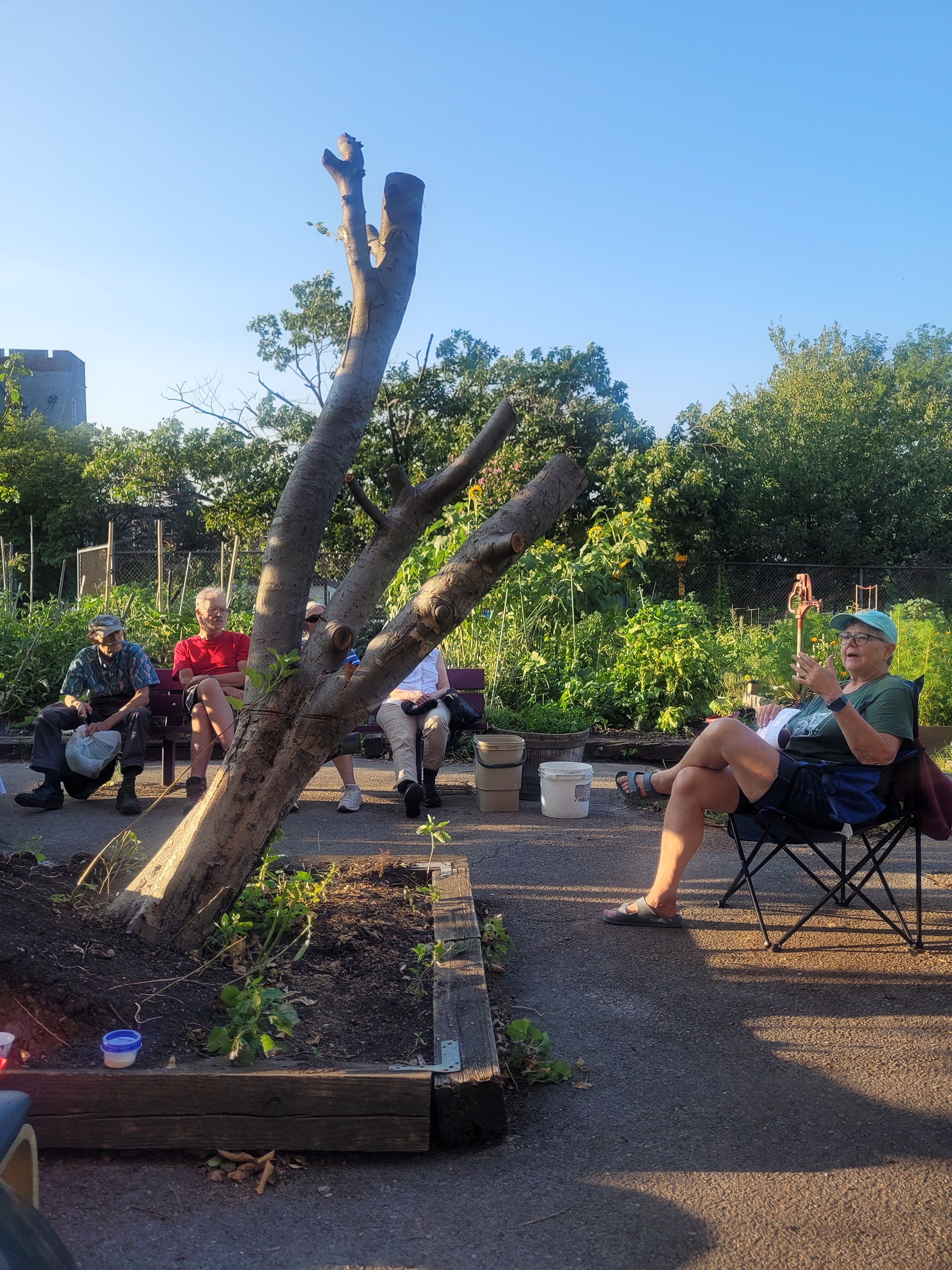
The Sunday following Philadelphia’s apocalyptic microburst storm, the Garden Court gardeners gathered late in the day to honor our fallen fruit trees. They sat around the apple stump and shared stories of the shade the tree had offered on hot July days and the roost the branches had made for birds and squirrels. Of the apples the wind sometimes threw down — always more sour than we’d like — or the cherries hung a ladder’s reach above our heads — always sweeter than the low-growing fruit. Then they shared silence and offered gifts: a scattering of cornmeal, a ripe tomato, a splash of water.
This was climate grief, moving through a community.
The Garden Court Community Garden is a natural respite on a busy street. In midsummer, when the squash and collards were in full flush and the central apple tree had leafed out into a wonderful umbrella of shade, the garden became a cool, green oasis. But when I returned from traveling just one week after the storm in early July, I was warned by a friend: “It looks really different.”
Our oasis had been disrupted. The apple tree, along with our cherry and one peach, had been toppled. In place of green shade, only stumps and sweltering sunshine.
News of the storms first reached me on vacation through a flurry of messages from a panicked neighbor. Downed trees everywhere, power out on the block, a transformer on fire — it was the craziest storm she’d ever seen in over a decade living in West Philly. For a while, she said, she’d just sat by her back door holding it shut. It had already blown open once in the violent winds and she was afraid of it flying off completely.
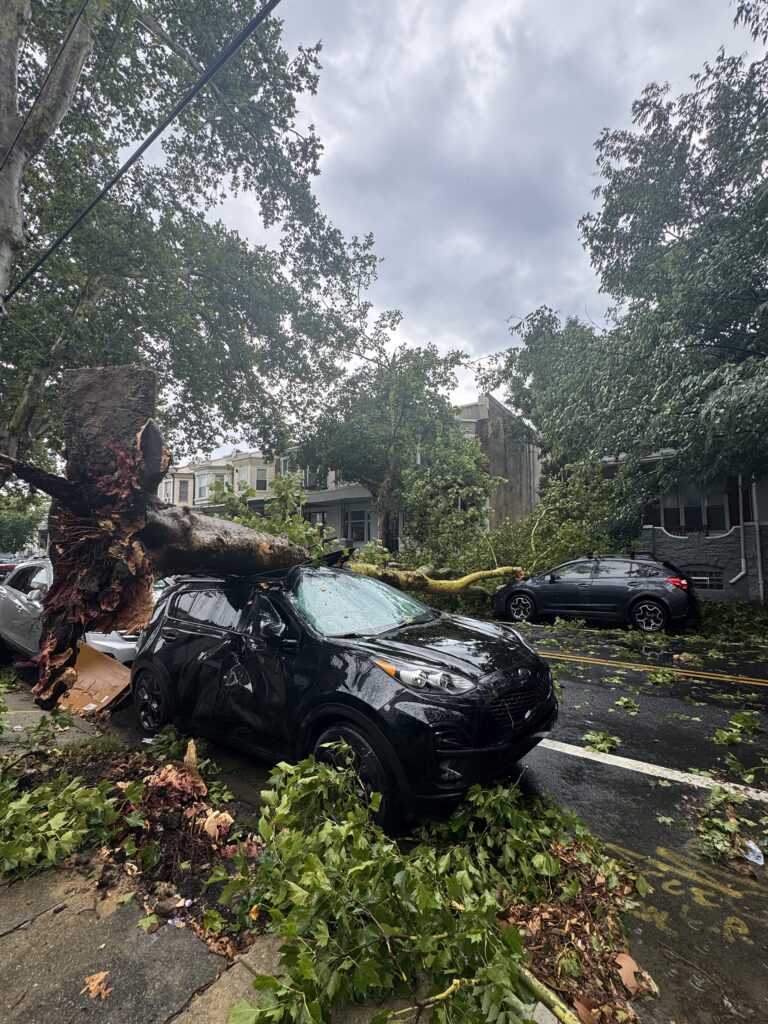
The storm was only one of three back-to-back climate disasters that hit Philly while I was away. First, there was the stagnant heat wave that parked 101-plus-degree temperatures over Philadelphia for three days. Then the sudden violence of the microburst storms, with winds reaching up to 70 miles per hour in a single gust, followed by acrid wildfire smoke drifting down from burning Canadian forests that caused a Code Red air quality day in the city.
I’ve documented a lot of scenes like these over a nearly decade-long career writing about climate change and the environment. I’ve also lived through a fair number of heat waves and freak storms. I understand them on an intellectual level as the result of climate change — the atmosphere, warmed by carbon emissions, is causing more extreme and erratic weather. But rarely does my work allow me to dwell on the emotional significance of each new devastation. To be human for a moment, and feel the event for what it truly is: a loss.
Ecological grief — the pain experienced when witnessing environmental destruction — has been a documented concept for at least the last century, its first articulation widely attributed to the environmentalist Aldo Leopold. But in recent years, the American Psychological Association (APA) has begun documenting a type of grief specific to the impacts of climate change. In 2017, it published a report that details the mental health outcomes of the ongoing climate crisis, including grief.
Humans can endure a great deal, both physically and emotionally. But our society is poorly equipped to handle the kind of grief that climate change is throwing at us.
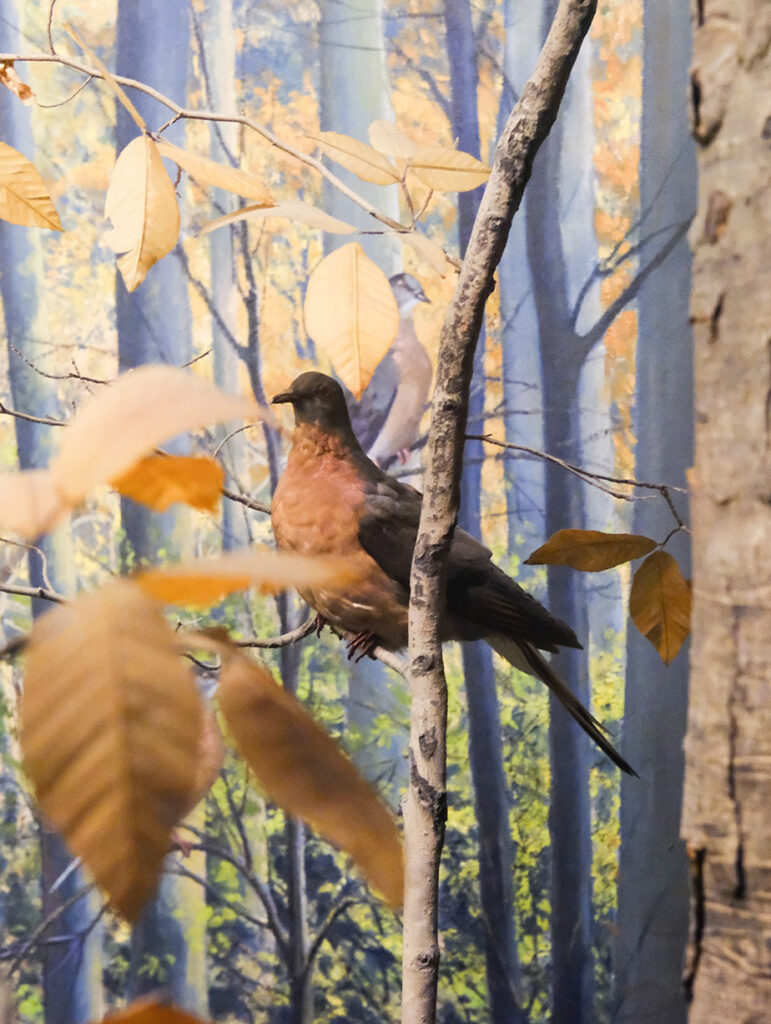
As with the death of a loved one, climate grief stems from the same knowledge that what once existed is gone and cannot be brought back or replicated. It’s the feeling of sorrow felt hearing the last known member of some endangered bird calling out for companions. The fear and anxiety of watching the sea’s edge eat away at a shoreline. The pang of hauling off toppled tree branches that once grew proudly toward the sky.
Humans can endure a great deal, both physically and emotionally. But our society is poorly equipped to handle the kind of grief that climate change is throwing at us. Human cultures have developed rituals over millennia to mourn our fellow humans: funerals and feasts and wakes and wailing processions that bring grief out in the open, share the burden of it with others and begin the long and winding process of dispelling it. But our trees? Whole species? The concept of winter or the memory of snow? How do we begin to mourn them?
Grief is also amplified by the speed at which climate change is unfolding. There is barely enough time between each new disaster for power lines to be restored, emergency services staffed up and municipal resources replenished, let alone to begin processing painful emotions. Our focus is dragged along from one recovery effort to the next. Without mourning time, grief can overwhelm us.
In the garden, this is a raw point. Climate isn’t the only agent of change in Garden Court. We have already lost our sunshine to the towers on our south flank. Now, development has begun to our west with the promise of more towers on the way. The mural that bordered our lot — an original from the Philadelphia Anti-Graffiti Network, created with support from DJ Jazzy Jeff — has been torn down in the demolition. Longtime neighbors are leaving. The boards that have framed our vegetable plots for three decades are at last rotting away. Losing our trees, on top of everything else, feels like the tempest of change around us finally striking home.
There are two ways to meet grief. The first is to isolate, to hunker down and wait for the storm to pass. But climate change is already here, and it will not be waited out.
The second is to seek community, find others that share your grief and mourn together. The APA recommends community. Humans are stronger together.
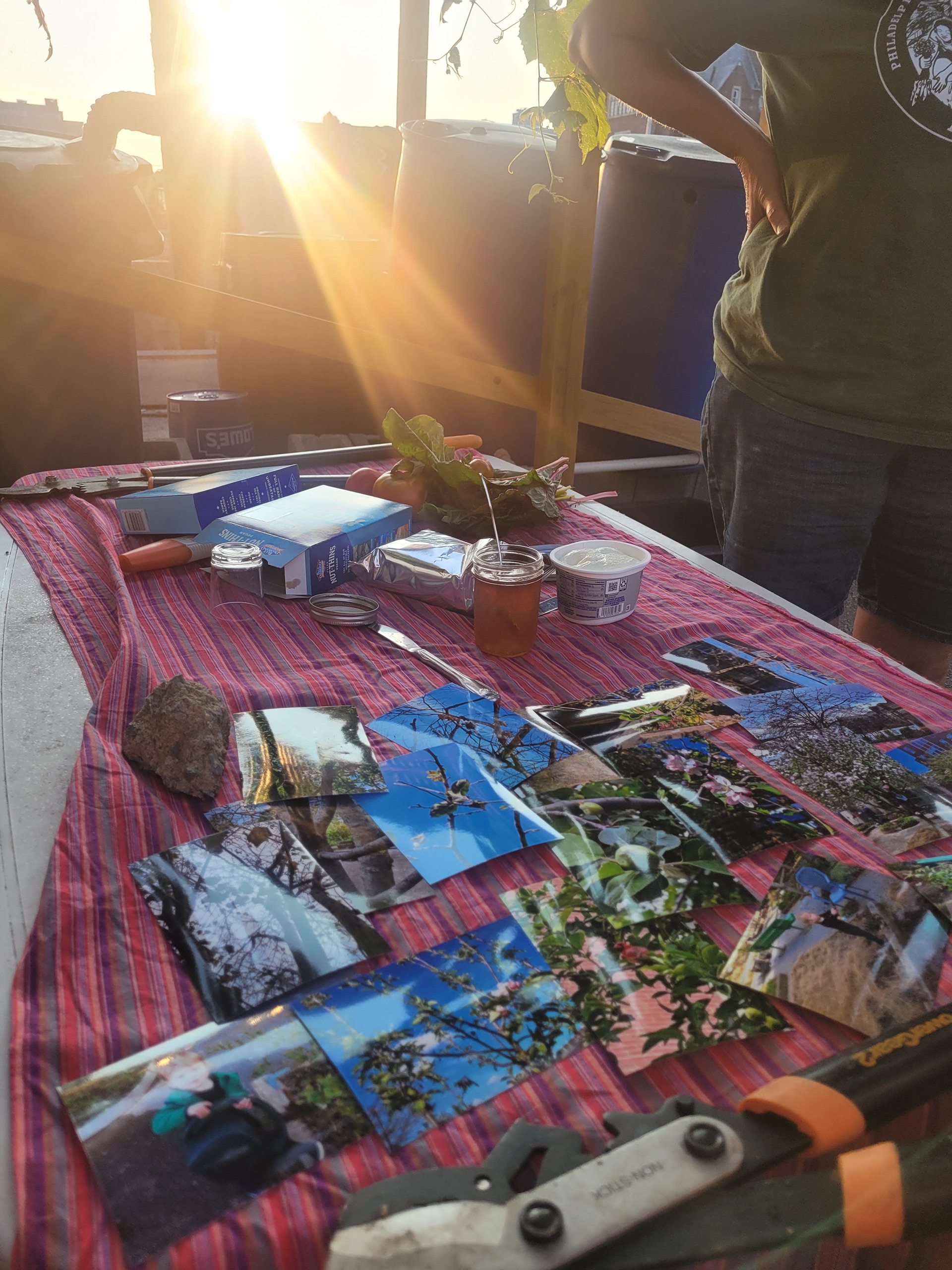
So, the Garden Court gardeners gathered to build a ritual for a new kind of loss. A wake for our trees. As at any good wake, there were snacks. Crackers with jelly distilled from the apple’s final crop. Later there would be conversations about what the future would look like: how to rebuild, whether to replace the trees and with what. But that moment was a time for mourning.
And as the sun slipped below the half-demolished wall to the west, the gardeners departed.