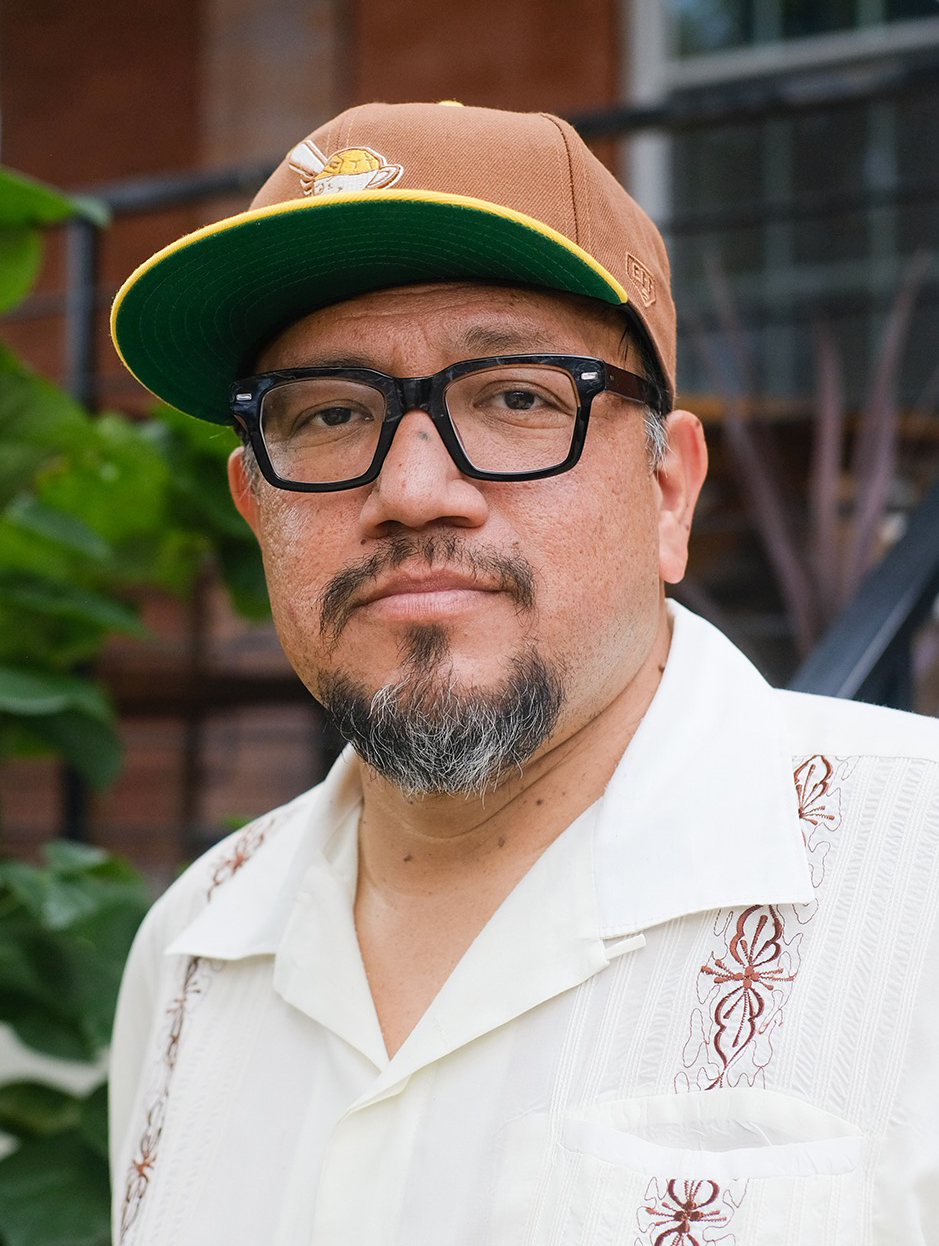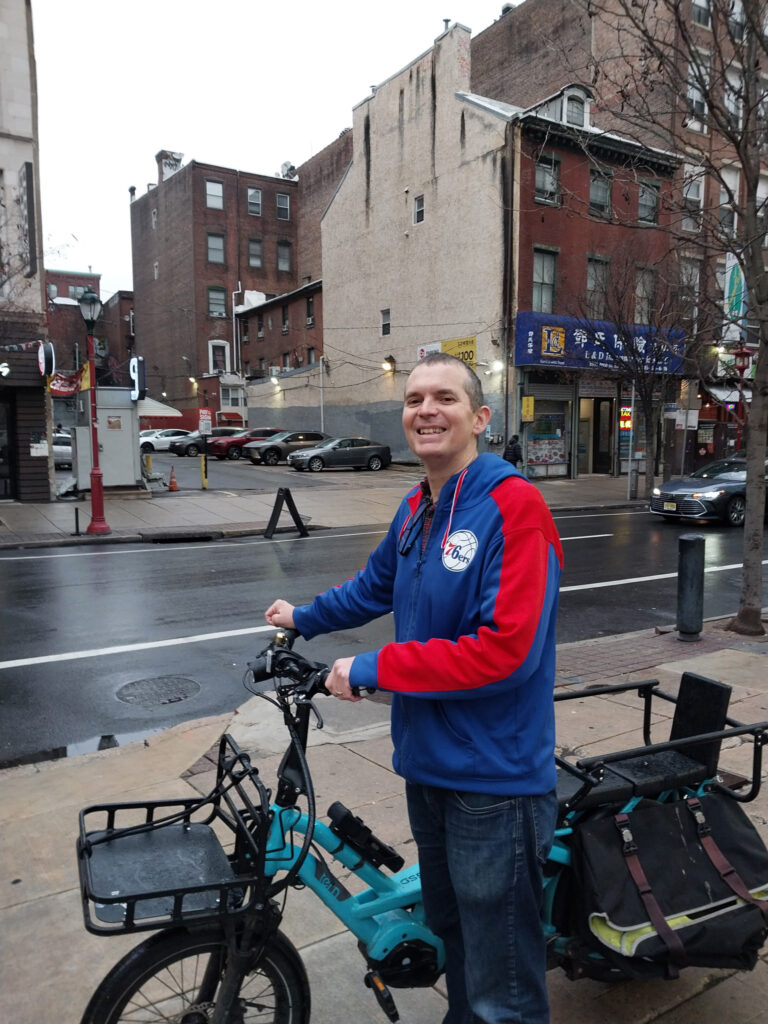
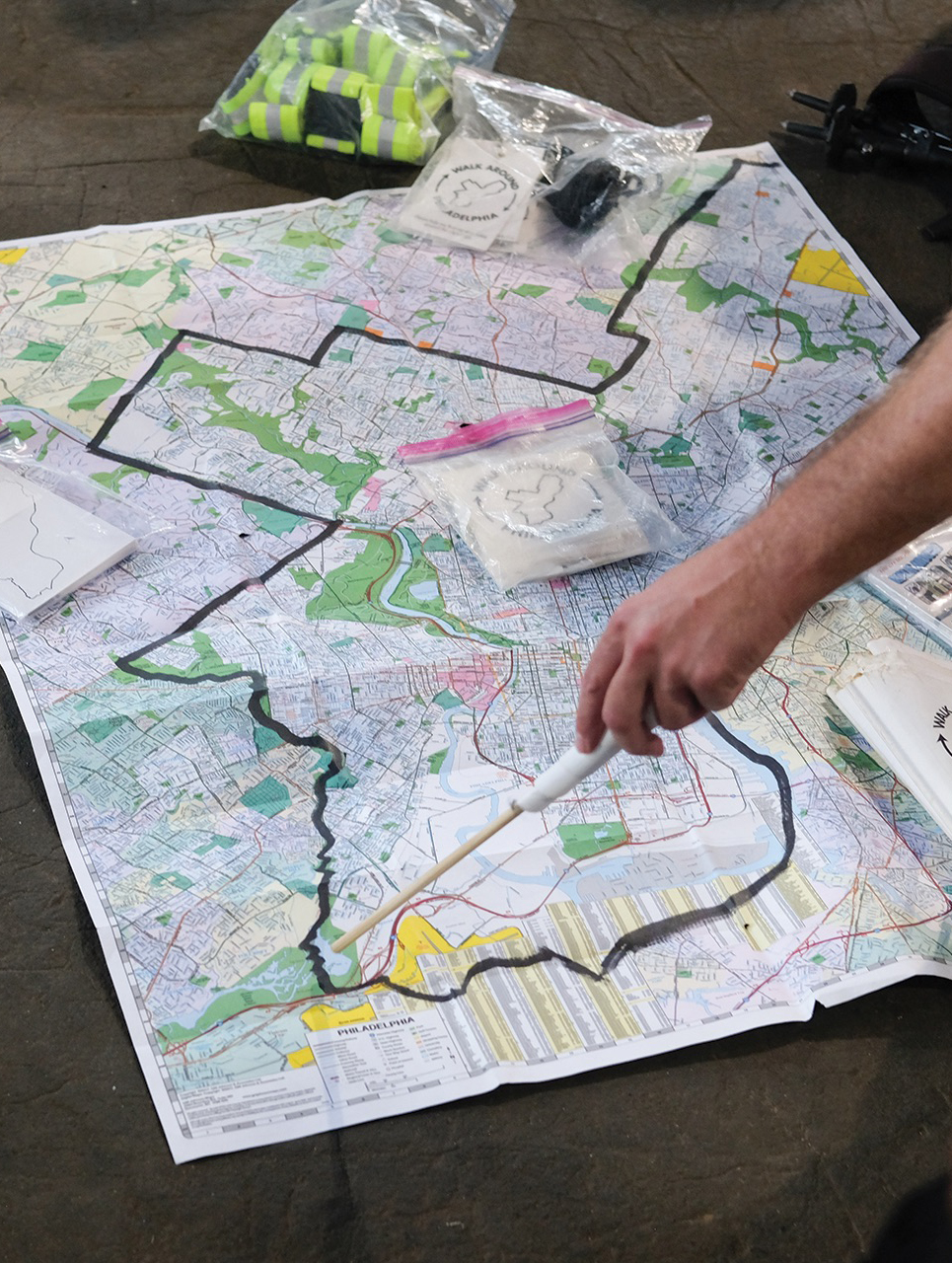
“1854,” says Jacques-Jean “JJ” Tiziou, with authority, when asked about the origins of Philadelphia’s borders. “That’s when the Consolidation was signed: February 2, 1854.” Good luck finding another Philadelphian who could, on the spot, provide the exact date on which the Consolidation Act transformed the neat rectangle of William Penn’s colonial city — from Vine Street to South Street, Schuylkill to Delaware — into the considerably less tidy shape of the city today. But to be fair to the rest of us, Tiziou has good reason to know this obscure bit of trivia: He has walked the city’s odd, jutting perimeter no less than 17 times.
Tiziou completed his first walk in 2016 as part of an artist residency, to which he’d applied as a photographer. (In 2011, he photographed and designed Philadelphia’s largest piece of public art: “How Philly Moves,” a mural on the side of a parking garage at the Philadelphia International Airport.) Over the next few years, he made the 100-mile trek an annual ritual. He’d set off clockwise from 61st and Baltimore and complete the walk in segments over five or six days.
“I thought I knew Philly pretty well before I walked it,” says Tiziou. “It was a humbling, humbling experience. The city is vast and unknowable and magical.”
In 2020, hoping to share that magic, Tiziou began accommodating larger groups through his organization, the Walk Around Philadelphia. He talks about “gifting people places”: showing them parts of their city they wouldn’t encounter otherwise. “We took a group of high school kids from the Kensington Health Sciences Academy out on a spring break walk,” he says, “and these youngsters had never been on the banks of the Delaware.”
I thought I knew Philly pretty well before I walked it. It was a humbling, humbling experience. The city is vast and unknowable and magical.”
— JJ Tiziou, founder, Walk Around Philadelphia
On a sunny Saturday in September, Grid joined Tiziou and thirteen others for a section of the walk along that very river. The group set off from Cherry Street Pier wearing lanyards that bore the outline of Philadelphia and a message: “Please help me find my way safely around the city’s edge.” The walkers joked that they looked, and felt, like unaccompanied minors at an airport: excited, wide-eyed, a little intimidated by the hourslong journey ahead.
Damien Eikerenkoetter, who had already completed several segments, was aiming for a full perimeter. “I want to be able to tell my grandchildren that I walked around this city,” he said. “I hope they’ll want to do it, too.”
The group hadn’t gone more than a few hundred yards before being waylaid by a baby red-eared slider on a log. Meandering north in this manner, the walkers stopped often to admire the oddities and marvels that tend to accumulate in urban edgelands. Savannah Mudd, a birder in the group, would occasionally exclaim: “American kestrel!” “Elevent double-crested cormorants!”
As obstacles presented themselves, the walk became a miniature exercise in democratic deliberation: Should we take this narrow path? Duck through this hole in a fence? Each group answers these questions differently, and thus traces a version of Philadelphia that is subtly its own.
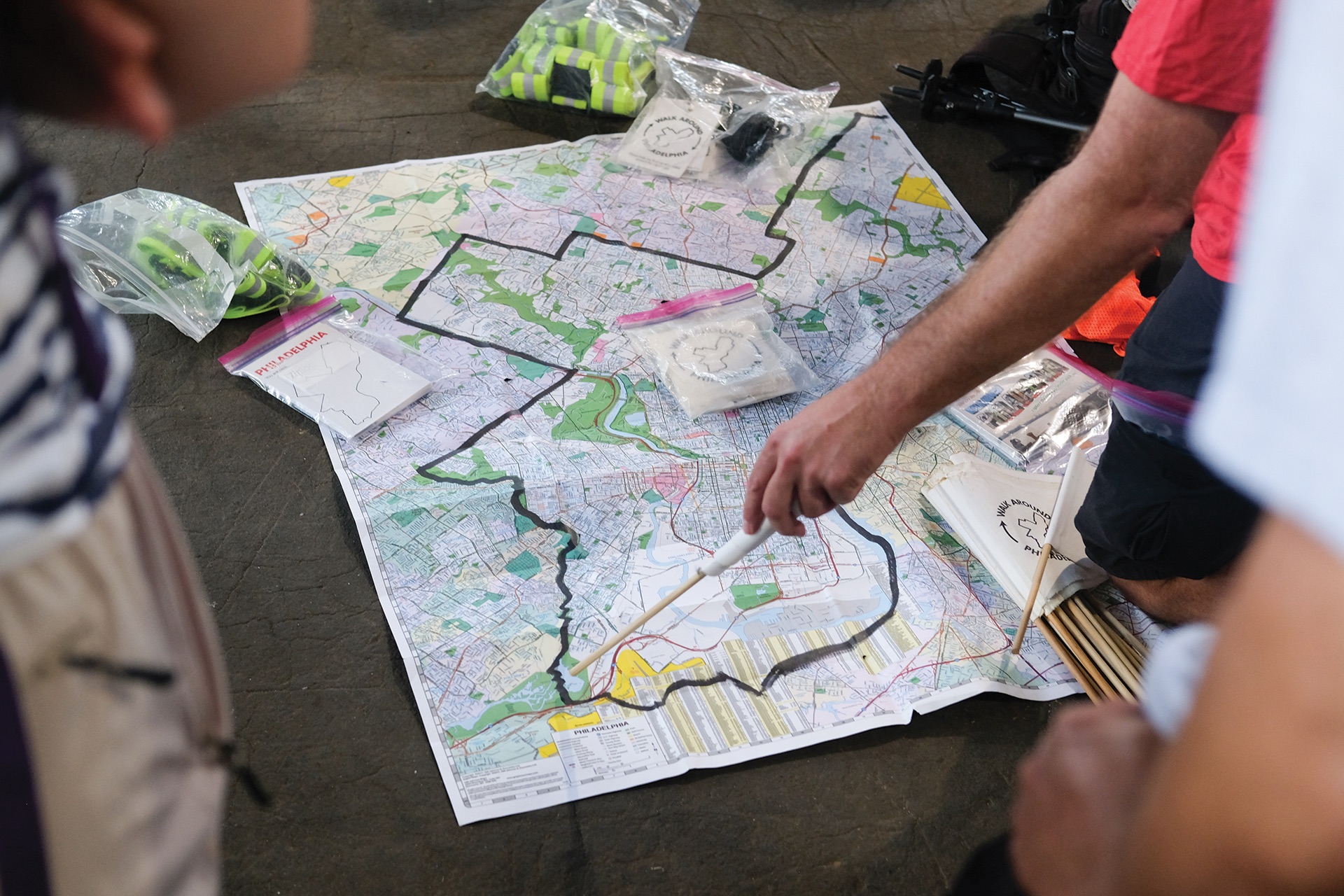
About 40 people have now completed the circuit, ranging in age from 11 to 94, and hundreds more have walked segments. Some walkers pay to participate, and others — those facing financial hardship — are given stipends. Last year, the Walk gave out $11,000.
Ten years after Tiziou’s first circumambulation, the Walk Around Philadelphia is evolving. The organization is hiring a full-time staff member in order to support a slate of ambitious goals, from a reentry program to more robust financial support for participants.
“If 20% of our neighbors live below the poverty line, that’s a big barrier to access,” Tiziou says. “And so the goal is that 20% of each group be stipend-supported.”
The broader aims are civic, spiritual and social. In a world riven by arbitrary boundaries and ruled by people bent on exploiting them, it’s instructive, Tiziou says, “to think about a thing from its borders and from its edges.”