Ihad expected the logs, half-deflated basketballs, plastic bottles and other assorted urban debris when I tagged along with a crew from the Philadelphia Water Department tasked with cleaning out the Fairmount Dam fishway back in 2012. What I hadn’t expected was to see the workers pull out two flathead catfish the size of toddlers. The beasts had broad heads and lightly mottled tan patterns on their shiny, scaleless skin.
A fishway (also called a fish ladder) consists of a linked series of closet-sized compartments, each a little higher than the last. These allow shad and other migratory fish to go up and over the dam in steps, resting when they need a break. The predatory flatheads had parked themselves in the compartments; their prey swam right to them.
It might seem obvious that large predators eating shad in fish ladders could have an impact on the waterway. But flatheads can also discourage shad from even trying to go through the ladder. “So they’re not only preying on fish,” says Geoff Smith, a fisheries biologist with the Pennsylvania Fish and Boat Commission who has worked on several studies of flathead catfish ecology. “They’re probably interfering with movement of fish through that fishway.”
I was surprised to see the flatheads in 2012, but they had first been found in the Schuylkill River at that very fish ladder in 1999, two years after having been found in Berks County’s Blue Marsh Lake, which drains into a Schuylkill tributary. They then worked their way back up the Delaware River from the Schuylkill. Also introduced to the Susquehanna River, they have steadily spread through both systems, as documented in a 2021 paper. They are native to rivers in the Mississippi river system, including the Ohio tributaries in western Pennsylvania. The study’s authors, including Smith, couldn’t say for sure how the species made it into the Delaware and Susquehanna, but Smith says signs point to a fisherman transporting the fish from one of their native rivers.
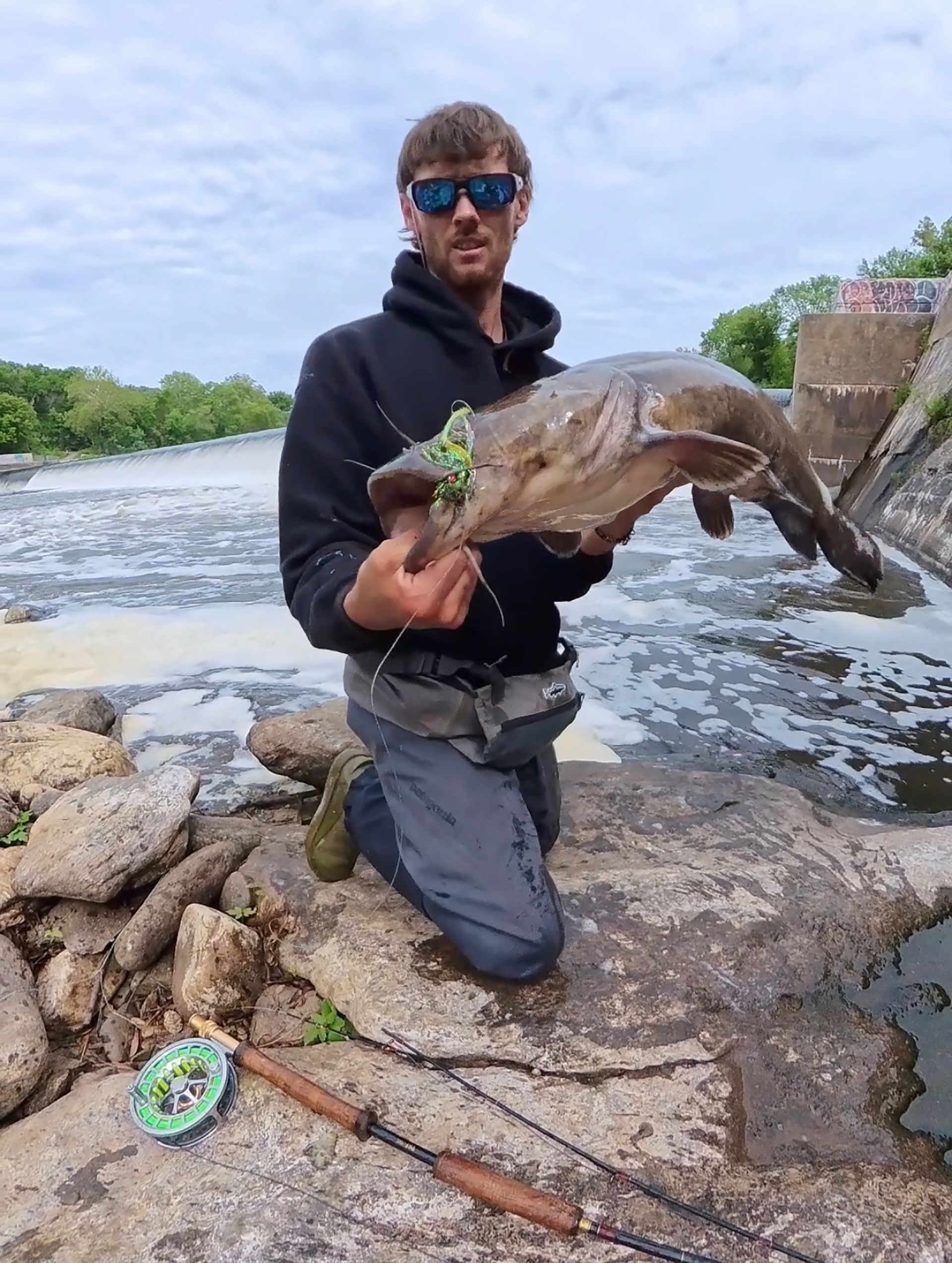
Those catfish I saw removed from the fishway still would have had a lot of growing to do. In June 2025, a Philadelphia angler named Daniel Brown posted pictures on Facebook of a 72-pounder he had hauled out of the Schuylkill in South Philadelphia. (He did not respond to a request for an interview.) The heaviest ever caught was a 123-pound leviathan hooked in a reservoir in Kansas in 1998.
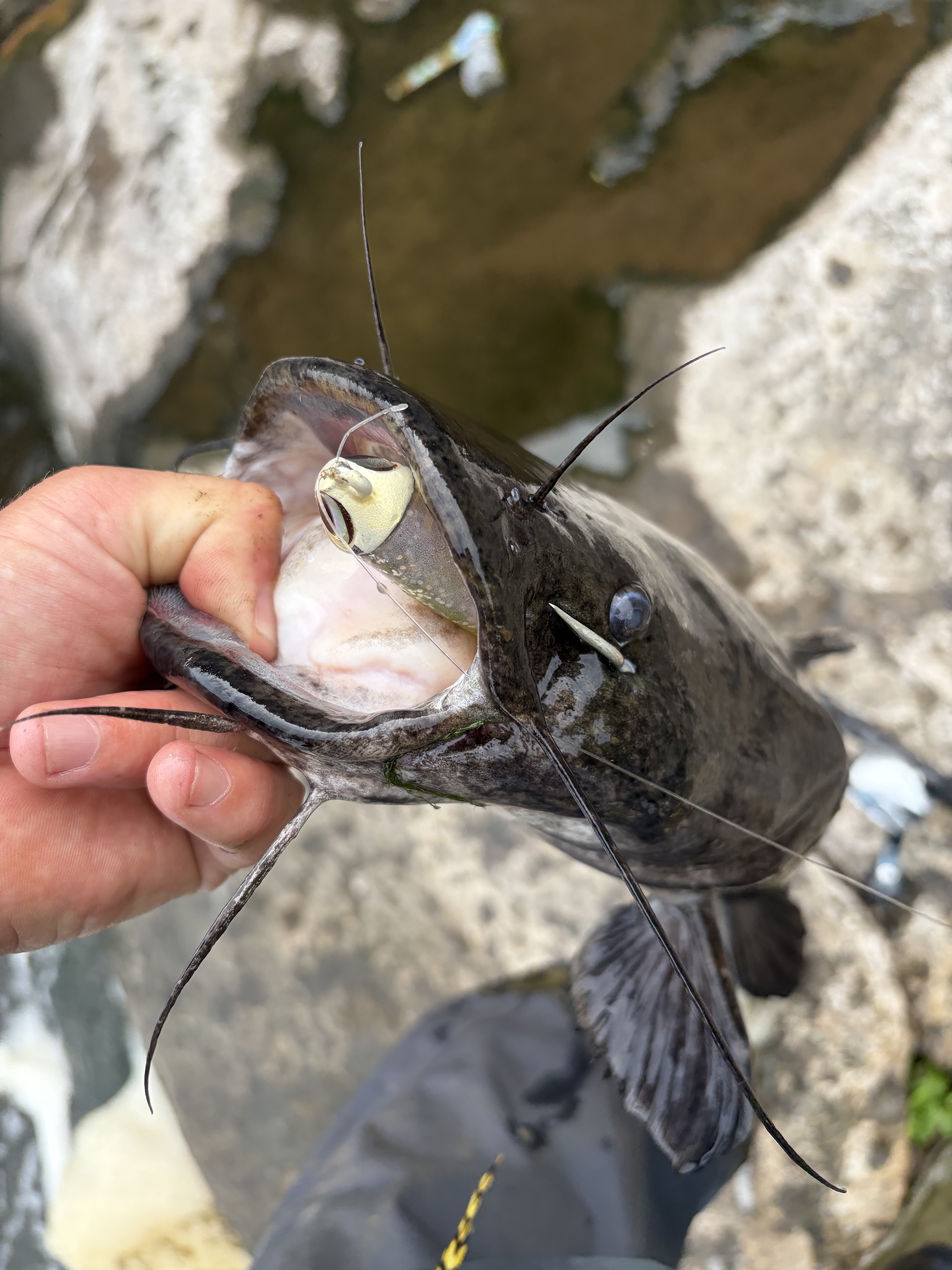
In 16 states, though not Pennsylvania, it is legal to noodle flatheads, a practice that involves ducking underwater and grabbing the fish by the lip so that it bites down in self-defense. The noodler then wrestles the fish to the surface, hopefully before their lungs run out of oxygen.
Tempting as it is, I have not tried to noodle the flathead catfish that I have met underwater. As someone who enjoys snorkeling in our rivers, I occasionally take a peek under a submerged boulder and find a flathead staring back at me: a wide slit of a mouth with barbels (the sensory organs that look like whiskers) at the corners.
Flathead catfish have arguably not been good for the rest of the Schuylkill River, nor for the Delaware, Susquehanna and other Atlantic slope rivers where they have recently become established. A 2009 paper found that largemouth bass and redbreast sunfish populations declined after the flatheads moved into the Satilla River in Georgia.
Redbreast sunfish are also native to the Delaware system, where they are often caught by Leo Sheng, who goes by Extreme Philly Fishing on YouTube and other social media. Sheng is a dedicated multispecies fisher who targets the full diversity of any body of water he fishes. I asked Sheng how he would feel if flatheads reduced local redbreast sunfish populations. “My example is even smaller than the redbreast,” he says. He recalls catching a small flathead catfish near where the Wissahickon Creek flows into the Schuylkill. “And the fish just regurgitated a little tessellated darter.” The darter is a small but charismatic fish. “I was just imagining, man, how many of these do they eat a year?”
A research team found that flathead catfish have shifted the food chain on the Susquehanna River, essentially taking over the top spot from channel catfish and smallmouth bass.
A research team including Smith found that flathead catfish have shifted the food chain on the Susquehanna River, essentially taking over the top spot from channel catfish and smallmouth bass. Another study on the Susquehanna found they ate plenty of fish but also a lot of crayfish. Smaller catfish tended to eat more crayfish, and according to Smith, one of the authors, it illustrates that flatheads tend to eat whatever is convenient. “Most species we see them eating are species that are in close contact with them,” Smith says.
Flathead catfish are probably here to stay. Smith says that while fish in their native range tend to grow slowly and live long lives, those in introduced populations tend to grow quickly and breed young, making them difficult to control. I asked Smith how old a 50-pounder would be. “If it was in its native range, it could be 50, 60, 70 years old,” he says. “Here, it’s probably 10 or 12.”
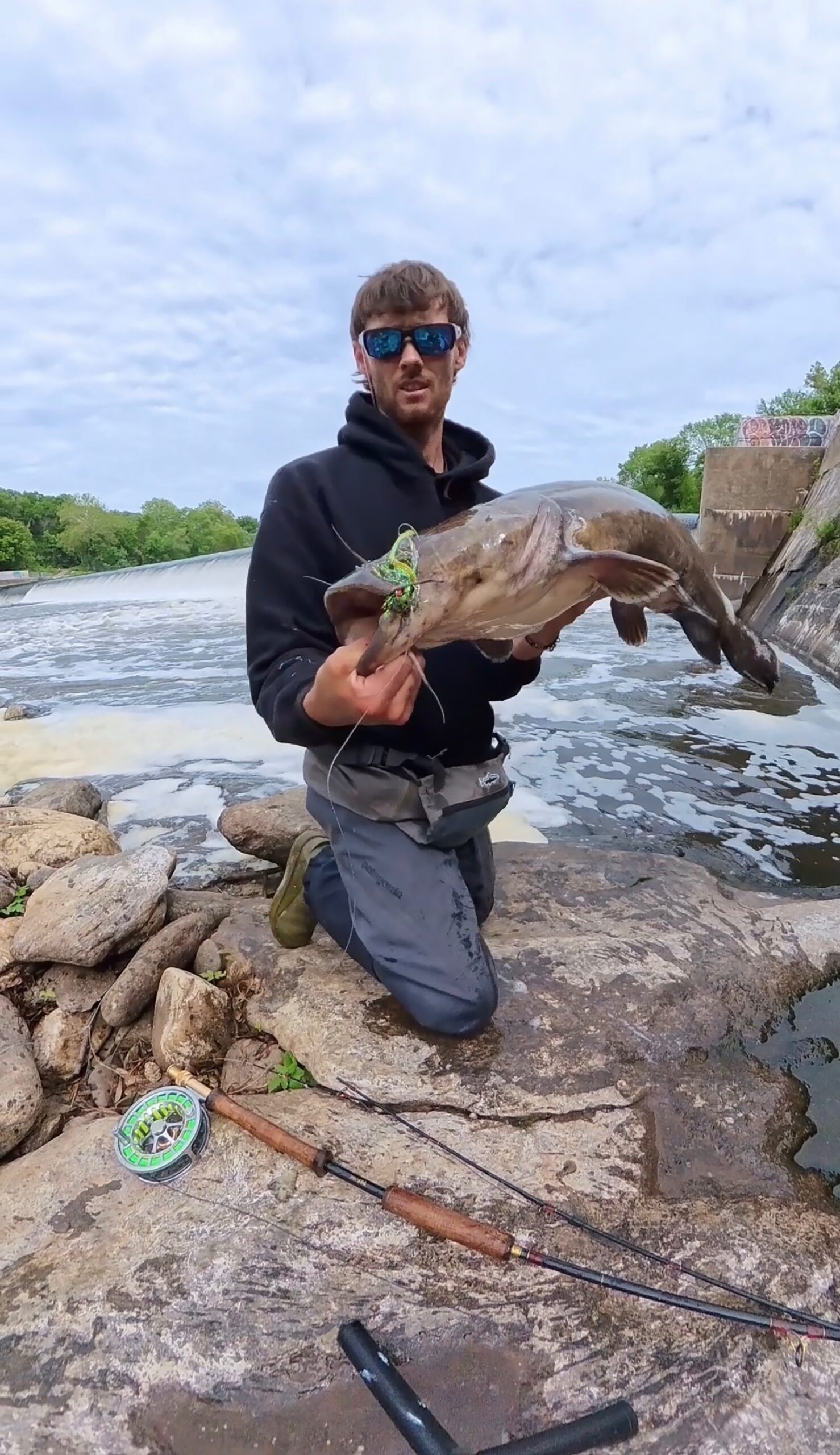
In early May, Connor Brown, who lives in Ambler and captains a charter fishing boat out of Atlantic City, scrambled down the bank of the Schuylkill at the top of the Manayunk Canal and cast a Clouser fly into a large eddy at the base of the Flatrock Dam. Flatheads like to hang out near obstacles that break the current, where prey fish tend to congregate. Brown hooked into a large flathead that broke his rod as he fought it to the bank. “I’m using a 12-weight fly rod, which is what I use for tuna and sharks out on the ocean,” Brown says.
“Head to tail, they’re stronger than anything but a pelagic,” he says, comparing them to ocean fish such as tuna, marlin and mahi-mahi. Brown enjoys hooking into the powerful fish, but he also relishes the challenge of fly fishing for a species usually caught on spinning or bait-casting tackle. “It’s something that no one else is doing, so I wanted to dabble in it.”
Flathead catfish are considered excellent eating in their native range, perfect for a fish fry. In the Delaware system, long plagued by industrial pollution, they tend to accumulate toxic chemicals such as PCBs. The Pennsylvania Fish and Boat Commission advises eating Philly flatheads no more than once per month, which presents a conundrum when you land a large fish that could yield dozens of meals.
Sheng recommends eating smaller flathead catfish since he says they taste better and have had less time to accumulate toxicants. “For me, a perfect size to eat is like two to three pounds.”
Smith enjoys sharing flathead catfish with other members of his research team. “And people are hesitant,” he says. “They get started and they’re like, ‘Yeah, I’m not eating that,’ and by the time it’s done, ‘I can’t eat it fast enough.’”
Invading flatheads might soon be followed by similarly sized blue catfish. Also native to the Mississippi system, blue catfish have recently been documented in the Delaware. The blues will also be difficult to control. The lesson, Smith says, is to avoid any introductions, no matter how minor they might seem at the outset.
“If I was able to revert any ecosystem around the world to its native stage, where no invasives were introduced, I would do it in a heartbeat,” Sheng says. “It’s a lot of fun when people introduce different species. The snakehead fights hard; the flathead grows big. But when you think about the entire ecosystem, there are going to be consequences.”