

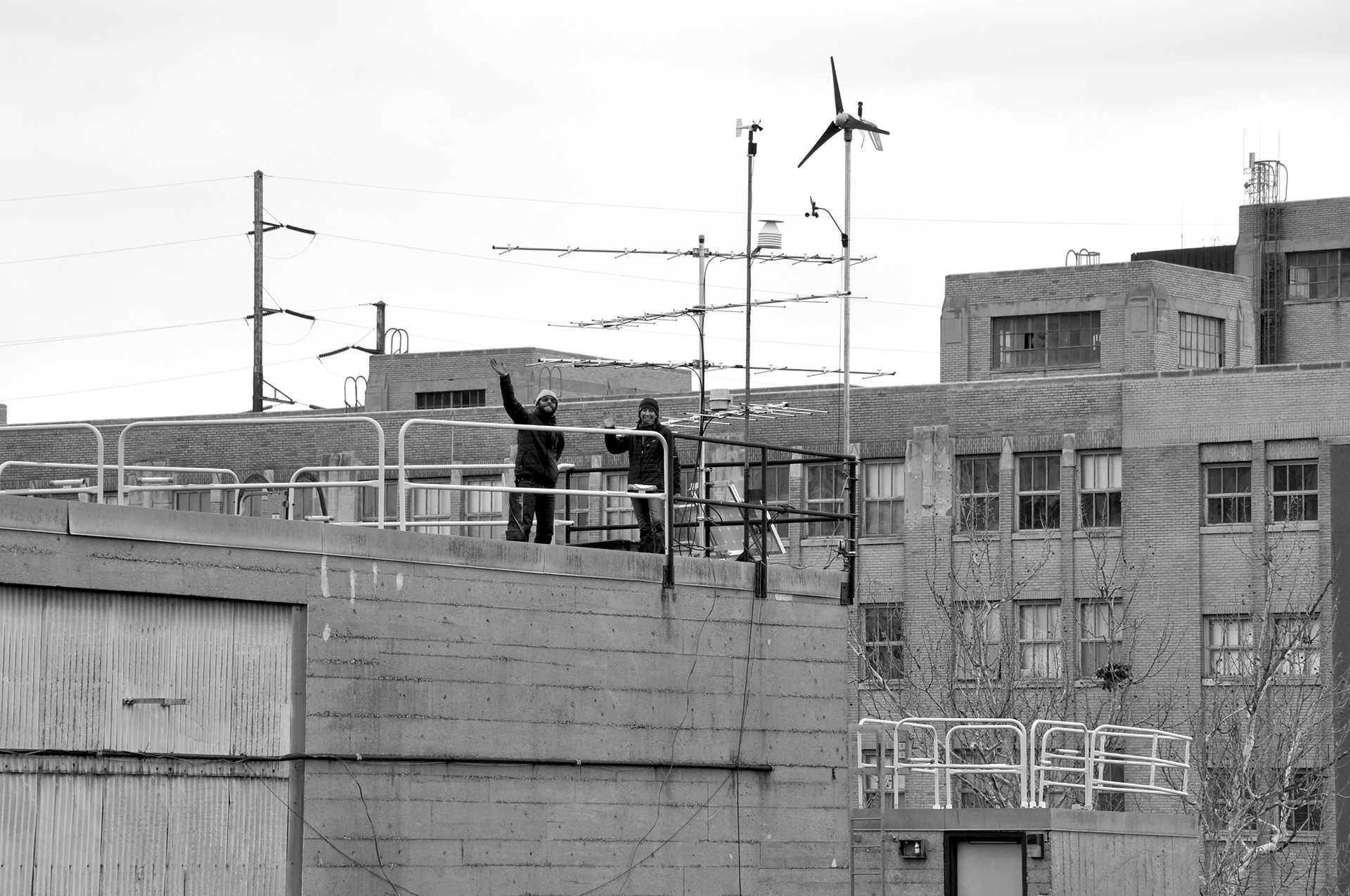
On Sept. 27, 2025, a wood thrush flew past the David Rittenhouse Laboratory at the University of Pennsylvania on its way to Central America. We know this because a tiny solar-powered radio transmitter on the bird’s back sent out a signal that was picked up by a receiver on the roof of the building. That ping landed in the database, enabling researchers to follow the bird’s migration. Now, the data from that wood thrush (known as #63179) can help shape conservation efforts from Canada to Central America.
Motus, a collaborative effort run by Birds Canada, consists of a network of more than 2,400 receivers called stations. Those stations pick up signals from radio transmitters (“tags”) that researchers attach to birds and bats. Researchers interested in a particular species’ migration can now collect data as their animals fly all over the hemisphere.
Thrush #63179 had been caught at the end of May 2025 at the Wachusett Meadow Wildlife Sanctuary in central Massachusetts and fitted with its transmitter. In September, it headed south. The last Motus station to pick it up was in Alexandria, Virginia.
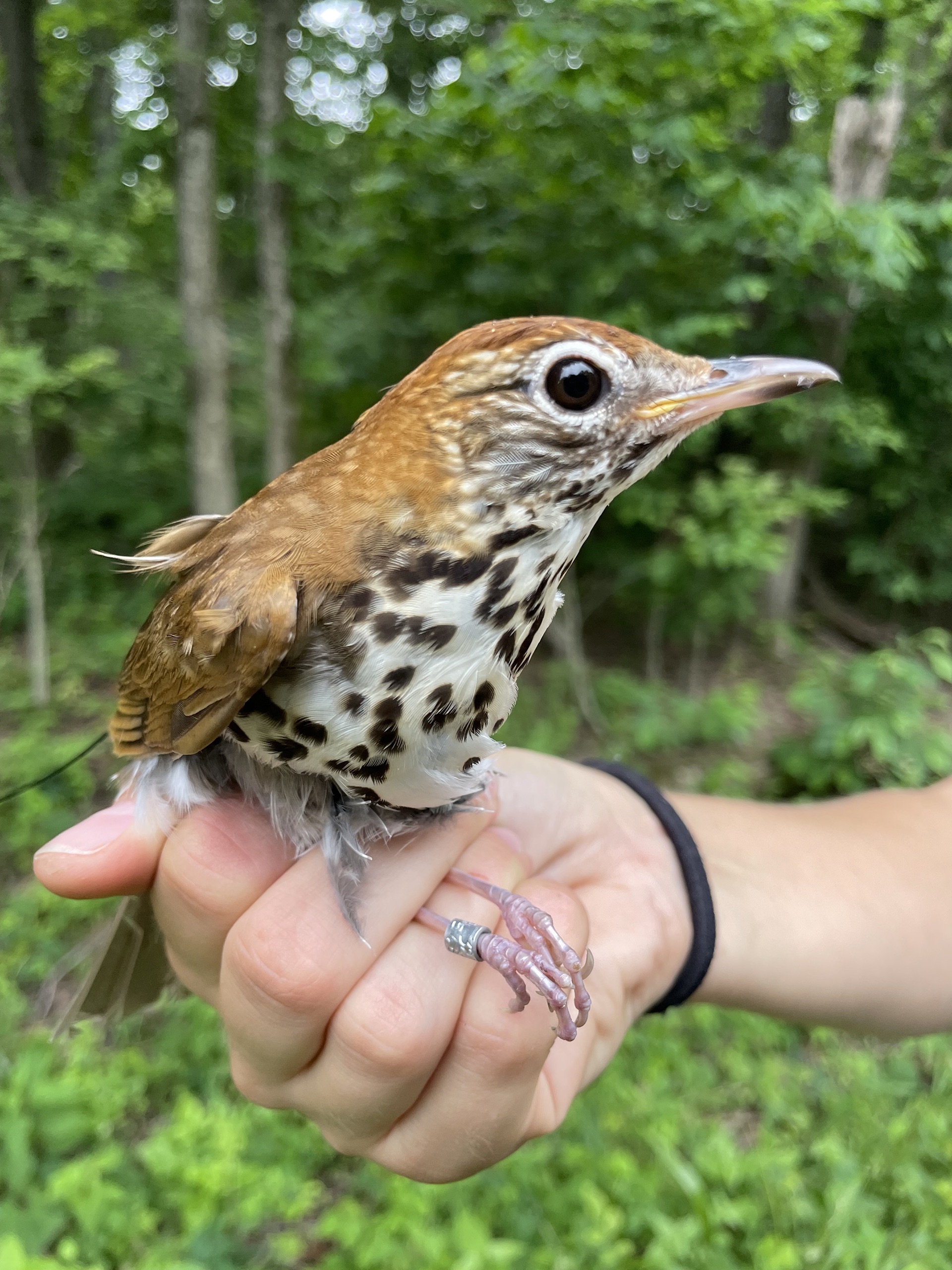
Wood thrushes aren’t much to look at. They have a brown back and a white underside dotted with black. But their song, like three notes played on a flute, is one of the most beautiful in the forest. Philly hikers and birders can hear wood thrushes sing in mature forests from Cobbs Creek to the Pennypack.
Although they’re widespread, wood thrush populations have declined by about 1% per year from 1966 to 2023. That adds up to a total 45% decline. Understanding how they use their entire range, including the migratory path between their summer and winter habitats, is crucial to reversing their population decline.
A Need Meets a Network
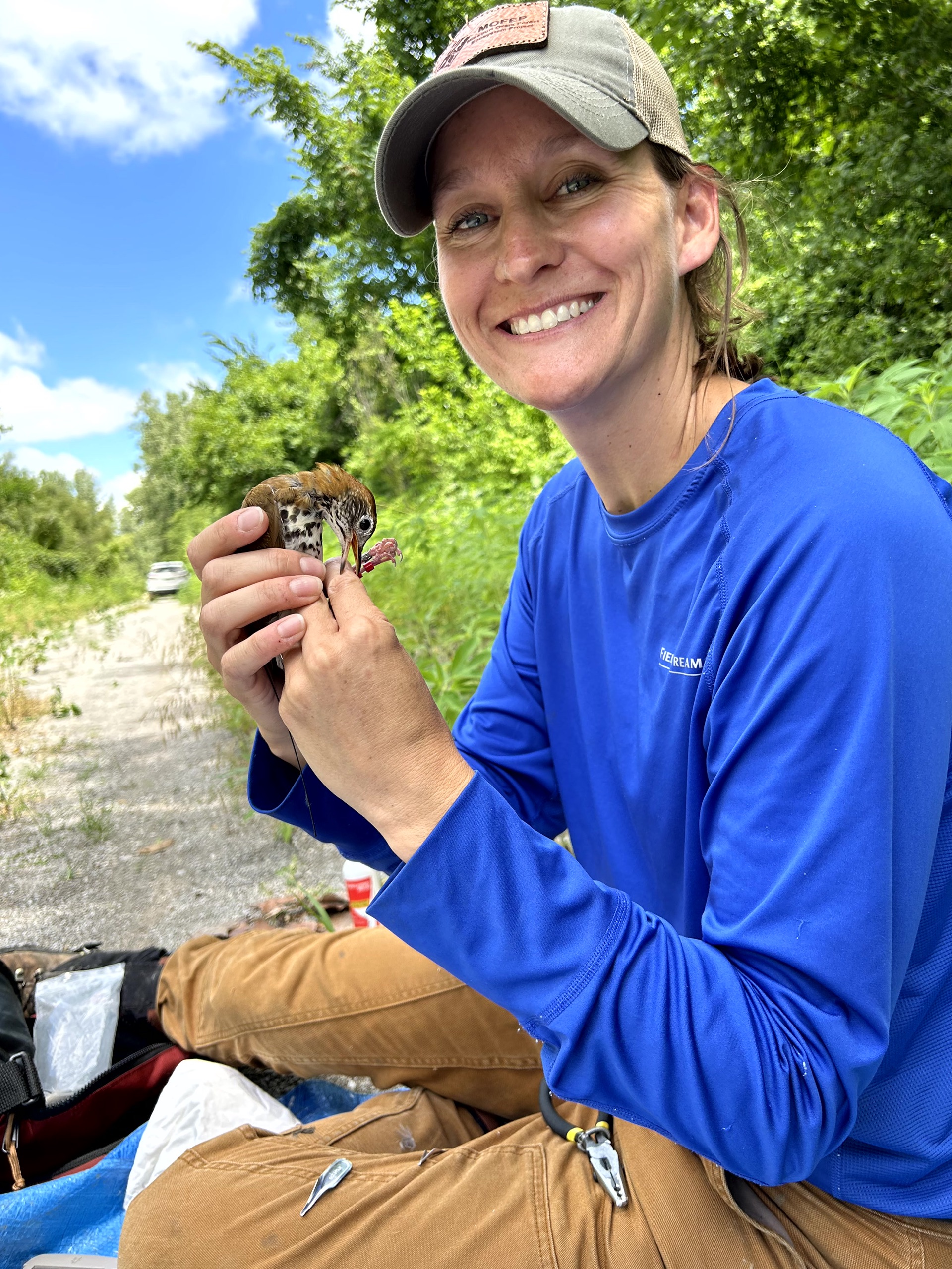
Willistown Conservation Trust (WCT), based in Chester County, started setting up Motus stations in 2016. “We got involved with this because we have been running a bird-banding station since 2010,” says Alison Fetterman, avian conservation biologist with WCT. At banding stations, scientists attach uniquely numbered bands to birds so they can be identified if caught again. The problem is that that seldom happens. “Songbirds are only ever captured again about 1-3% of the time,” Fetterman says. Radio transmitters have revolutionized the study of bird migration, making it much more likely that a bird will be heard from again.
“The signal is constantly emitted from the tag, and every station is just listening for it,” Fetterman says. “And so you’re getting a data point every time it passes by a station. You never have to recapture the bird again.” The tags are designed to fall off after a few seasons so that the birds aren’t saddled with them for life.
Seeing the value of the technology, Willistown joined with three other conservation groups to launch the Northeast Motus Collaboration, setting up more than 150 stations to date. “We planned the stations strategically so that they would create a line across states or regions,” Fetterman says. The range of a station receiver is 15 kilometers, so the collaborative tries to space them 30 kilometers apart to detect any tagged birds flying between them. The station on Penn’s campus went up in 2018, funded by the Penn Green Fund.
Scaling Up
Sarah Kendrick, a migratory bird biologist with the U.S. Fish and Wildlife Service, started setting up Motus stations in Missouri in 2017, while working for the Missouri Department of Conservation. At U.S. Fish and Wildlife, she partnered with Nick Bayly at SELVA, a conservation organization based in Bogotá, Colombia, on a pilot project to put transmitters on golden-winged warblers and wood thrushes. “We were able to tag them from both ends of the range,” Kendrick says.
In 2023, again partnering with SELVA, Kendrick expanded the pilot into the Range-Wide Wood Thrush Motus Project to tag wood thrushes and use Motus stations to track their movements. SELVA worked with agencies and organizations spanning six countries from Mexico to Costa Rica, where the birds overwinter. Kendrick recruited state wildlife agencies in the Mississippi and Atlantic flyways. (Flyways are concentrated routes along which birds migrate, and agencies along the flyways coordinate efforts.) She signed up 17 state and provincial (including Ontario) agencies, two federal agencies, 22 nonprofit organizations and seven academic institutions.
Altogether, 65 partners (including Willistown Conservation Trust) tagged 1,300 wood thrushes across their breeding and winter territories. The project won’t be able to start releasing findings until 2027, but Kendrick hopes information on wood thrush migration will be able to shape conservation strategy. Species that spread out in migration can be flexible in the face of hazards along the way. However, “if they’re going along the same route at the same time, it makes them vulnerable to habitat changes,” Kendrick says.
Wood thrush #63179 was on its way back north as of early May, picked up by Motus stations in Chester County before arriving back in Massachusetts. Since last fall, the bird has been picked up on 15 Motus stations overall. Seven of those are managed by the Northeast Motus Collaboration, Fetterman says.
Like the collaboration, the wood thrush project demonstrates the benefits of working together across a wide area. “I’m hoping it does provide a template for people to coordinate projects at a scale this size,” Kendrick says. “It only works together.”







Great absolutely the greatest.
Excellent report about this exciting technology and our dwindling migrant birds…