In the gray light of early morning, four activists snuck onto a bridge overlooking U.S. Route 202 in Pennsylvania. There on the chain-link fence, they clipped their banner and unfurled it in view of the sleepy commuters just starting to pass below. Spelled out in 90 feet of white paint on fluttering black canvas was the message: “Vanguard has a climate problem.”
The activists, or “rebels,” were members of the Philadelphia chapter of Extinction Rebellion (XR), a global protest group that uses civil disobedience to demand that governments, companies and other powers take the climate emergency seriously.
XR formed in the United Kingdom in 2018, following the release of a United Nations special report on climate change that starkly outlined the Earth’s trajectory toward nearly 3 degrees Celsius of warming by 2100. Spurred by the severity of the report and lackluster government response, a group of British activists and organizers launched Extinction Rebellion on Oct. 31. With colorful banners, joyful noise and firm resistance in the face of arrest, over a thousand protesters shut down the road outside the Houses of Parliament and recited their “Declaration of Rebellion.”
The propulsive energy of the new movement spawned satellite XR groups across the world.
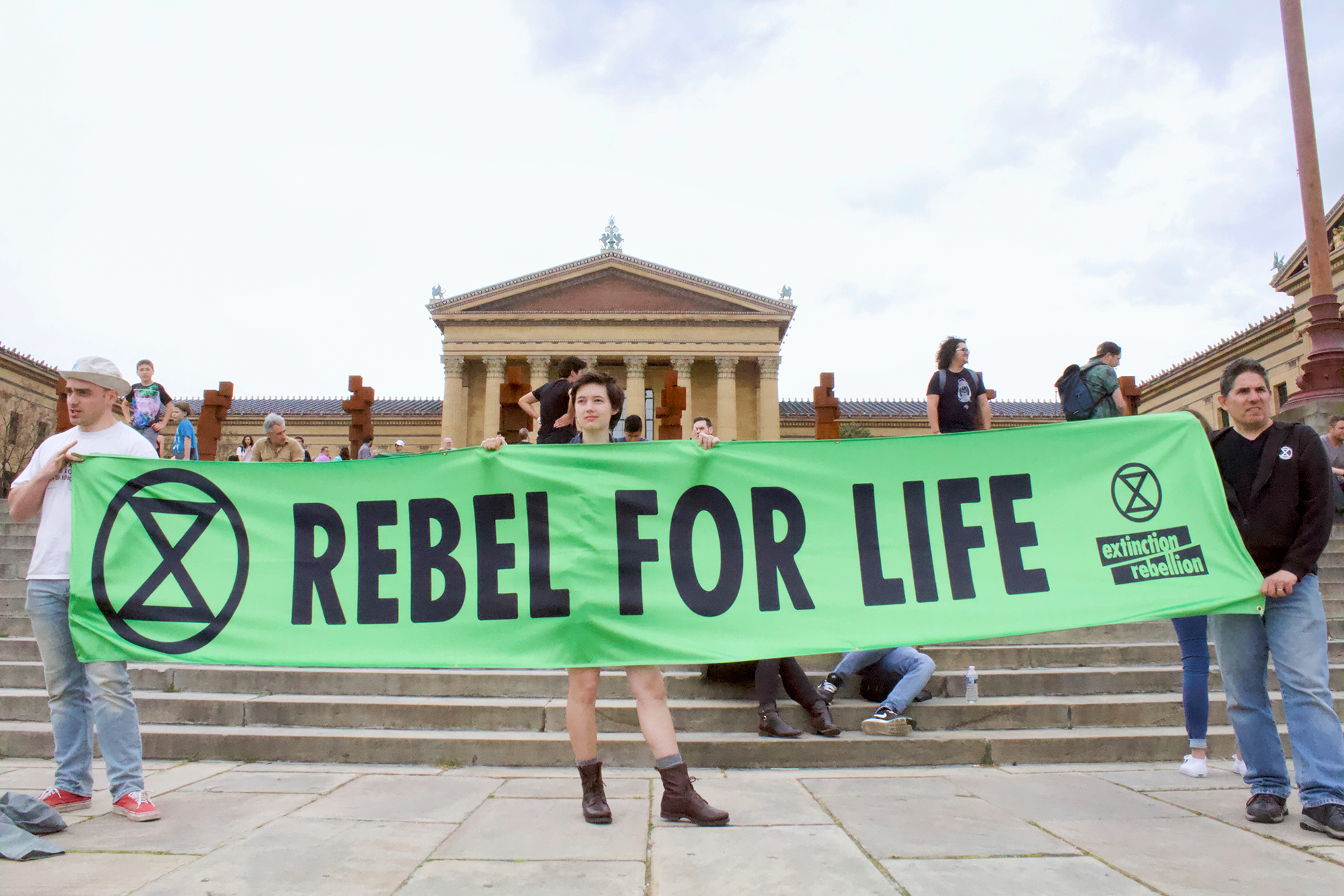
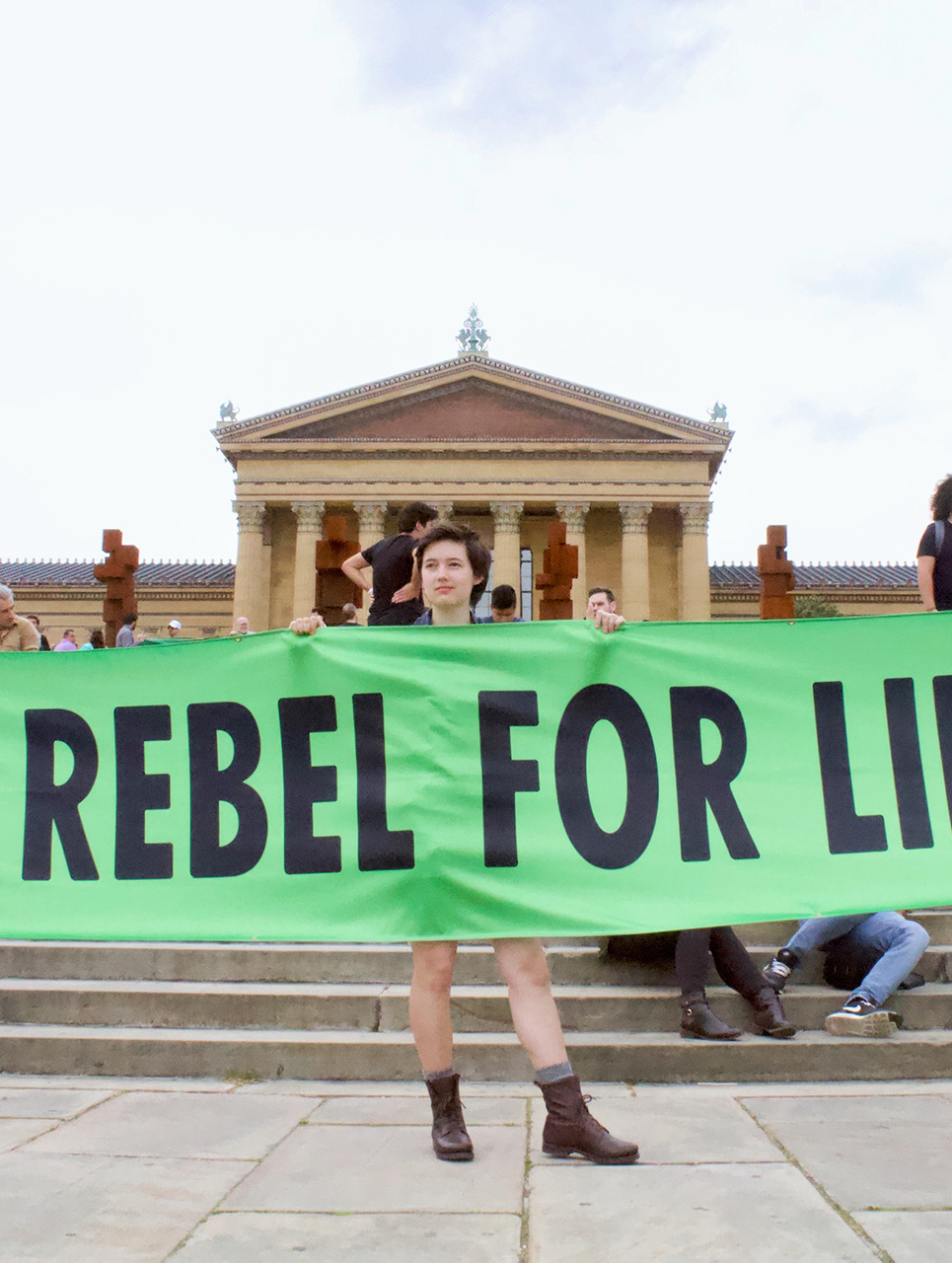
Philadelphia’s chapter was founded in early 2019. That May, holding a green banner with the words “Rebel for Life,” XR Philly lent its voice to the global movement with a protest on the steps of the Philadelphia Museum of Art.
“That energy that was happening in 2019 was what the movement of movements needs: that direct action, but also celebration of the life that we want,” says Frank Fortino, who joined XR Philly in its first year. “XR would have fun interactions: the color, the dancing, the seriousness, the sacrifice of getting arrested.”
XR Philly’s messaging coalesced around four demands adapted from those of the global group: First, “tell the truth” about the climate crisis and who is causing it. Second, “act now,” because the climate crisis is an emergency and should be treated like one. Third, “decide together,” a call for people’s assemblies on major issues, because decisions that affect everyone should include everyone. And fourth, pursue a “just transition” that acknowledges the unequal distribution of climate impacts.
The group expresses these demands through direct actions designed to disrupt the status quo: banner dropping, conference room storming, road blocks and “die-ins,” where protestors collapse and refuse to move. According to member Eric Moss, XR Philly is not particular about its methods, operating under the mantra “good enough for now, safe enough to try.” Actions target institutional powers that bear an outsized share of the blame for perpetuating the climate crisis: companies expanding oil and gas infrastructure in Pennsylvania, financial institutions like Vanguard that invest in fossil fuels, and politicians who won’t speak up.
Members often knowingly risk arrest during protests, but it’s not the primary goal, says member Liam Sacino.
Taking nonviolent direct action is a historically justified and important part of social movements. And at the same time, it’s not a decision that anyone should step into lightly.”
— Liam Sacino, member, Extinction Rebellion Philadelphia
“We believe strongly that taking nonviolent direct action is a historically justified and important part of social movements. And at the same time, it’s not a decision that anyone should step into lightly,” says Sacino. “It’s very empowering when you’re in the street blocking the garage. … It can become far less empowering when you now have your hands tied behind your back, and you’re put into a van that you’re not allowed to leave.”
When not tangling with law enforcement, XR Philly members engage with the public by passing out flyers and holding action-training workshops. They also connect with other activist groups to share resources and manpower. Sacino says XR Philly often steps in to fill a support role for local organizations. In the past, it has collaborated with the Delaware Riverkeeper Network, Philly Thrive, No ICE Philly and the Sunrise Movement.
“We’re kind of like the rent-an-activist organization of Philly,” says Sacino. “Like, you need a couple people who know how to just really go in, maybe sit somewhere you’re not supposed to sit and say, ‘I’m not leaving’? You rent a couple activists.”
These “solidarity actions” and mutual aid efforts have become more of a priority for XR Philly in the past few years, according to Moss. A pandemic, a genocide, attacks on immigrants and rising fascism in the United States have “taken climate off the front page,” he says. But he doesn’t see supporting other causes as a distraction from the group’s mission.
“I might have had this reductionist view that we have to solve the climate crisis at its source,” Moss says. “But then, when you realize that the source is the whole system that underlies it, and you see these other symptoms that are of that same system, then it makes a whole lot of sense.”
For Sacino, mutual aid is part of how XR Philly models the future that the group is pushing for.
“If we are to solve the climate and ecological crises, it’s going to require a far more cooperative future,” says Sacino.
Cooperation and connection to community have also helped XR Philly members personally navigate an increasingly fraught world. Sacino, Moss and Fortino all came to XR in moments of despair about the state of the Earth, and taking direct action has worked as a balm for that despair.
“It is therapeutic for me, the work. Getting out in the streets, screaming, chanting, singing, … making a banner for hours, quiet,” Fortino says. He invites all who feel anxiety about the way the world is turning to join him.
“Don’t sit alone on that couch and suck in all the violence, suck in all the harm. You have comrades out here that are also in pain, that want to talk about it.”