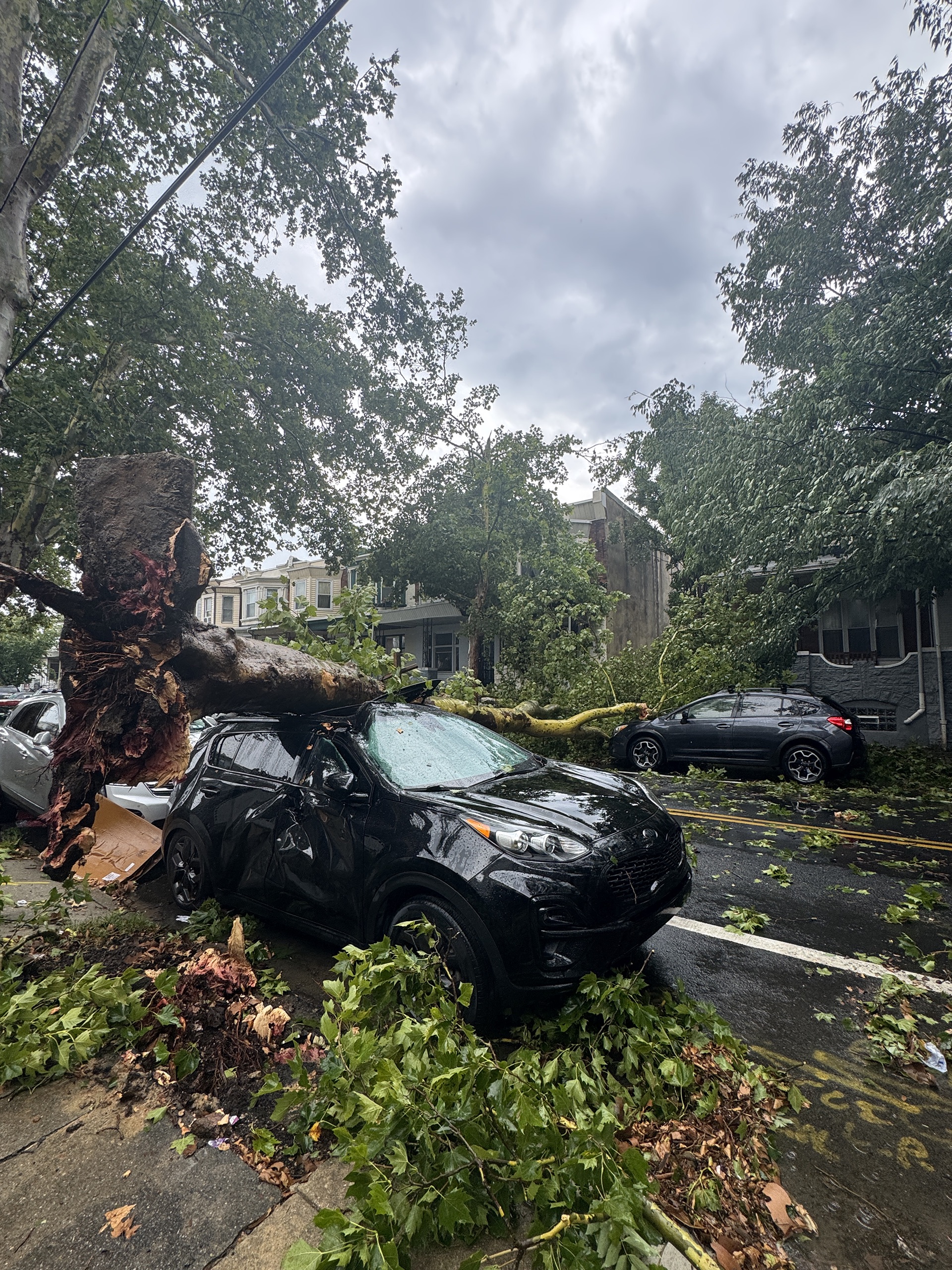
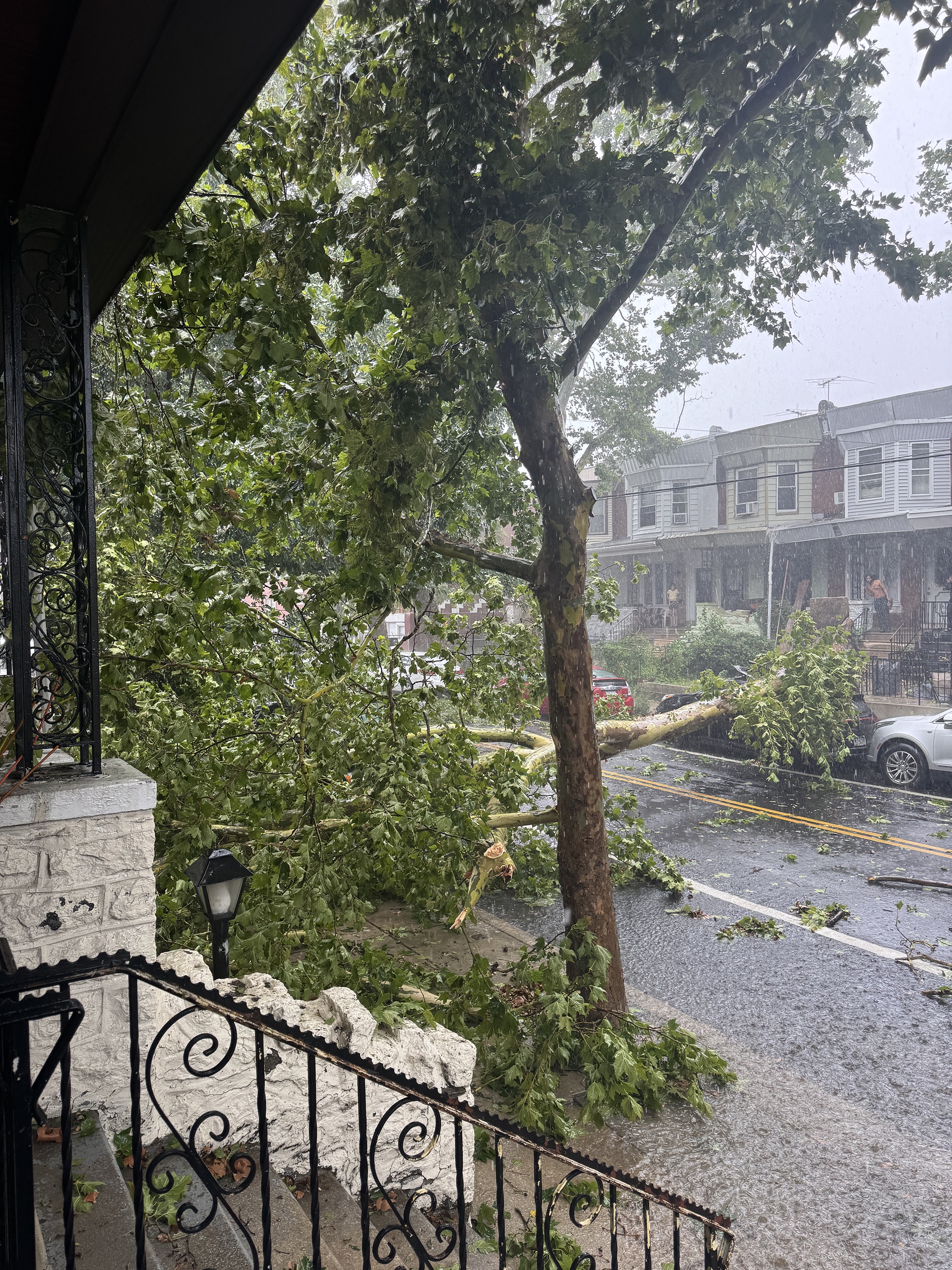
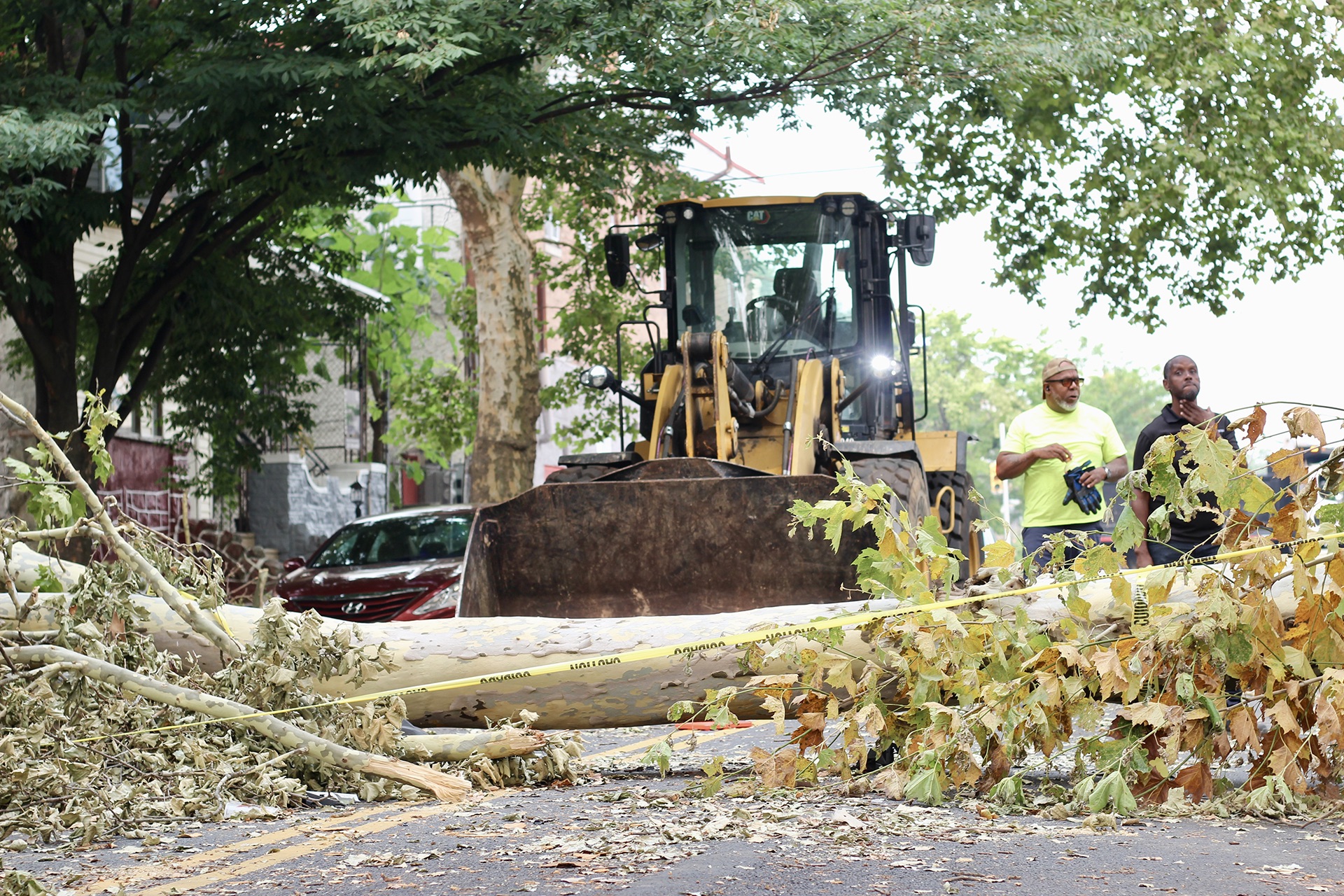
Nicole Pepe’s house on the 5100 block of Catharine Street shook as the tree hit it. She had been watching through a window as the fierce winds of the July 11 microburst whipped leaves and bits of roofing shingles in a vortex behind her house. “My husband said, ‘Get in the middle of the house,’” just before the century-old London plane tree fell over. “You’d think it’d be like a thunderous crash, but it hit a car first, so it was like this weird kind of metallic sound.”
When the storm finally passed and the winds died down, Pepe and her husband went outside to find the tree wedged against their porch. And it turned out it had actually crushed two cars when it fell across the street.
“One of them happens to be mine,” says Liz Beard. Beard had been watching the torrential downpour from a second-floor window. “My house was like literally going through a car wash,” she says. After the storm, “I come outside to see what’s up, and there’s one of the huge London planes across two cars on our street.”
Trees bring a lot to a neighborhood. Their shade makes hot days bearable, which is especially important as cities bake in a rapidly warming climate. They help soak up rain, which makes it easier to manage urban stormwater. But they also carry costs, especially when storms knock them over. As tree-toppling storms, amplified by a warmer, wetter climate, become more common, will property owners decide the canopy isn’t worth it?
The tree that fell across the 5100 block of Catharine wasn’t the only one. According to an Aug. 3 City press release, “Philadelphia Parks and Recreation (PPR), working with the Department of Streets, responded to more than 500 tree emergencies.”
Two of the downed trees had stood a few doors from Katie Brindley’s house near 50th and Chestnut streets in West Philadelphia. Massive London planes, they had come down while Brindley and her husband were driving back home after a trip. One of their teenagers FaceTimed them to show the trees down across the intersection. “He said, ‘You can’t park on 50th because of the storm and the trees.’” On their way back to their Walnut Hill neighborhood, the couple cruised through an unfamiliar landscape. “There’s trees down, there’s not a single light that’s working until we get to Walnut.” Brindley says.
As far as Brindley can tell, the trees that fell on her block had damaged a porch and some of the siding of a roof across the street, but otherwise had not caused major property damage. They had crushed parked cars, but miraculously had not hit any drivers. “No one was sitting at the traffic light in their car waiting to go. It was unlucky and incredibly lucky at the same time,” she says.
At least four microbursts hit the city along a path from West Philadelphia into South Philadelphia. Mayor Cherelle Parker signed a Declaration of Emergency Disaster the same day as the storm to speed up recovery efforts. The next morning, crews hired by the City cut the trees at 50th and Chestnut into sections and trucked them away, Brindley says. “It happened within like 24 hours, super impressive.”
It took until July 16 for the City to remove the tree from the 5100 block of Catharine. In the meantime, on the Monday night following the storm, a motorist turned the corner from 51st and plowed into the downed tree, knocking it off the two crushed cars and jamming it more firmly into Pepe’s house.
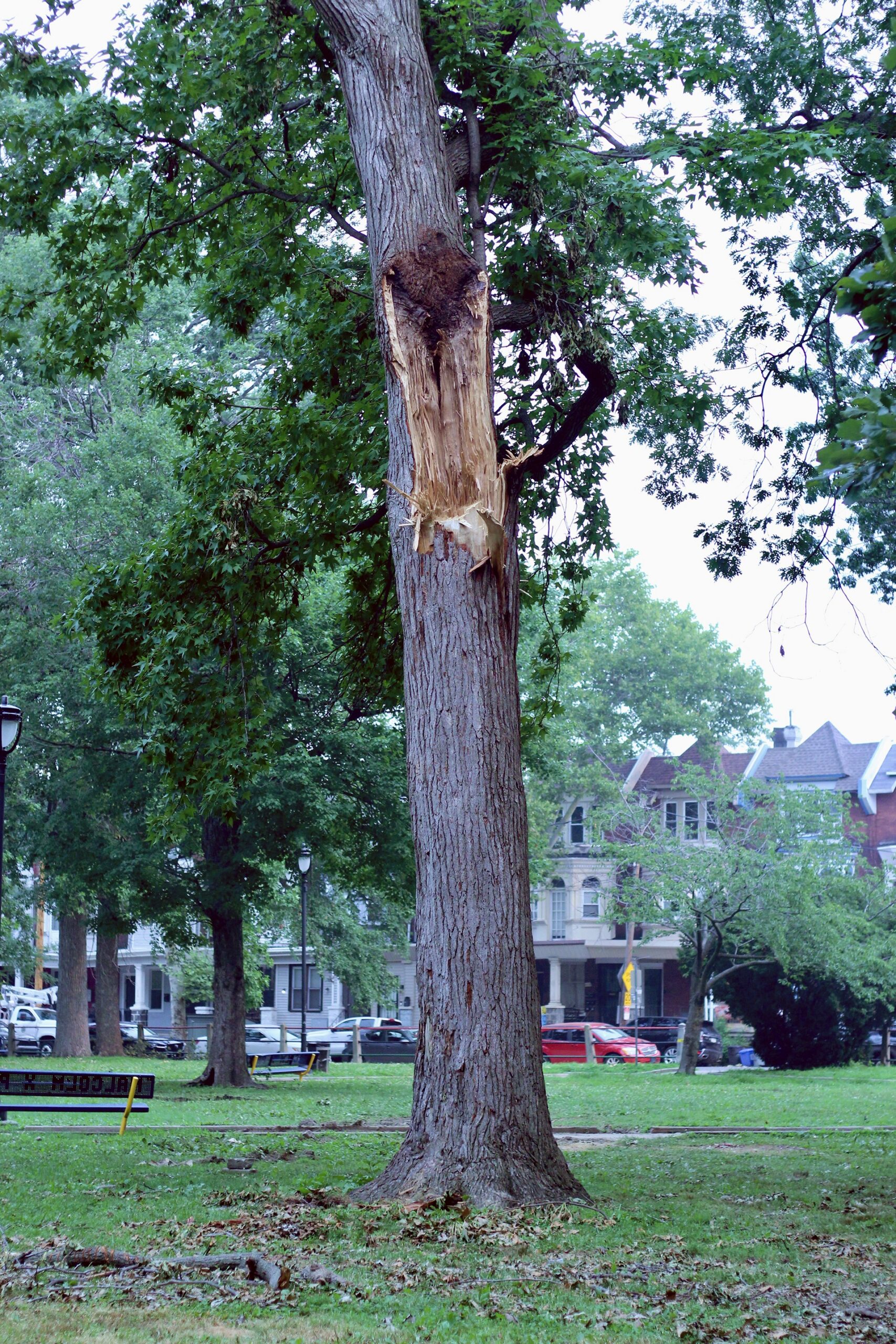
Along with street trees, trees in parks along the storm’s parth also took a hit on July 11. “There was massive tree loss in Wharton Square [in South Philadelphia],” Smith Fichman says. The same was true in Carroll Park at the western edge of the city and Malcolm X Park in West Philadelphia, where the winds snapped off the crown of a massive white oak tree next to the playground. In FDR Park, gusts knocked over trees and wrecked the Southeast Asian Market.
We’ve had storms where we’ve lost trees for sure, but not at this scale. In my time here, we’ve never had to close the gates for more than 24 hours.”
— Jessica Baumert, executive director, Woodlands cemetery
At the Woodlands cemetery, the damage was so bad it took them until July 21 to make the grounds safe again for visitors. “There was a lacebark elm that was massive that fell and smashed a bunch of gravestones,” says Jessica Baumert, the cemetery’s executive director. Another large tree fell into the community garden, and several others split. Crews also had to remove hazardous “hangers,” broken branches suspended in a tree’s crown. “We’ve had storms where we’ve lost trees for sure, but not at this scale. In my time here, we’ve never had to close the gates for more than 24 hours,” she says. Baumert estimated the cost of cleaning up at about $50,000, which is not covered by insurance.
The “micro” in microburst is a bit misleading. By definition, these storms cover a relatively short distance — under 4 kilometers (2.5 miles) — but they can be intense. Microbursts start with an updraft of moist, warm air pulling rain droplets and hail high into a cloud. When that cloud cools, the suspended air suddenly drops and, when it hits the ground, gets shunted horizontally, producing wind speeds up to 100 miles per hour. Wind gusts on July 11 were as high as 70 mph, just shy of what you’d see in a Category 1 hurricane. The wind can also come at trees from multiple directions: down, sideways and in vortices as air reacts to the landscape, says Jason Lubar, a retired board-certified master arborist.
Trees can withstand a lot of wind, says Lubar, but urban trees are often placed in positions they didn’t evolve to survive. A sycamore (the London plane tree is a hybrid of American and European sycamore species) in a forest grows surrounded by other trees that buffer it from the wind. Strong roots of that tree grow out in all directions, intertwined with the roots of its neighbors, giving it powerful support.
A similar tree growing in a small pit between a sidewalk and the street is, by comparison, on its own. The curbstones block its roots from growing into the street to one side, and the foundations of nearby buildings also block it underground. The roots running under the sidewalk can brace it to a point, but not if the pavement buckles, as often happened on July 11. “If you look at tree failure in urban environments, full trees blowing over, you’ll see that the sidewalk is lifted up,” Lubar says, “They’re grabbing, so to speak, everything they can to hold on.”
Trees with more room for their roots are better able to withstand strong wind gusts. “What we can do in our urban areas is provide adequate rooting volume through things like soil cells [underground frames that keep soil from compacting],” Lubar says. “We can design our hardscape to better accommodate root growth and expansion.”
Before a storm, it might not be obvious to a homeowner that the tree in front of their house is a hazard. In addition to underground failures, trees rotting from the inside can break off. Trees with more than one trunk growing tightly together can split, as sometimes happens with Bradford pears and silver maples.
Erica Smith Fichman, Philadelphia’s City forester, says property owners can hire an arborist certified in tree risk assessment by the International Society of Arboriculture to inspect their trees. A crew from Philadelphia Parks & Recreation can do the same for street trees. Though they are not all certified, “they have hundreds and hundreds of examples of seeing a tree, seeing what specific defects it has, and having a sense for what will happen,” Smith Fichman says.
The Philly Tree Plan calls on the City to “Develop a proactive inspection cycle for maintenance of public trees,” but Parks & Rec currently lacks the personnel to do that. “It’s a work in progress,” Smith Fichman says. “Proactive inspections are something the Philly Tree Plan very loudly calls for, but you’ll also see that it calls for more staff.”
Well, how are you going to replace these trees if the homeowners can’t even take care of getting rid of the stump where the diameter is as big as a car?”
— Katie Brindley, West Philadelphia resident
Although the City removed fallen street trees, homeowners are left to remove stumps and repair their torn-up sidewalks. In New York City, the City repairs sidewalks damaged by trees, but Philadelphia does not. Soon after the storm, Mayor Parker promised to replace all the trees that were lost. Brindley is skeptical: “Well, how are you going to replace these trees if the homeowners can’t even take care of getting rid of the stump where the diameter is as big as a car?”
According to an Office of Emergency Management representative, property owners can apply for Small Business Administration physical damage disaster loans to repair sidewalks damaged in the July 11 storm.
Smith Fichman pointed to progress Philadelphia has made by hiring a sidewalk coordinator who will work on a comprehensive sidewalk plan for the city. “You can’t talk to people about trees in the city without talking about sidewalks. And this all comes back to maintenance as trust building.”
As Smith Fichman and the tree plan makes clear, growing the city’s canopy is a matter of public confidence as much as dollars. The whole neighborhood benefits from a towering street tree thanks to the cooler temperatures, but if homeowners worry the tree will drop a branch on their roof or leave them with thousands of dollars in sidewalk repairs, they will be less inclined to have one in front of their house.
Global warming could be making those trees more risky just as it makes the city’s canopy more valuable. By pumping more heat and moisture into the atmosphere, climate change has made storms more powerful. Although experts Grid interviewed in the wake of the storm couldn’t point to specific research on trends in storm-related tree damage in Philadelphia, anecdotally, they say the problem seems to be getting worse.
According to Smith Fichman, a similar storm hit Northeast Philadelphia last year. “The staff that have been here the longest when we had last year’s storm, they said they had never seen anything like that,” she says. “And then we had another one this year.”
Meanwhile, extreme heat is the deadliest natural disaster, and trees are one solution, helping to shade hot neighborhoods while they suck up carbon dioxide. That’s particularly important in environmental justice communities, as the City’s climate action playbook notes: “Increasing tree coverage and green spaces in these communities can support resilience to heat and flooding.”
In 2009, the Nutter administration set a goal of reaching a 30% tree canopy in every neighborhood. Between 2008 and 2018, the canopy actually shrank by about 1,000 acres, a decline driven by “the widespread removal of individual trees and small patches in areas which had below-average tree canopy to begin with,” as found by a 2019 tree canopy assessment. The Philly Tree Plan, completed in 2023, emphasized the importance of supporting homeowners so that trees that benefit the entire community don’t become individual burdens.
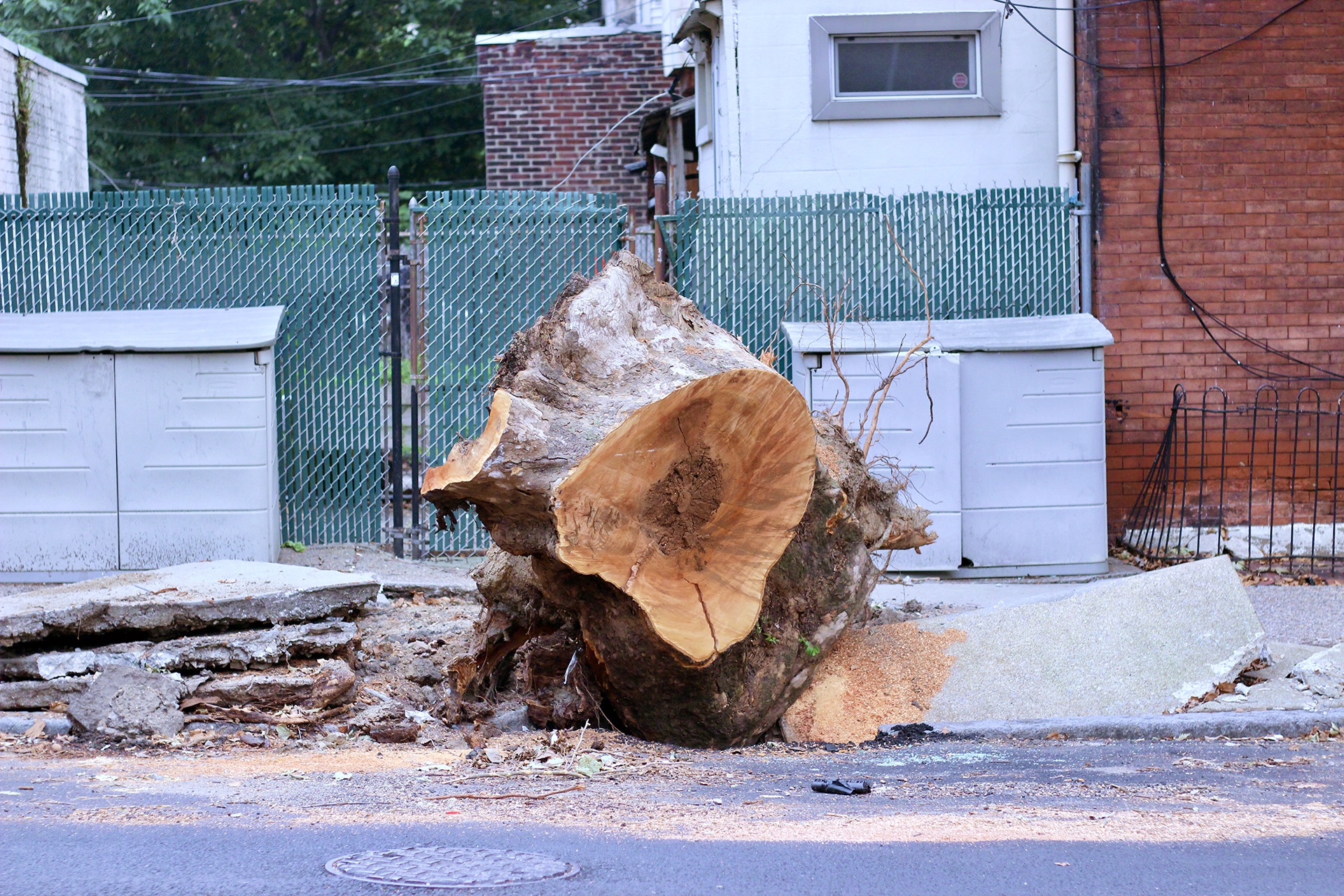
“The City’s response showing that there is support when this type of thing happens can make a huge difference,” Smith Fichman says. “The first 10 days [are] all about taking trees off of homes and cars, clearing roads, but then you’re left with these huge uprooted root balls that tore up the sidewalk. Then you have ADA problems, you have extreme expense for people. So, how the City comes through and really supports people … is going to help also determine people’s willingness to plant new trees.”
Brindley hopes her neighbors won’t decide against planting new trees once the damage is all cleared. Together with the remaining London plane, “those trees were providing an abundance of shade on our homes,” she says. “Parking your car under them, you knew it would be shaded.”