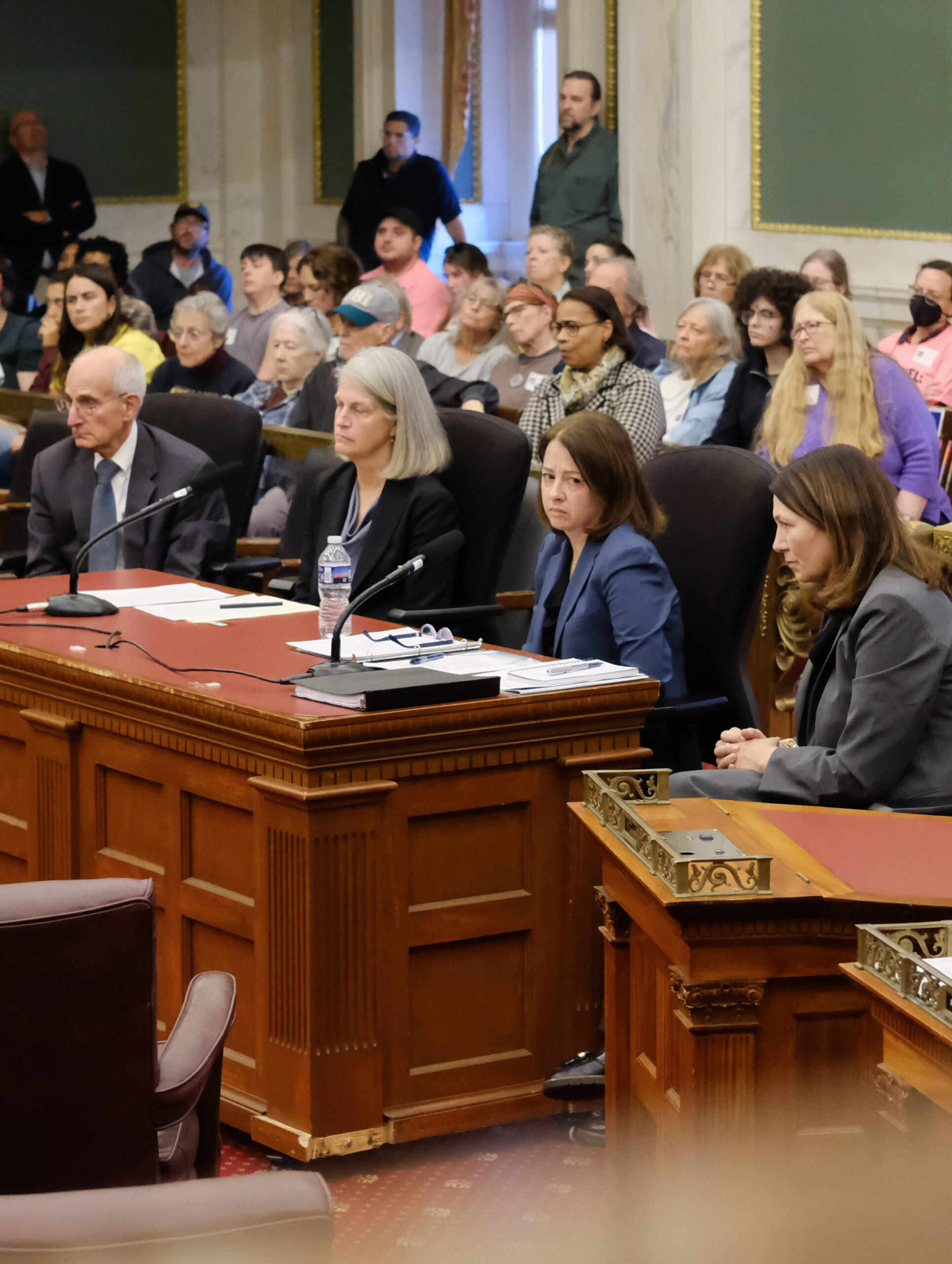
When Drexel University announced Sept.1 that the Academy of Natural Sciences Museum would shutter at the end of the month, City Council responded to widespread public outcry by announcing a legislative committee hearing to investigate. On Monday, Oct. 26, after a nearly three-week postponement, the long-awaited day had come: more than 120 people — many of them holding “Save the Academy” signs — filled City Council’s chambers on the fourth floor of City Hall to watch as councilmembers heard testimony and interrogated representatives from Drexel about the museum’s closure.
Committee Chair Isaiah Thomas began the contentious hearing by pointing out a glaring absence. “We do not have the presence of the Administration here today,” Thomas said, eliciting a chorus of boos.
Deputy Mayor Patricia Wellenbach, whom Mayor Cherelle Parker appointed to represent the City in matters related to the Academy, and who had been slated to testify, did not appear at the hearing, and her name was crossed off on a list of witnesses distributed to attendees. Instead, Wellenbach had submitted a written statement, claiming that, because she couldn’t speak on behalf of Drexel or the Academy, she was “not the appropriate person to testify.”
“This is disrespect,” said Councilmember Jeffery Young. “Someone who is paid by the taxpayers, someone who is a representative of the administration, should be here to talk to us.”
“This is what I think of this testimony,” he said, and then ripped the sheet of paper down the middle. Attendees cheered.
“We’re going to be issuing subpoenas to talk to these folks,” Young said, referring also to Drexel President Antonio Merlo, who missed the hearing because of a campus visit by the Middle States Commission on Higher Education.
City Council rarely wields its subpoena power — has not done so since 2022, in fact — but, three days after the hearing, the body made good on Young’s promise. Councilmember Thomas honored Councilmember Nina Ahmad’s request to subpoena Merlo, who will now be compelled to testify when the committee’s hearing on the Museum’s closure resumes Nov. 16. “President Merlo’s absence during Monday, October 26, 2026’s investigatory hearing was unacceptable,” Ahmad said in a statement. “I look forward to hearing directly from President Antonio Merlo about how Drexel came to the decision to close the Academy’s public museum, and to put his account on the public record.”
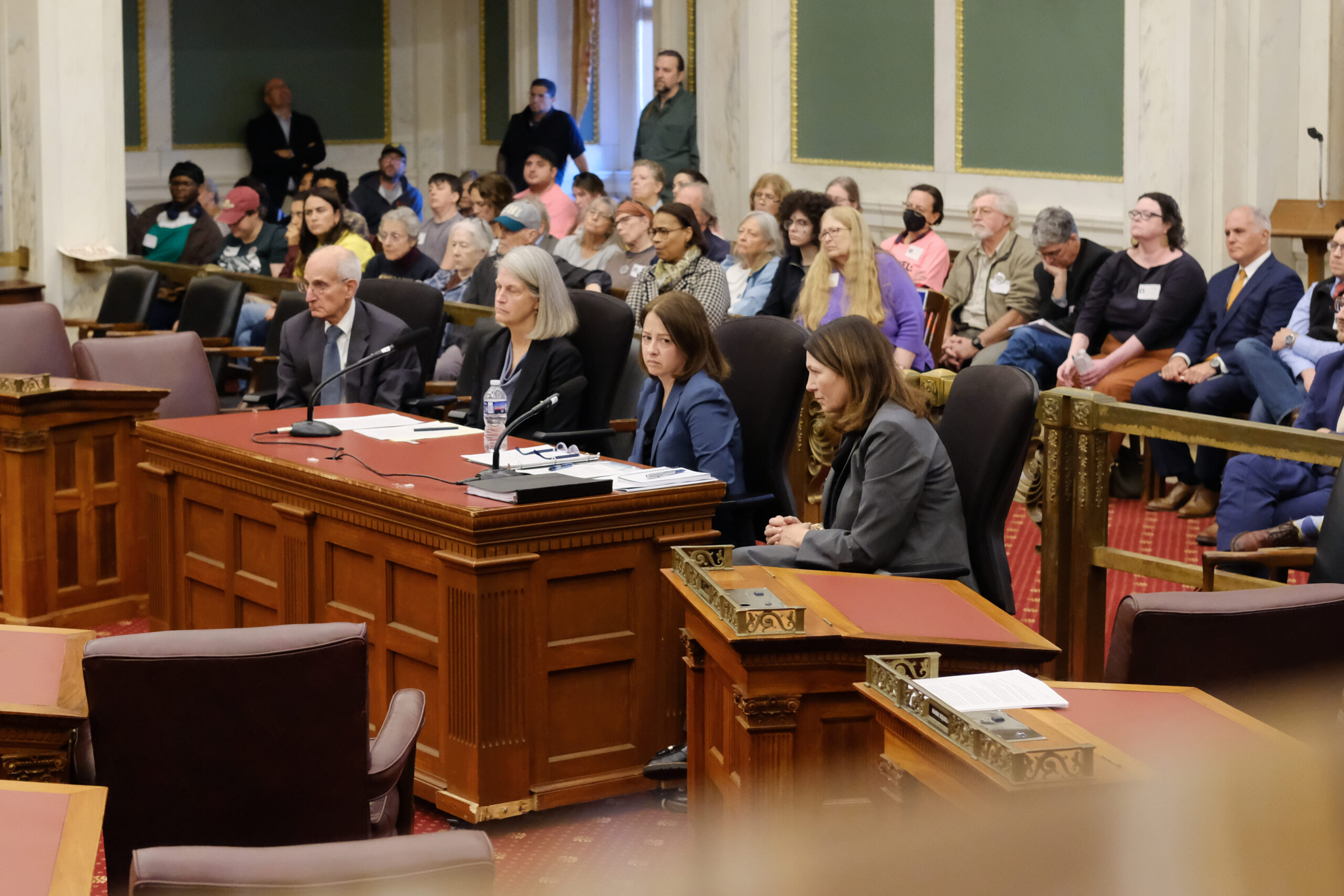
Drexel was represented at the hearing by Melissa Richman, executive director of operations, who testified in the afternoon’s first panel that the decision to close the museum was “neither abrupt nor hasty.”
She cited a two-year study funded by the Pew Center for Arts & Heritage that, she said, “explicitly recommended the closure of the Academy’s public museum.” (The audience booed.)
“Last year,” Richman explained, “the Academy’s public programs cost $7.7 million but brought in only $3 million in revenue.”
The great surprise of the hearing, which has the potential to shake up stalled negotiations on the museum’s future, came when Academy board chair Suzanne Biemiller offered her own, quite different figure for the museum’s deficit. She testified that, in 2025, the museum’s expenses were $3.6 million and its revenue was $2.7 million — leaving a shortfall of less than $1 million. Councilmembers and attendees alike looked stunned when she read the numbers.
“Are you…?” Councilmember Thomas trailed off. “We’ll give you a minute to kind of just talk to your folks to make sure that that number is accurate,” he said.
Financial documents reviewed by the Inquirer indicate that Biemiller’s numbers are correct. Drexel’s deficit figure, according to the Inquirer’s analysis, included spending on all of the Academy’s educational programs, not museum operations alone.
Biemiller said in her testimony that “there should be a civic response to help us figure out how to move forward.” Councilmembers, citing Biemiller’s deficit figure, suggested that public funding for the Museum was possible.
This is less than a million dollars. We can save the museum.”
— Councilmember Quetcy Lozada
“About four years ago,” Thomas said, “the City of Philadelphia pledged $50 million to the African American Museum.”
“I just want the general public to understand,” he continued, “that this legislative body does have an appetite to invest in arts, culture, museums.”
Councilmember Quetcy Lozada agreed with Thomas. “This is less than a million dollars,” she said. “We can save the museum.”
The committee also heard testimony from a panel of advocates in the cultural sector, who attested to the museum’s importance to the city’s cultural and economic life. “This museum is more than a place where we take pictures with dinosaurs as kids,” said Sarah McAnulty, a science educator and organizer of the Save the Academy Coalition. “It’s a place where we develop a lifetime of care for biodiversity, where scientific careers are launched, and where we can connect and envision a safer, healthier Philadelphia.”
Alex Palma, president of the Museum Council of Greater Philadelphia, addressed widely held concerns that Drexel’s closure of the museum was, in the words of Councilmember Thomas, a “land grab.” (“Drexel is currently choosing to shut down the Academy, and one can only imagine what Drexel will do with the valuable land that it sits on,” said Gabriel O’Brien, a co-chair of the Drexel Young Democratic Socialists of America, at a pre-hearing press conference organized by Save the Academy.) “I don’t think that another building filled with million-dollar condos on the Benjamin Franklin Parkway supports Philadelphia’s standing as a world-class city,” Palma testified, “and I don’t think it really does that much for the working-class families of Philadelphia.” Such concerns prompted Councilmember Young, in September, to introduce a zoning bill that would block residential and commercial uses of the Academy property.
We’re calling this, internally, the Fifth Extinction.”
— Mariah Romaninsky, executive director of engagement and visitor experience, Academy of Natural Sciences
The last of the hearing’s three panels comprised Ted Daeshler, the Academy’s curator emeritus, and Mariah Romaninsky, its executive director of engagement and visitor experience. Romaninsky began her testimony with a reminder that 43 people, herself included, have had their positions eliminated as a result of the Museum’s closure. (Her tenure officially ended Nov. 1.) “We’re calling this, internally, the Fifth Extinction,” she said, explaining that since 2019, the public-facing staff had shrunk by almost three-quarters in “layoff after layoff after layoff.”
Nearly three hours after it began, the hearing moved to public testimony. Susan Glassman, director at the Wagner Free Institute of Science, said that the city’s cultural institutions have reached a “crisis point.” She described the William Penn Foundation’s offer to fund the museum for a year, which Drexel has not yet accepted, as “a chance to develop a solution with accountability that preserves the Academy as a whole.”
“Please make it happen,” she implored.
Marie Gilbert, a retired staff member and longtime volunteer who spoke later, was more frank: “You need to open that damn museum.”