One night in July 2016, Jean-Pierre Lokombe woke up to a group of armed men banging on the door of his home in a small village in the Democratic Republic of Congo. The men were part of the Allied Democratic Force, one of the deadliest of the more than 100 rebel groups that rape, kill and maim to control the Congo’s rich resources. Threatened with death, Lokombe, a nurse, then 40, his wife and five children, and their fellow villagers scrambled to flee their land, leaving it to be mined for minerals. The Lokombes, whose names have been changed for their safety, began a grueling journey that ended in Philadelphia.
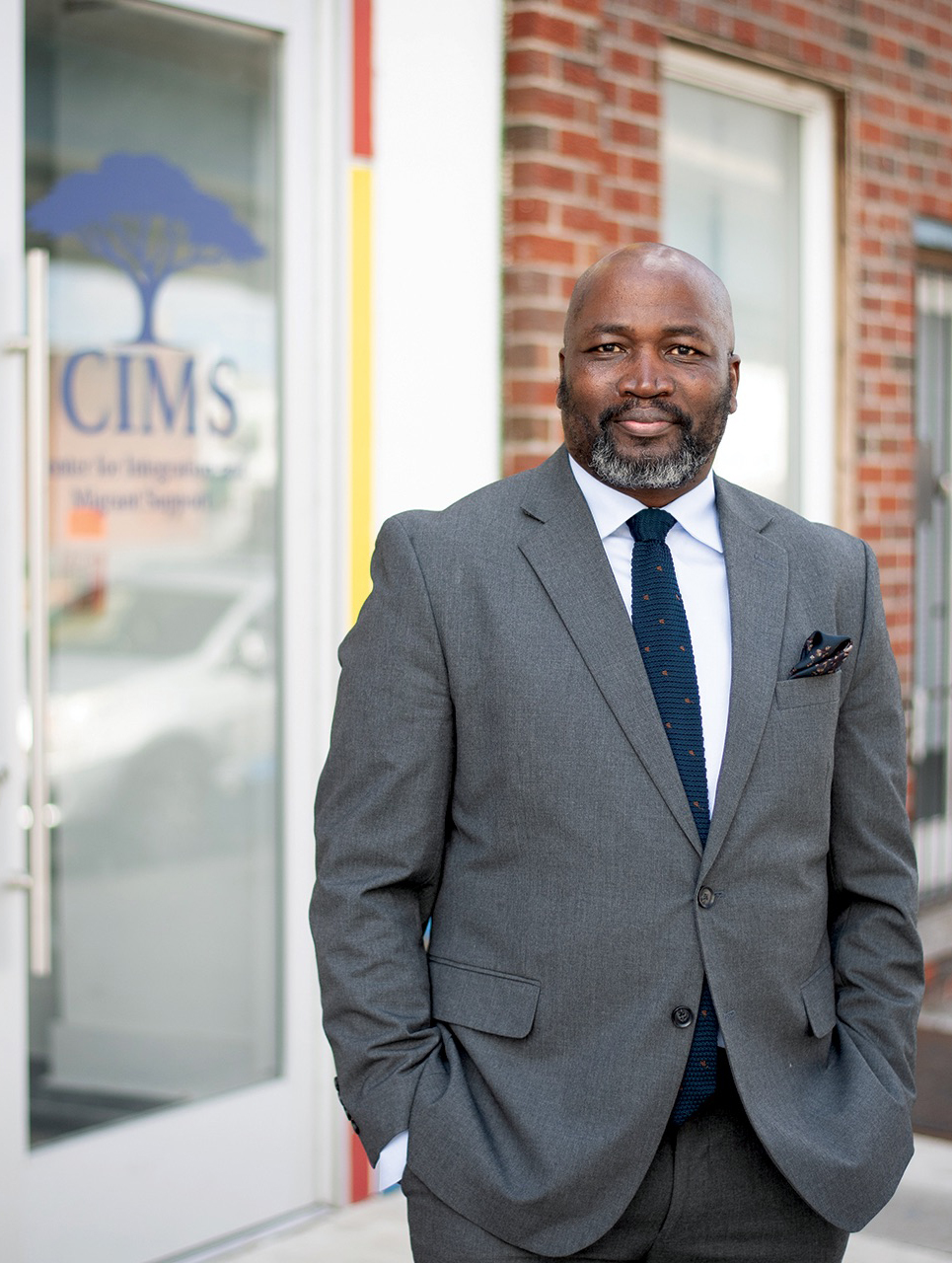
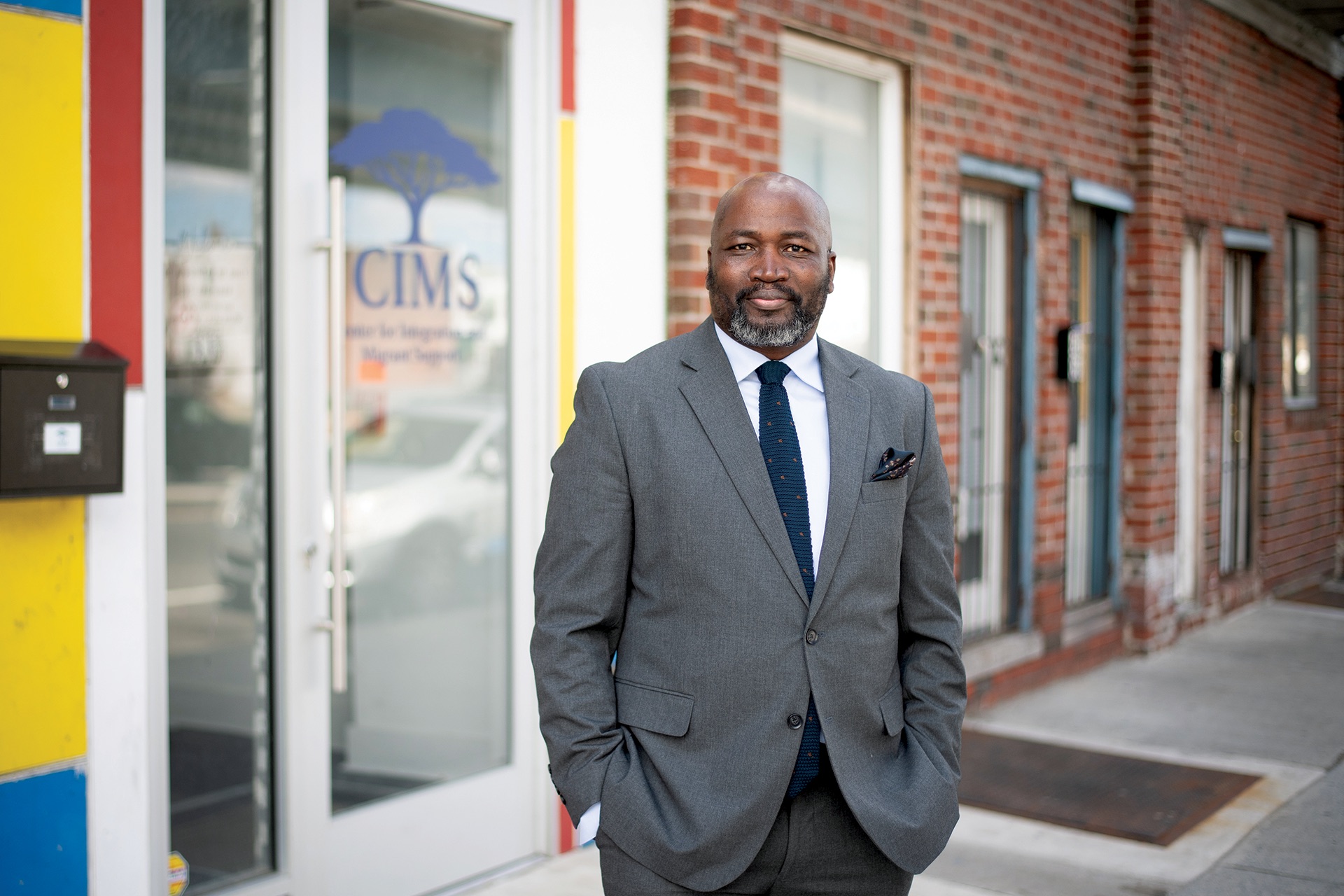
Nine years would pass before the Lokombes would meet Kennedy Chesoli, founder and executive director of the Center for Integration and Migrant Support (CIMS), a West Philly nonprofit that assists newly arrived immigrants from sub-Saharan Africa resettle in Greater Philadelphia.
Congo — Central Africa’s largest country — has copper, lithium and rare earth minerals needed for smartphones and other electronic devices. The fight to control those resources has meant decades of violence, poverty and instability.”
— Kennedy Chesoli, founder, Center for Integration and Migrant Support
Born and raised in Kenya, Chesoli learned early about Congo’s mineral-linked conflicts. “Congo — Central Africa’s largest country — has copper, lithium and rare earth minerals needed for smartphones and other electronic devices,” he says. “The fight to control those resources has meant decades of violence, poverty and instability. My father and I used to volunteer at a refugee camp in Kakuma in northwestern Kenya, near South Sudan,” says Chesoli, whose background includes philanthropy and healthcare, and who previously served as an economist in the Office of the United Nations Secretary-General.
In 2020, after leaving the U.N., Chesoli became program director for CHOICE Regional Health Network in Olympia, Washington. In his free time, he mobilized COVID-19-related assistance for vulnerable African families. As those efforts wound down, Chesoli, now living in Wayne, Delaware County, realized that Philly’s Congolese residents faced continued difficulties adjusting to life here. In response, in 2022, he established CIMS, a community-based organization, to serve this often overlooked population. CIMS gained 501(c)(3) nonprofit status in 2024.
However, in 2016, when the Lokombes escaped from Congo, the family was years away from receiving CIMS’s help. After leaving Congo — not to be confused with the neighboring Republic of Congo — Lokombe and his young family hitchhiked to Kampala, Uganda’s capital. “We lived on the street and survived on handouts and odd jobs,” he says. When the Lokombes learned that the U.N. had established a refugee camp in Kyaka, Uganda, about 120 miles away, they sought and received admission.
“We lived in a tent and had no running water,” Lokombe says. “There was an outdoor latrine.” The 31.5-square-mile camp housed 133,000 residents, including some 130,000 Congolese fleeing their country’s violence. “I worked on farmland surrounding the camp, planting, weeding, harvesting from dawn to dusk for $2 a day,” says Lokombe. Meanwhile, his children attended the camp’s makeshift school. After an intensive interview with the International Organization for Migration (IOM), which works in tandem with the U.N. High Commissioner for Refugees, the Lokombes’ names were placed on a list of people wishing to leave. “I couldn’t wait,” Lokombe says.
After five years, their turn came. IOM provided a loan for the family’s airline tickets to the U.S. “I would have preferred France,” says Lokombe, who speaks Swahili and French, the official language of Congo since colonial times.
Congo and France have a long history, Chesoli explains. France’s large Congolese community would have made it easier for the Lokombes to find supportive networks.
“We weren’t given a choice,” Lokombe says.
Adasa, 13, the Lokombes’ youngest child, had some misgivings upon landing at Philadelphia International Airport in December 2024. “It was very cold,” she says, “and I couldn’t eat the airport food. It was too spicy.”
The Lokombes joined an estimated 50,000 African immigrants in the city, most of them from Nigeria, Liberia and other West African countries, according to Global Philadelphia. These new Philadelphians have established restaurants and boutiques along Baltimore Avenue as well as in Africatown, which consists of some 700 businesses on or near Woodland Avenue from 47th Street to the city’s southwestern limits. Yet, only a small number of Africans in that enclave are from Congo.
“We’ve been unable to ascertain an approximate number of Congolese in Philly and Upper Darby,” Chesoli says. “They originate from different refugee camps in Kenya, Tanzania and other countries … and are dispersed across the city and resettled by different agencies. That said, in 2025, CIMS served 1,100 individuals,” he says, noting that the Nationalities Service Center, a nonprofit that helps immigrants resettle, referred the Lokombes to CIMS. CIMS offers services in French and Swahili attuned to the cultures of Congo.
CIMS guides immigrants in securing housing, often a struggle after the Trump administration’s cuts in funding for that purpose. The nonprofit also helps newcomers obtain familiar foods, such as rice, beans, plantains and corn flour. Additionally, CIMS helps clients find English classes and employment. “Our work is grounded in the lived realities of the families we serve,” Chesoli says.
That goal includes mitigating challenges big and small. For example, the Lokombes had shared one temperamental cell phone between all seven of them. CIMS found a plan that allows them each to have their own phone.
Congolese families who have lived in rural settings and refugee camps may also face a steep learning curve. “When one family moved into an apartment in winter, the thermostat was set at 72 or 73 degrees [Fahrenheit],” Chesoli says. In summer, the apartment became an inferno because they didn’t realize they had to turn down the thermostat. “Instead, they slept in the corridor outside of the apartment,” says Chesoli. “Sometimes, they don’t know how to clean the apartment, use trash bags or put them out for pick up because no one has shown them.”
Healthcare is a top concern for the organization, and that extends to emotional well-being. CIMS has had mixed outcomes when referring clients to established service providers due to language barriers, scant knowledge of sub-Saharan African cultures, and the effect of years of trauma on families, Chesoli says. To mend this gap, CIMS is launching a mental and behavioral health initiative.
Finding work that pays a living wage also takes priority. Some CIMS clients deliver food, drive for Uber or Lyft, braid hair in salons or clean until they learn enough English to work in occupations for which they are trained. CIMS recently began offering GED and digital literacy programs to equip clients for economic mobility. Ryan Tucker, CIMS’s education pathway coordinator, partners with other grassroots groups and churches to recruit people who could benefit from these initiatives.
My priority is education. When I can speak English well enough to communicate with patients, I can work as a nurse again.”
— Jean-Pierre Lokombe, immigrant from the Democratic Republic of Congo
Lokombe, who lost his professional diplomas when he left Congo, has enrolled in the GED program. “My priority is education,” he says. “When I can speak English well enough to communicate with patients, I can work as a nurse again.” Currently, he prepares food in a restaurant where his wife cooks.
Meanwhile, Adasa, who attends a West Philly elementary school, seems to have grown her life by leaps and bounds. “The education here is way better than in the refugee camp,” she says. “I had trouble with English at first, but that’s OK now,” she says, her speech fluent. Adasa’s four siblings, who are in their teens and early twenties, attend the School District of Philadelphia’s Franklin Learning Center. They also seek part-time jobs to help support the family.
The Lokombes’ progress heartens Chesoli in moments of frustration. Increased ICE enforcement has sown fear and reluctance — even among legal residents — to take advantage of educational programs and other opportunities, he says. At the same time, cuts in federal funds for housing, food and other basics barely allow some families to eke out a living.
Yet, Chesoli points to the accomplishments of Philly’s Congolese immigrants. “They are entrepreneurs operating transportation services, home health agencies, retail shops, beauty salons and import/export ventures,” he said in an email. “They create jobs and strengthen the region’s economy. Besides starting restaurants that serve Congolese cuisine, they’ve brought to Philly rumba music, now recognized on the Representative List of the Intangible Cultural Heritage of Humanity.
For her part, Adasa has found much to like in Philly. “If you need something, you ask your friends,” she says. “Everyone is kind, and I’m kind to everyone. I like movies, milkshakes, school and playing basketball. I love money. I want to be a lawyer.”
To volunteer or donate at CIMS, visit thecims.org or call (215) 486-0888.