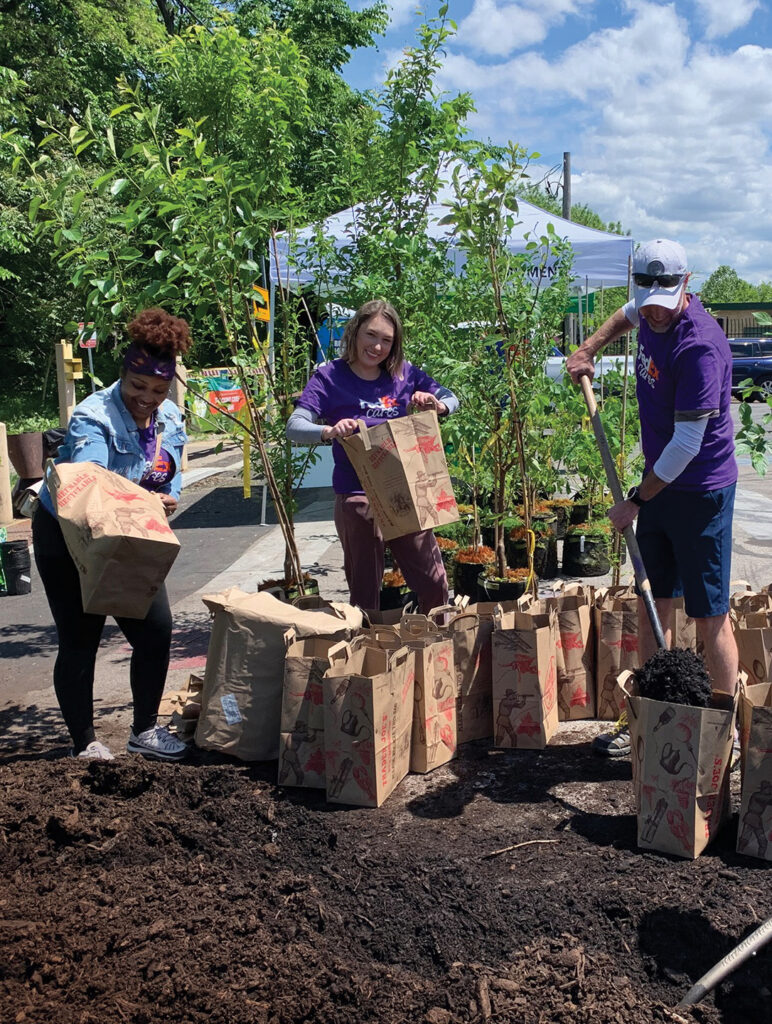
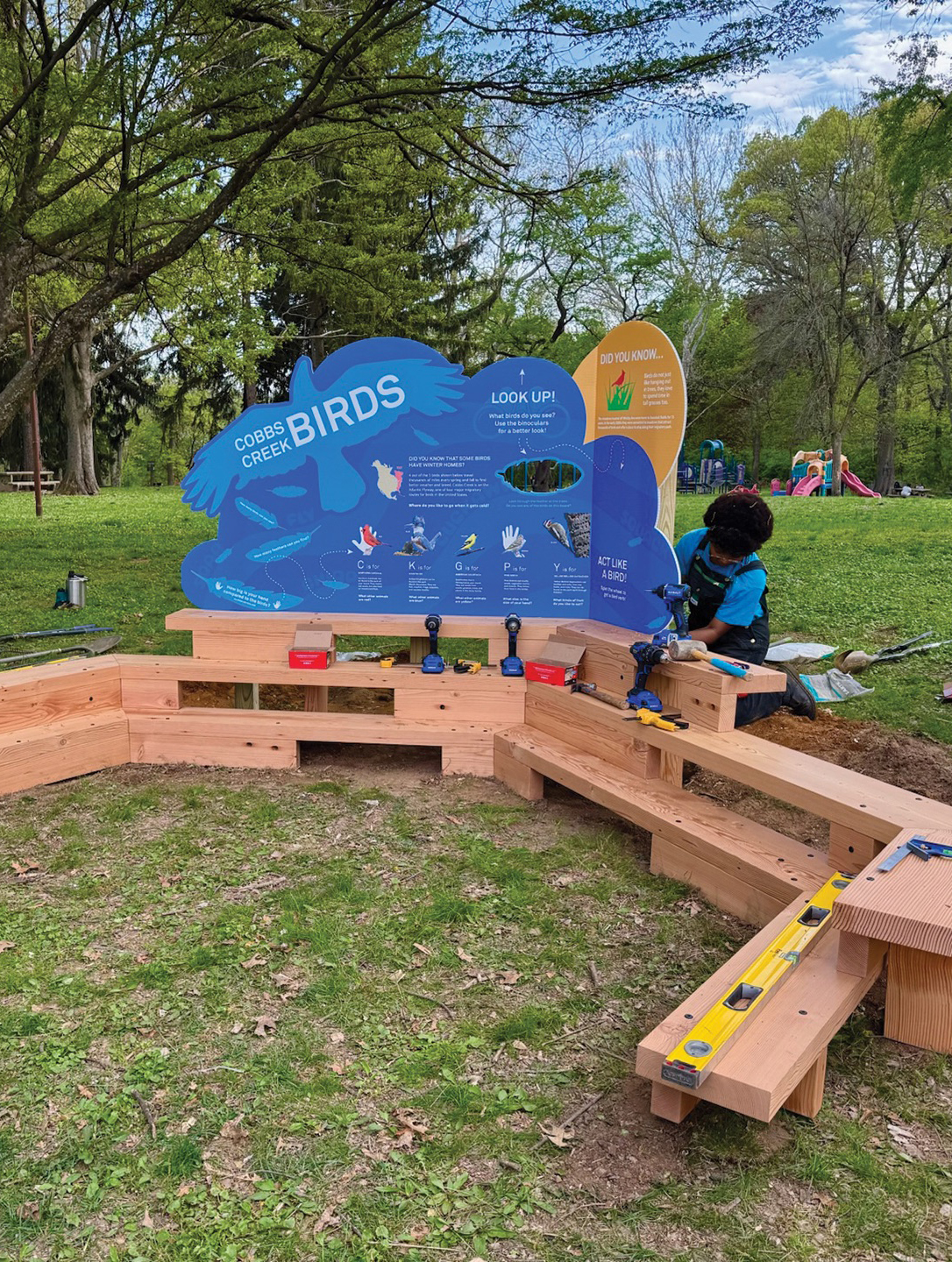
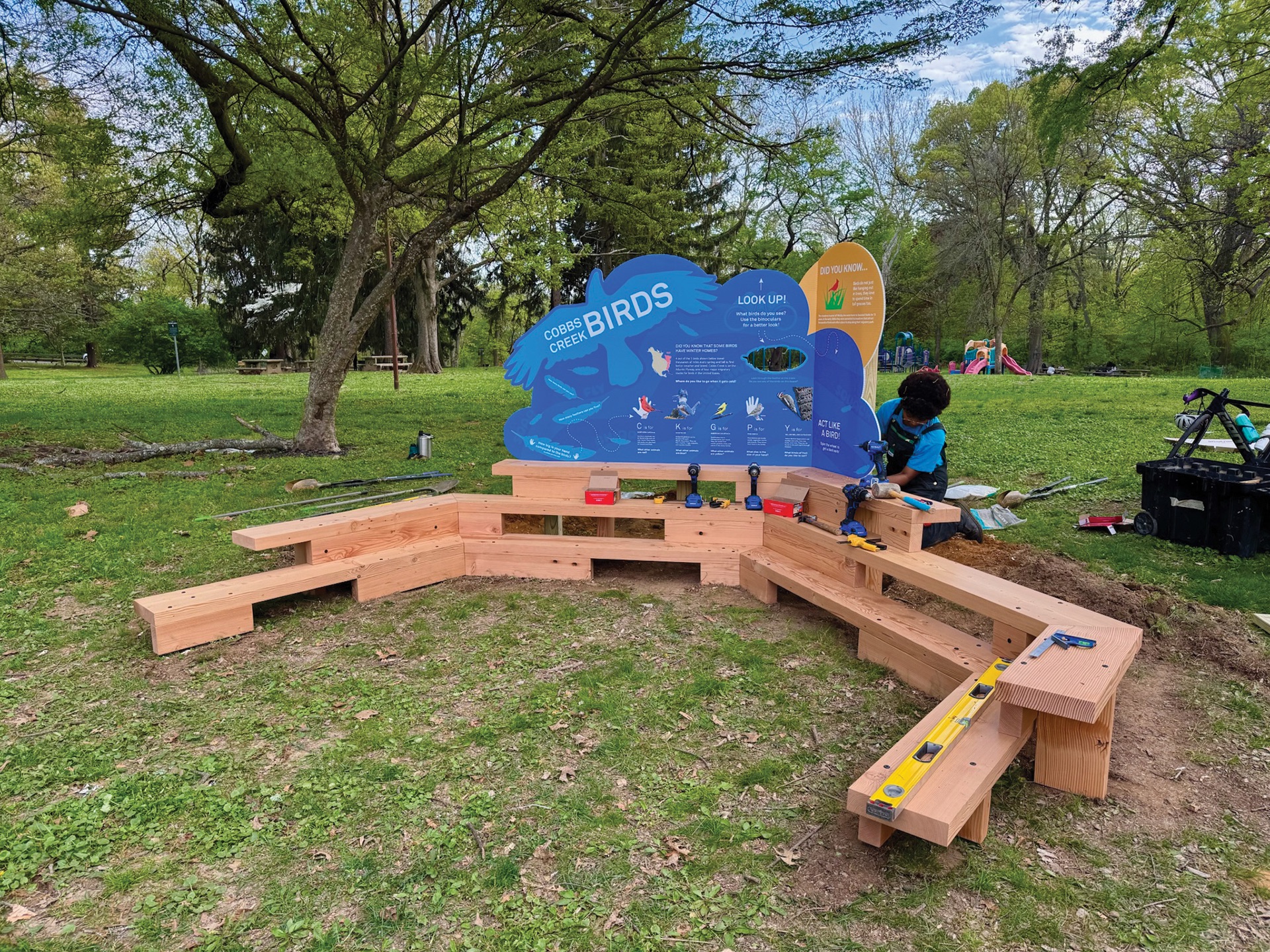
When entering Cobbs Creek Park at Florence Avenue and Cobbs Creek Parkway, a mural on the sidewalk asks, “How far can you hop?” On an adjacent wooden display, a spinning wheel lists actions inspired by reptiles and amphibians in the creek — slither, crawl, jump — and challenges the player to cross a series of tree stumps using those motions.
The pair is one of four Little Nature Playgrounds, built to welcome visitors to the nearly four-mile Cobbs Creek Trail at safe intersections. Each is inspired by different nature elements found within the 851-acre park, which constitutes much of Philadelphia’s West and Southwest border.
“There’s not a whole lot of entrances where you can cross from the residential side of the street to the park side of the street, and as you go further south on the Parkway, it gets worse,” says Monica Allison, co-founder of the community group Cobbs Creek Neighbors, which brought the idea to Clean Air Council to create the miniature playgrounds.
Cobbs Creek was considered a high-priority neighborhood for more and higher-quality playsites in a 2023 study of Philadelphia, where nearly a third of census-designated neighborhoods were found to have limited access to playsites. Cobbs Creek’s high-priority status led to the funding of the Little Nature Playgrounds project, also called Art in the Park.
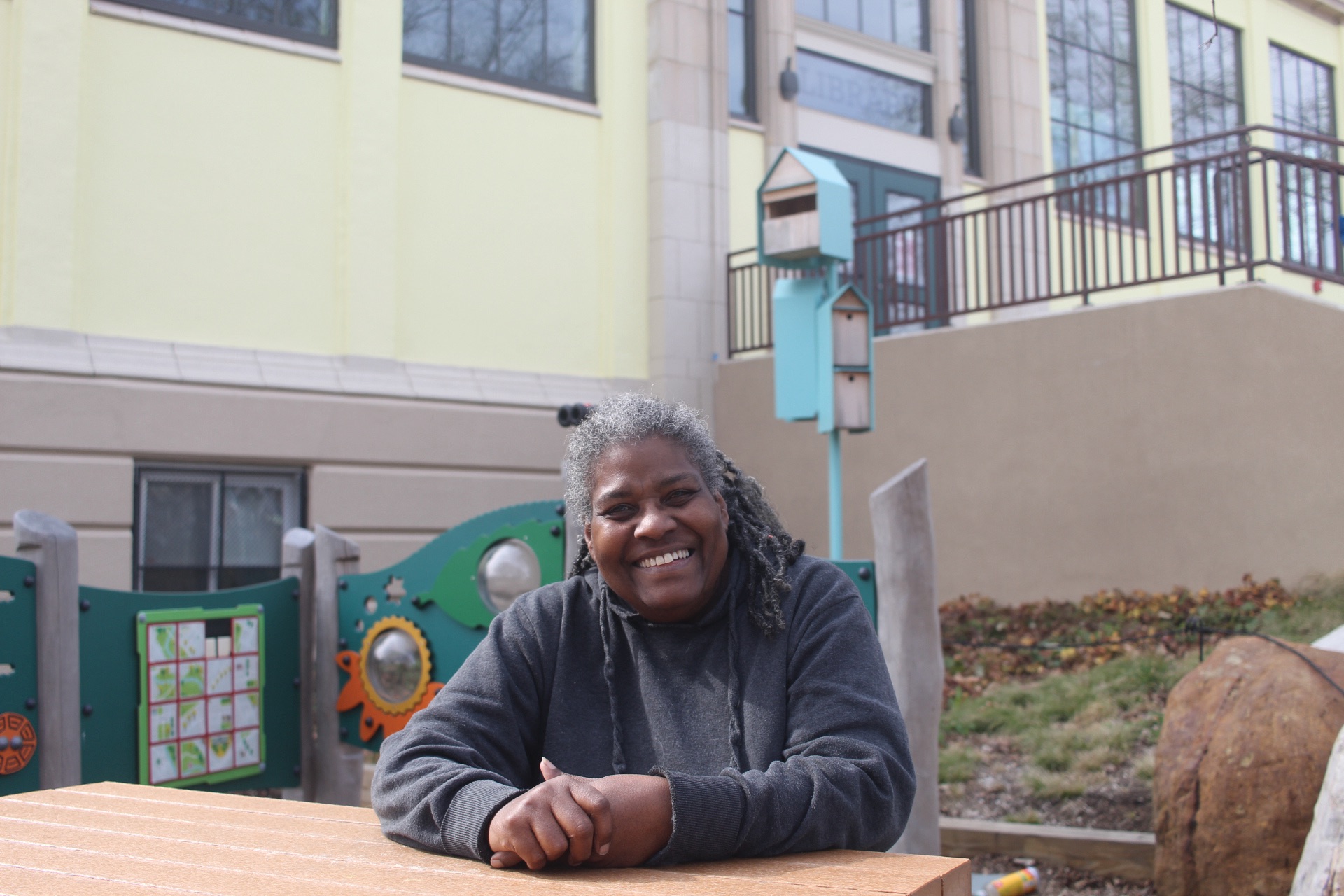
Allison says it’s “because the parks in this area have been neglected for so long” that she wants to attract people to the park, let them know it’s there for their use, and that they can use it safely. She brings up another factor that she has found to be a culprit in the underutilization of Cobbs Creek Park: its perception.
“There were times in the height of the crack era where the parks were full of abandoned cars and dead bodies,” she says. “Now that that’s not an issue, and we are able to utilize the park the way the park was designed to be utilized, we should be able to bring people back. And a lot of the barriers, I think, is the fact that people still see it in that time period.”
Will Fraser, Clean Air Council’s trail and watersheds program manager, says the project builds on a multiyear initiative focused on increasing wayfinding and overall welcoming infrastructure to increase usage.
Signage along the trail and surrounding areas was first installed outside the Blanche A. Nixon Cobbs Creek Library in late 2021, according to WHYY News, an effort led by Cobbs Creek Neighbors’ co-founder Larissa Mogano. Such signs map the trail, offer information about local ecology, and are a place for neighbors to post resources and information about community happenings. It then grew into a greater project to connect residents to the park in their neighborhood.
You don’t have to have a picnic in the park, and you don’t have to be waiting for your family reunion to happen to utilize the park.”
— Monica Allison, co-founder, Cobbs Creek Neighbors
“You don’t have to have a picnic in the park, and you don’t have to be waiting for your family reunion to happen to utilize the park,” Allison says. “These are some ways you can just bring the kids from the neighborhood or a daycare and have them engage with a green space.”
A second set of “parklets” is now in the early design stage to expand the network. Residents are being asked where the next three installations should be placed and what themes they want featured in the artwork. Designers are soliciting topics of interest related to the creek that fall under the categories of “learning,” “playing” and “health/wellness” at community input sessions, says Linda Fernandez, an artist whose company, Amber Art and Design, is one of the project’s consultants.
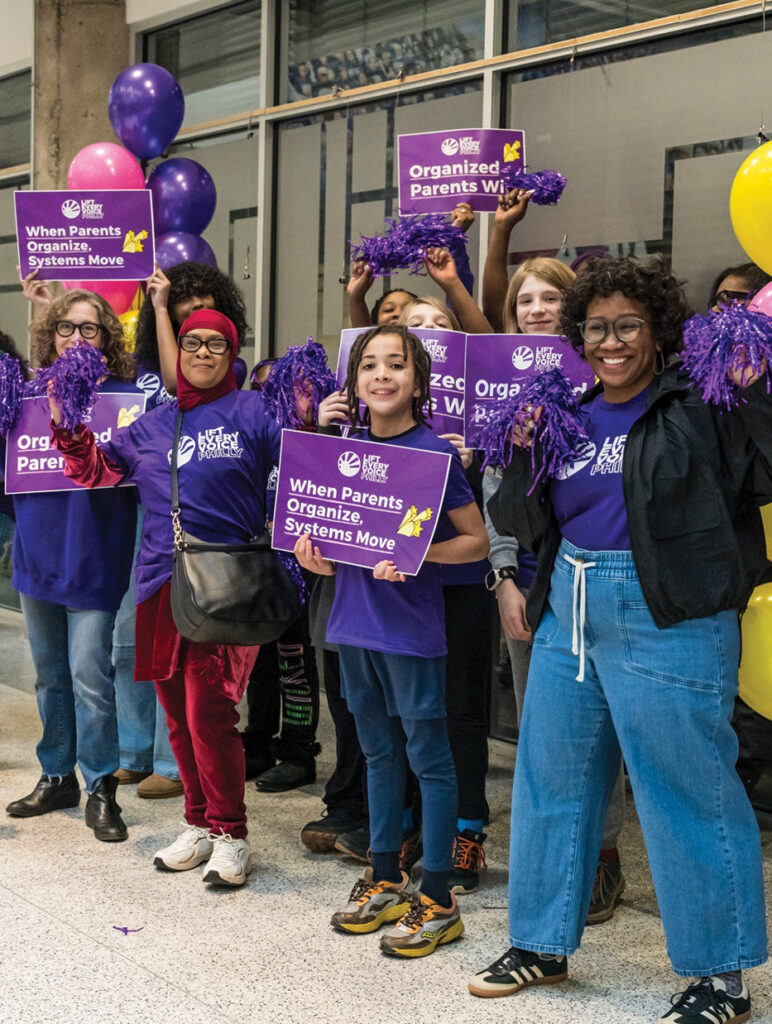
At a community design session in early March, roughly 50 parents, caregivers and children gathered in the lower level of the Cobbs Creek Library to offer their opinions. Neighborhood input for the first group of installations led to the inclusion of seating options that could double as surfaces for climbing or jumping, Fraser says.
Allison observed that this time around, design session attendees are showing a lot of interest in the health and wellness perspective as a focus of the parklets.
But, of course, creating a space for play continues to be top of mind.
Kamaiyah Jackson is a fabricator at Brewerytown-based Tiny WPA, the consultant for the building of the parklet structure, and emphasizes the value of play for development, especially as children have fewer opportunities for the trial and error that happens on the playground.
“I think [society has] made play really, really simple and really safe for kids, and it’s not necessarily a good thing,” she says. “You learn a lot in those little innocuous moments at the playground where they’re like, ‘Am I climbing too high? Do I have the confidence in myself and my skills to be able to do this?’ But those small touch points that you were getting in outdoor play, we’re not really getting anymore, because people are too afraid of kids hurting themselves and then being liable for it.”
Cameron Staley attended the March design session with his mother and 3-year-old nephew and says he would like to see a space for creative expression where people can just hang out along the trail. A nearly lifelong Cobbs Creek resident, Staley says Philadelphia has “a lot of room for opportunity” with its parks.
The city needs these green spaces that are better protected and better maintained.”
— Cameron Staley, Cobbs Creek resident
“The city needs these green spaces that are better protected and better maintained,” he says, noting that where the Cobbs Creek Trail crosses Baltimore Avenue, “there’s debris everywhere, construction machines, the path is broken up … It’s not a safe space.”
A hope for the project is that it will curb the illegal dumping that regularly occurs within the park.
“As we put things around the park to beautify it, I think we’re also bringing attention to the fact that this is a green space, not a dumping space,” Allison says. “It’s a beautiful space, and we want to keep it that way.”
The community input sessions are expected to continue until late summer, when the designers will create a plan and return to the residents for feedback, according to Fraser. Installations are tentatively scheduled to be completed next summer.
“There’s a lot of different parks throughout the city, and some of them get more attention and have more investment than others,” he says. “Having projects like this, making this kind of investment in underutilized space where there’s great potential in a park to bring those social, emotional, physical, mental health benefits to [the] community, and to bring even just a few more people into the park is an amazing win.”
Allison carries the same sentiment. To her, the importance of bringing people to the park is simple: “Because we live here.”