I would need to book a flight to Portland, Oregon, to see shad runs like Philadelphians once did. That might surprise Delaware Valley residents accustomed to hearing how scarce the once-abundant fish are. But while shad have long suffered in their home range, they have flourished out West.
The sleek silver herring is a celebrity in Philadelphia, having named a neighborhood (Fishtown) and (at least in legend) fed George Washington’s troops camped at Valley Forge on the Schuylkill River. For thousands of years, the Lenape relied on migratory fish such as shad to deliver a bounty every spring. They were abundant into the beginning of the 20th century, when fishermen landed 3 million per year in the Delaware system.
The spawning shad population is currently stuck below a million adults per year. There was a population bump in the 1980s, reaching 830,000, but today the number appears to be stable at a lower level, according to a report on the status of shad and other river herring published last year by the Partnership for the Delaware Estuary.
It is impossible to directly count all the fish entering the Delaware River, so biologists rely on other clues to estimate the size of the population. Among other methods, they can count fish swimming through fish ladders on tributaries. Scientists can look at fish caught coming up the river as adults to see how many were reared in hatcheries, using that proportion to estimate the overall population.
The report’s authors sorted through these and other indices and came up with a mixed bag, according to Ellie Rothermel, urban resilience manager with the Partnership. “Some are surprisingly good, some are bad, but what they’ve concluded is that when you look at the time series, it is not trending upward, not trending downward,” Rothermel says. “That’s the overall takeaway.”
According to the Partnership for the Delaware Estuary report, in the mid-20th century, pollution created a dead zone in the Delaware at Philadelphia, with oxygen so low that fish couldn’t swim through it. Since then, water quality has improved dramatically, but plenty of other challenges remain, including dams, mortal injuries from catch-and-release fishing, climate change and exotic predators such as flathead catfish that wait at fish ladders to suck up migrating fish.
“It’s the combination of all of these things,” Rothermel says. “It’s hard to pull out one of these things and say ‘that’s it’ without more studies.”
If shad can make it to the ocean, they spend most of their lives there as filter feeders, basically swimming with their mouths open to strain out tiny zooplankton. They can cover thousands of miles every year up and down the Atlantic coast. After a few years, they swim up rivers to breed, much like the larger and more charismatic salmon and steelhead (ocean-going rainbow trout) native to rivers of the Pacific Northwest.
It’s hard to pull out one of these [environmental challenges] and say ‘that’s it’ without more studies.”
— Ellie Rothermel, Partnership for the Delaware Estuary
The native migratory fish on both sides of the continent suffer from some of the same problems, including climate change and finding their breeding territory in rivers blocked by dams (though some hazards don’t overlap, such as rampant predation by California sea lions).
The successful West Coast shad got their start as an intentional introduction, an effort to share the tasty and economically important fish with Californians. It’s hard to imagine today, but in the late 1800s, people introduced fish all over the continent for food and recreation; this is how we got channel catfish, smallmouth bass and carp in the Delaware. In 1871, a pioneer of hatching fish in captivity, Seth Green, took 12,000 baby shad from the Hudson River on a transcontinental railroad ride to San Francisco. He released the 10,000 that survived the trip into the Sacramento River. Now they spawn in rivers from San Diego up into Alaska.
In some years, more than 6 million shad swim past the Bonneville Dam in the Columbia River between Oregon and Washington, while individual salmon species and steelhead remain stuck below 1 million. Although shad have surged while the native fish have declined, biologists aren’t quite sure if this is more than a coincidence. A 2024 journal article reviewing the evidence concluded, “The sheer numbers and biomass suggest they should be ecologically important, but the studies reviewed here do not demonstrate or even imply strong interactions between shad and salmon, or a major role of shad in ecosystem processes.”
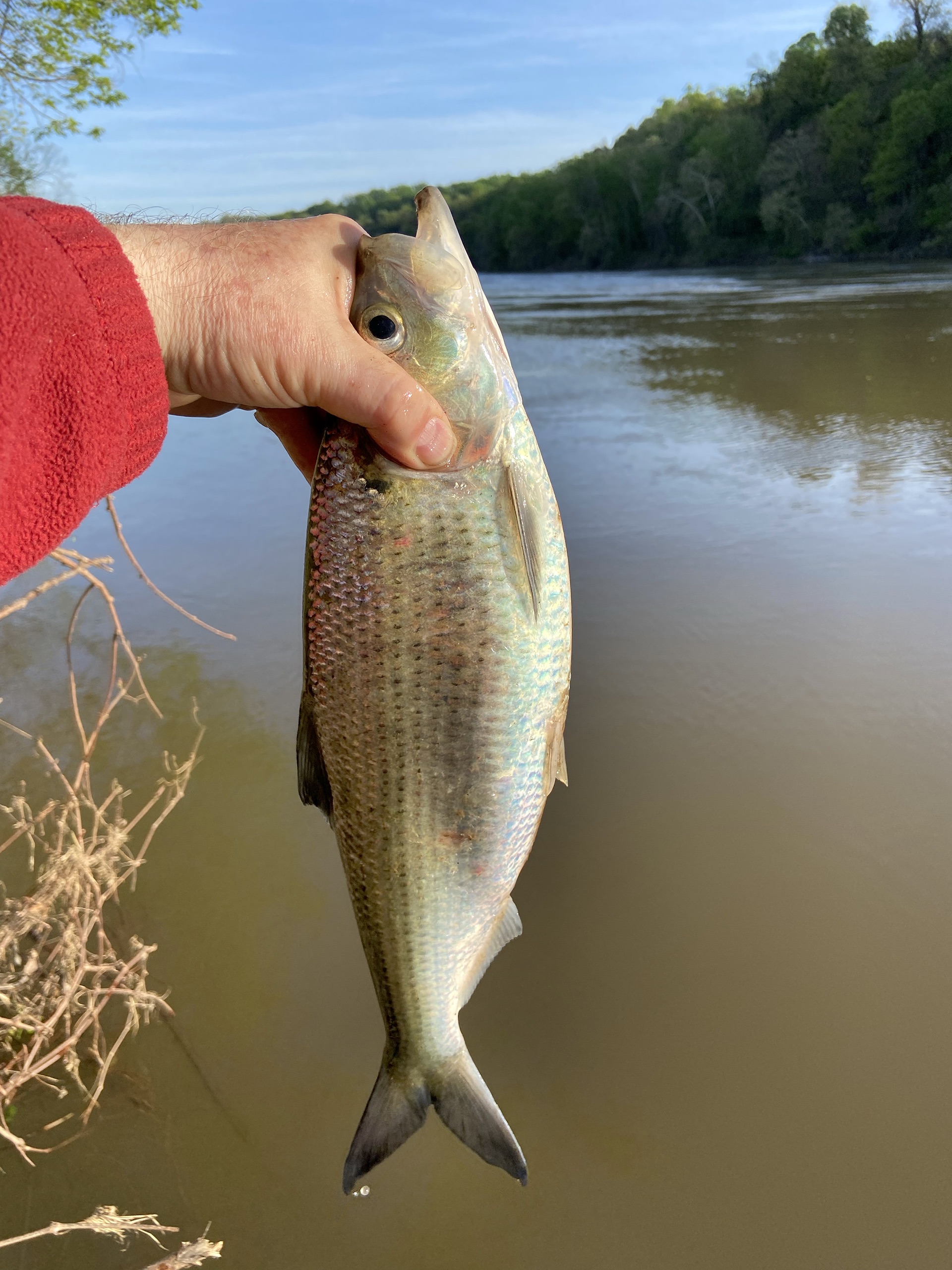
A 2021 report that focused on the Columbia chalked much of their success up to the giant hydroelectric dams built in the 20th century, which can be frustrating to read from this side of the continent, where much lower dams get in the way of shad migration. The Bonneville Dam is 177 feet tall, compared to Flat Rock Dam in Phoenixville, which you could practically hop over.
Unlike humans, salmon and steelhead, shad don’t jump. Those much taller dams on the Columbia and its tributaries flooded previously steep and rocky sections that shad had been unable to ascend. Thus, the dams’ expansive, well-maintained fish ladders opened up hundreds of miles of river for shad to spawn in. Baby shad coming back down the river found reservoirs that turned out to be great nursery habitat. Those juvenile shad now enter the ocean with a size boost that allows more of them to survive the gauntlet of predators that awaits them in the ocean.
Although the main stem of the Delaware is undammed for almost 300 miles, its tributaries large and small are blocked by a comparatively antique series of dams. Fish ascending Cobbs Creek from Darby Creek can make it about 7 miles from the Delaware before they are forced to stop at Woodland Avenue, where dams have blocked the creek since the 1600s. On the Brandywine River, they can make it 3 miles until they’re stopped by the Broom Street Dam.
Washington’s troops would need to find another fish if they were waiting at Valley Forge this spring. The Fairmount Dam has a fishway, but migrating shad have to stop at the Flat Rock Dam located above the Manayunk Canal, where the fishway is out of commission.
The 2025 report on the shad of the Delaware ended on an uncertain note. Since we don’t know enough about what is killing them or keeping them from reproducing, the authors called for research into the possible causes. “To effectively enhance the abundance of American Shad and river herring in the Delaware River Basin, resource managers require updated and comprehensive information on the sources of mortality affecting these depleted populations.”