In June, the School District of Philadelphia’s long-running struggle to protect staff and students from asbestos in its aging buildings came to a head with federal criminal charges and an agreement with the U.S. Justice Department to take care of the problem once and for all.
The Justice Department alleges that the Philadelphia School District violated the Asbestos Hazard Emergency Response Act, a federal law requiring schools to monitor their buildings for asbestos and to quickly remediate them if they find the toxic mineral, long used as insulation. Rather than proceed to a trial, the Justice Department and the school district entered into a deferred prosecution agreement, placing the district under judicial oversight as it inspects schools and either removes or seals up remaining asbestos.
This agreement is one step toward the transparency and accountability that Philadelphia families have always deserved.”
— Kendra Brooks, Philadelphia City Council
“Parents, educators, and community members had been sounding the alarm about this issue since before I was elected,” says City Councilmember Kendra Brooks. “We’ve known for years that the neglect of our school buildings is harmful to the point of being a crime. This agreement is one step toward the transparency and accountability that Philadelphia families have always deserved.”
This August the district announced the full reopening of Frankford High School after a $29.9 million renovation. According to a district press release, work included the removal or repair of asbestos-containing materials, as well as new wall panels to shield plaster that could still contain asbestos. The renovation also took care of other problems afflicting many of the district’s aging buildings: installing 83 new window air conditioners, refinishing 75,000 square feet of wood and linoleum floors, and refurbishing the auditorium and gym, among other improvements.
Frankford High wasn’t alone. “We keep finding asbestos,” said Jerry Roseman, director of environmental science and occupational safety and health for the Philadelphia Federation of Teachers (PFT) in a 2023 Grid article. Roseman pointed to 10 schools closed for remediation in 2019 and 2020, and six in 2023. Frankford High School was one of those six schools, closed after a maintenance team found asbestos in April of 2023.
Brooks is optimistic that the district has finally gotten on top of the problem. “The agreement — along with years of advocacy by students, staff and parents — have led to increased staff and resources going to asbestos monitoring. It brings me some relief, as a School District parent, to know that the District is now regularly inspecting buildings for damaged asbestos,” she says.
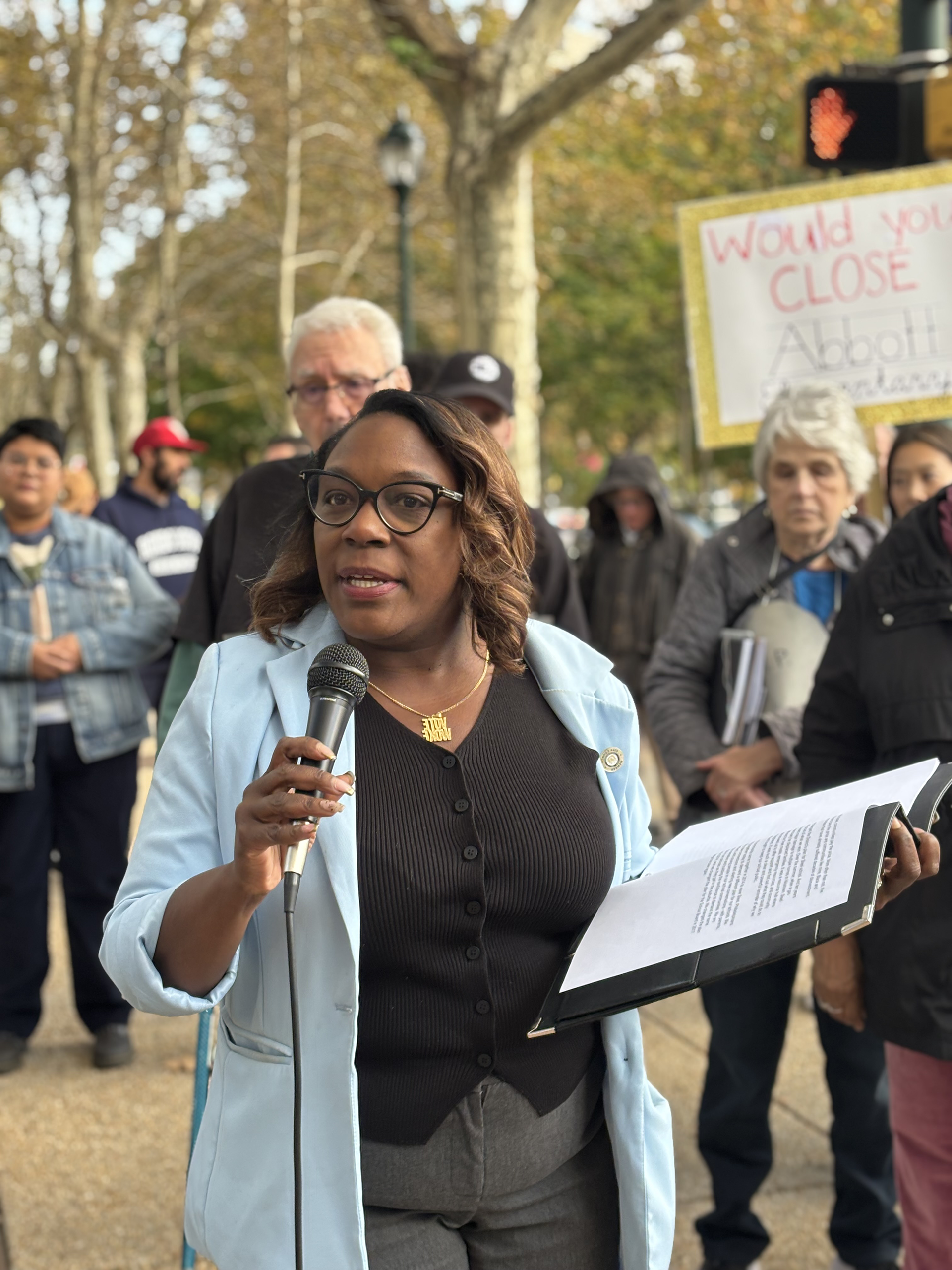
The PFT and education advocates such as Brooks argue that the district’s asbestos problems are symptoms of decades of underfunding and deferred maintenance. According to Arthur Steinberg, president of the PFT, interviewed for a 2024 Grid article about the district’s maintenance woes, its maintenance backlog had by then grown to about $7 billion, not including buildings that would be cheaper to replace than repair.
That kind of money will not be coming from Harrisburg anytime soon. The 2025-26 Pennsylvania state budget, passed on Nov. 12, included only $125 million for school facilities improvements statewide.
Although the district renovated Frankford High, it still has not released a comprehensive facilities plan. In 2023, superintendent Tony Watlington had promised City Council that a facilities plan would be completed by June 2024. Grid reached out to the district for this update and was told by Monique Braxton, deputy chief of communications, that “the facilities plan will be released this winter.”
 This special section is a part of Every Voice, Every Vote, a collaborative project managed by The Lenfest Institute for Journalism. The William Penn Foundation provides lead support for Every Voice, Every Vote in 2024 and 2025 with additional funding from The Lenfest Institute for Journalism, Comcast NBC Universal, The John S. and James L. Knight Foundation, Henry L. Kimelman Family Foundation, Judy and Peter Leone, Arctos Foundation, Wyncote Foundation, 25th Century Foundation, Dolfinger-McMahon Foundation, and Philadelphia Health Partnership. To learn more about the project and view a full list of supporters, visit