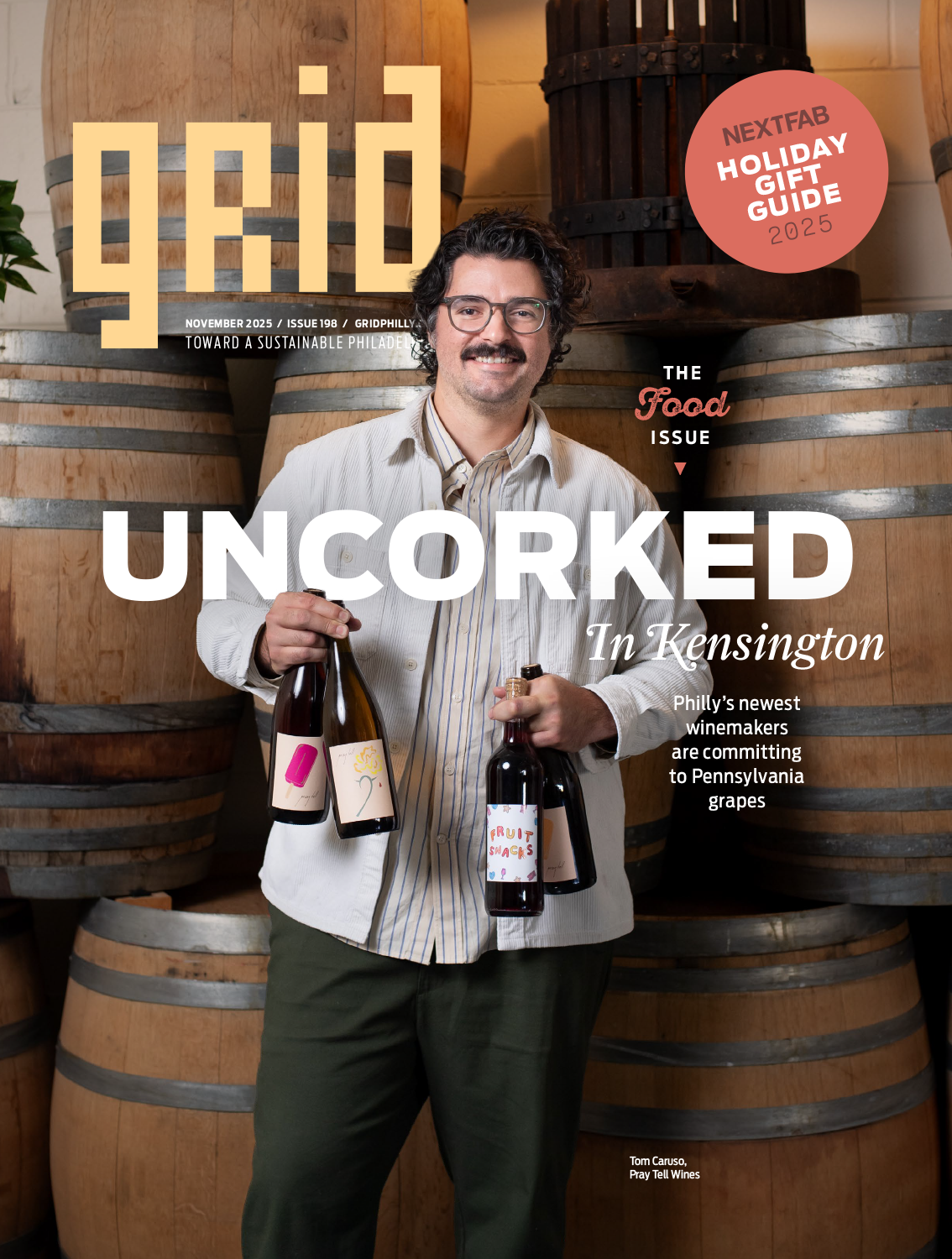
When visitors step into the Pray Tell Wines tasting room in a warehouse on a treeless street in Kensington, the first question they often ask is, “Where are the grapes?”
It’s a fair question. In Oregon’s Willamette Valley, where owner Tom Caruso ran Pray Tell for seven years before relocating to Philly in 2024, vineyards stretch across the horizon, tractors traverse the roadways hauling bins of fruit and the scent of fermentation drifts in the air. But here in the city, the winemaking happens far from the fields.
“People know wine is an agricultural product,” Caruso says, “but when they don’t see greenery, they’re trying to make that connection.”
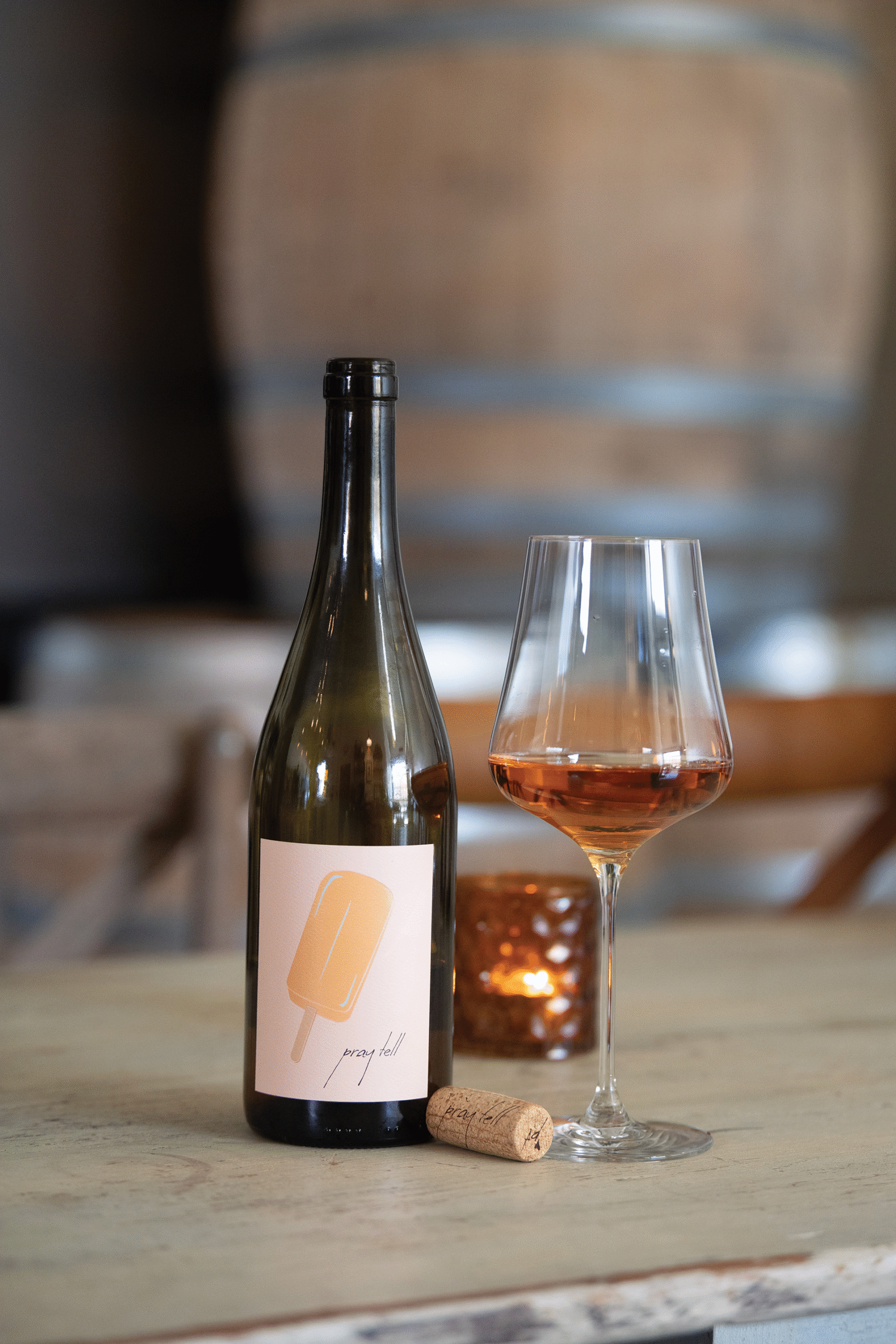
Back in their tight-knit community of McMinnville, Oregon where “everyone and their mom is involved in the wine industry in some capacity,” Caruso and his partner and assistant winemaker, Sydney Adams, could source any grape with a few phone calls. Now, the grapes for Pray Tell’s expressive wines come from Pennsylvania growers — and establishing these relationships takes time, trust and a fair amount of detective work. Setting up shop in Philly meant having to start from scratch.
Caruso and Adams are committed to working with Pennsylvania farmers, to see what expressions they can coax from local grapes with their low-intervention winemaking ethos.
There’s something beautiful about exploring what this region’s fruit can express.”
— Tom Caruso, Pray Tell Winery
“There’s something beautiful about exploring what this region’s fruit can express,” Caruso says. “How does merlot from Pennsylvania taste compared to Oregon or France? Seeing those true differences of terroir emerge — it’s a wine geek’s dream.”
When Pray Tell finally got its approval from the Pennsylvania Liquor Control Board in the summer of 2024, Caruso’s first round of emails to local farmers went unanswered. It was late in the growing season, and he understood that most growers were out in the fields, not checking inboxes. Harvest yields, he also knew, were down due to crop damage from the spotted lanternfly infestation. And, there was a deeper truth at play: sourcing grapes is a business built on reputation, not cold calls.
So Caruso turned to an old connection. He texted James Wilson, co-owner of Wayvine Wines in Nottingham, Chester County, whom he’d met years earlier at a wine festival. That message led to Pray Tell’s first 100% Pennsylvania wine, a juicy, fruit-forward field blend playfully named Fruit Snacks, made from cabernet franc, pinot noir, merlot and riesling.
“This wine is a younger expression of those grapes,” Caruso says. “Their more serious counterparts are in the cellar, and may be ready by November of next year.”
Then came another stroke of luck. After a story about Pray Tell ran in The Philadelphia Inquirer, Caruso heard from Mark Chien, a retired Penn State viticulture professor who connected him with a grower in Adams County, near Gettysburg. The relationship clicked, and Caruso bought gamay, cab franc, merlot and the winery’s first two hybrids, vidal blanc and chambourcin. This year, Pray Tell will process more than 30 tons of local grapes.
Over time, Caruso hopes to collaborate even more closely with growers — discussing decisions like canopy management or harvest timing that can subtly shape a wine’s character.
“That level of input comes with a leveled-up relationship,” he notes, “and a lot of two-way trust.”
Ultimately, he dreams of planting Pray Tell’s own vineyard somewhere in Pennsylvania. “We want to be PA farmers as well as winemakers,” he says. “But right now, it’s about doing right by the grapes we’re working with — and showing what this region can do.”
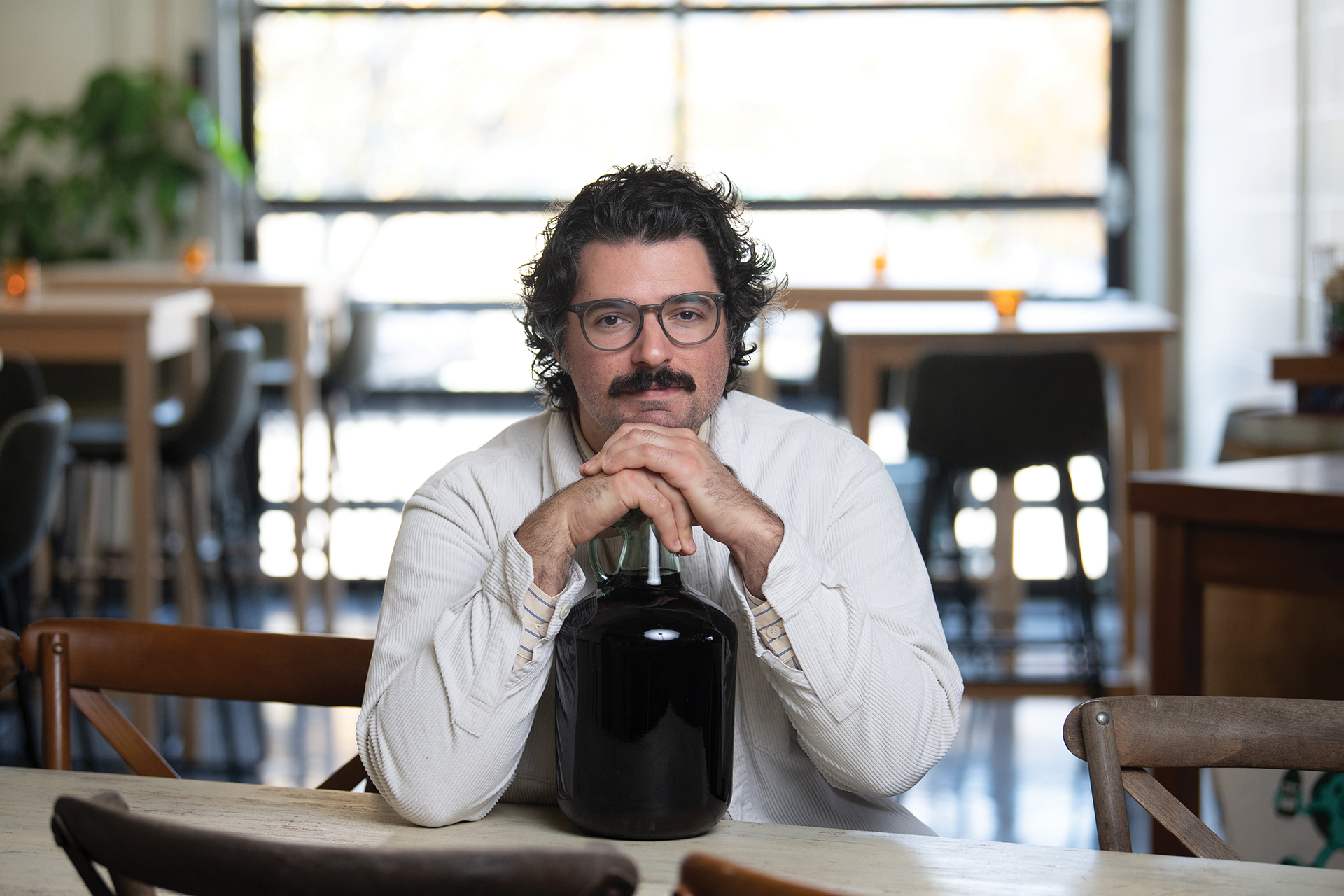
Deeper in Northeast Philly, another urban winemaker has been navigating similar terrain. Eli Silinis, owner of Camuna Cellars, a kosher winery, moved from the Bay Area in 2019 and faced the same challenge: where to find fruit. His first lead came from answering an online ad for chambourcin grapes grown in someone’s backyard. That one chance connection introduced him to the Outer Coastal Plain AVA wine region in New Jersey and a network of small growers.
“Finding vineyards can be ridiculously circuitous,” Silinis says. “Sometimes, if you find one ‘in,’ it leads to another, and soon you have a better map of the landscape.”
There’s also the added challenge that, for Silinis, not just any fruit will do. He vets all the growers he works with, usually by discussing their growing practices over the phone and then visiting their vineyards.
“I’m looking for what they’re growing — what varieties have people chosen to plant is kind of the first clue — then I see how vineyards look and take in the whole picture,” he says. “I also want to know how much time people have to pay attention to the vineyards; is it their job or their hobby?”
After five years of working with vineyards across Pennsylvania and New Jersey, Silinis has built a network of trusted partners. Still, each harvest comes with its share of uncertainty.
“I’ve gotten to the point where I can put the pieces together for harvest, picking up half a ton of this or that,” he says. “But there’s always that tension of making sure you have enough to sustain the winery.”
Both Caruso and Silinis begin fermentations in the fall, after harvest, when their hard-won fruit is processed and pressed. It may be anywhere from six months to more than three years for these wines to be ready to release. The puzzle of creating enough supply to satisfy future demand is ongoing for these two growing wineries, which employ multiple sales channels: selling direct to consumers online, supplying local bars, restaurants and bottle shops and working with wine distributors that sell their wines in other cities and states.
Emmett, a locally focused, Mediterranean-inspired restaurant in Fishtown, prominently features both Pray Tell and Camuna Cellars on its all-Pennsylvania wine list. General manager and wine buyer Marissa Chirico compares her sourcing methods to the way Emmett’s kitchen works closely with Pennsylvania farmers.
She notes that while Pray Tell and Camuna Cellars’ wines have different personalities (Pray Tell’s are “beautiful, dialed in, a nod to the classics,” while Camuna Cellars’ are “playful, joyful, alive in the glass”), both represent the immense potential of our region as a winemaking hub in the Mid-Atlantic.
“They’re both purchasing thoughtfully from people who are proud of their fruit, and the fruit they’re pulling is a good example of the personality of the land where it grew,” Chirico says.
For Pennsylvania to be taken more seriously as a winegrowing and winemaking region, innovative young winemakers — and sommeliers and bar managers who will give them a chance — are two crucial ingredients. These two Philly wineries can help shift things, she believes.
“I think what is important is that people decide to make wine here, wine they’re passionate about and proud of, that can help us discover what grows well and shows well in PA. Both Pray Tell and Camuna Cellars do that exceptionally well.”
AVAs in PA
Did you know that Pennsylvania is the nation’s fourth-largest grower of wine grapes? While we may not have the same “wine country” reputation as California or Oregon, grape growing and winemaking is big business here; the industry contributes upwards of $1.7 billion to the state’s economy each year.
Pennsylvania’s grape-growing regions are spread across five AVAs, or American Viticultural Areas. These are the official appellations of origin used on wine labels, and each one represents a specific grape-growing region. To list an AVA on a wine’s label, according to federal regulations, at least 85% of the grapes in the wine must have been grown in the AVA, and the wine must be produced and finished in the state where the AVA is located.
AVAs are important in providing transparency around the origin and quality of a wine, and helping consumers make purchasing decisions and get to know the shared characteristics of wines from the same region.
1. Central Delaware Valley: This 96,000-acre appellation covers parts of Pennsylvania and New Jersey. It crosses the Delaware River north of Philadelphia, and encompasses an area stretching from Trenton, New Jersey to Easton, Northampton County. The area features a hot-summer, humid continental climate, brown gravelly loam soil and a number of microclimates.
- Established: 1984
- Total Acres: 96K
- Number of Wineries: 3
2. Cumberland Valley: Southern Pennsylvania shares this large area (756,000 acres in total) with Eastern Maryland; it stretches between the Blue Ridge and South Mountains. It features mixed terrain with limestone-rich soil; grapes frequently grown here include chardonnay, cabernet franc, vidal blanc and merlot.
- Established: 1985
- Total Acres: 756K
- Number of Wineries: 22
3. Lake Erie: Thanks to the weather moderation of the Great Lakes, this cool-climate region that covers the northwestern corner of Pennsylvania, as well as parts of New York and Ohio, is an ideal grape-growing environment. It’s nicknamed “the Concord Belt,” as nearly 40% of the grapes grown here are concord grapes.
- Established: 1983
- Total Acres: 2.2M
- Planted Acres: 42K
- Number of Wineries: 58
4. Lancaster Valley: This is one of two AVAs that are completely in Pennsylvania; it covers Lancaster and Chester counties. The valley is a geological depression formed between the northern Appalachian Mountains, and is bordered on the west by the Susquehanna River. Its gentle hills, fertile soils and humid continental climate create good growing conditions for grapes like chardonnay, albarriño, pinot noir and riesling.
- Established: 1982
Total Acres: 225K
Planted Acres: 400
Number of Wineries: 10
5. Lehigh Valley: Covering Lehigh, Northampton, Berks, Schuylkill, Carbon and Monroe counties, the geological features of this area include rolling hills, shale and sandstone-based soils and moderating influence of the Delaware River. These factors set the stage for riesling, chambourcin and grüner veltiler to flourish in its vineyards.
Established: 2008
- Total Acres: 1.2 Million
- Planted acres: 230
- Number of Wineries: 10