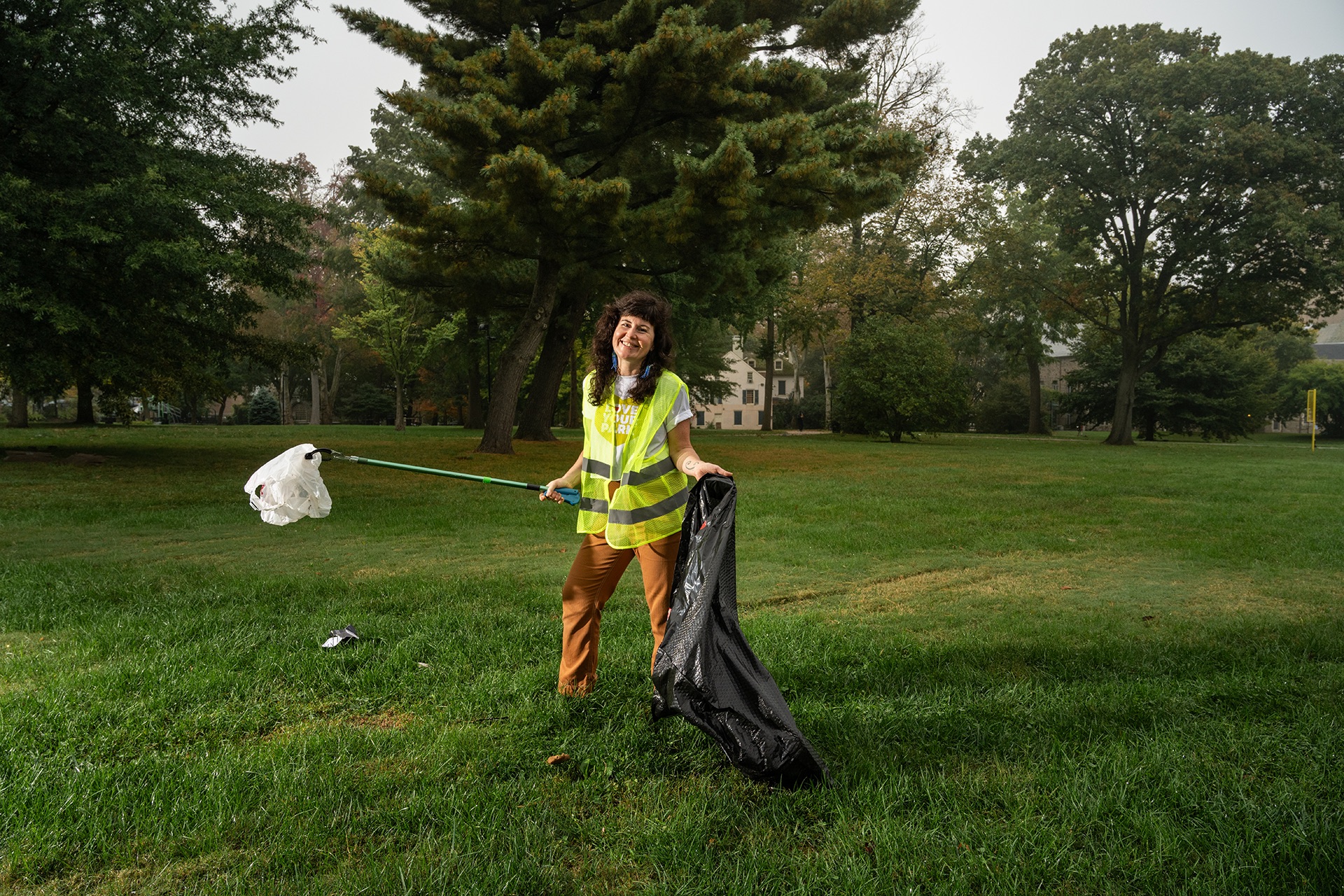
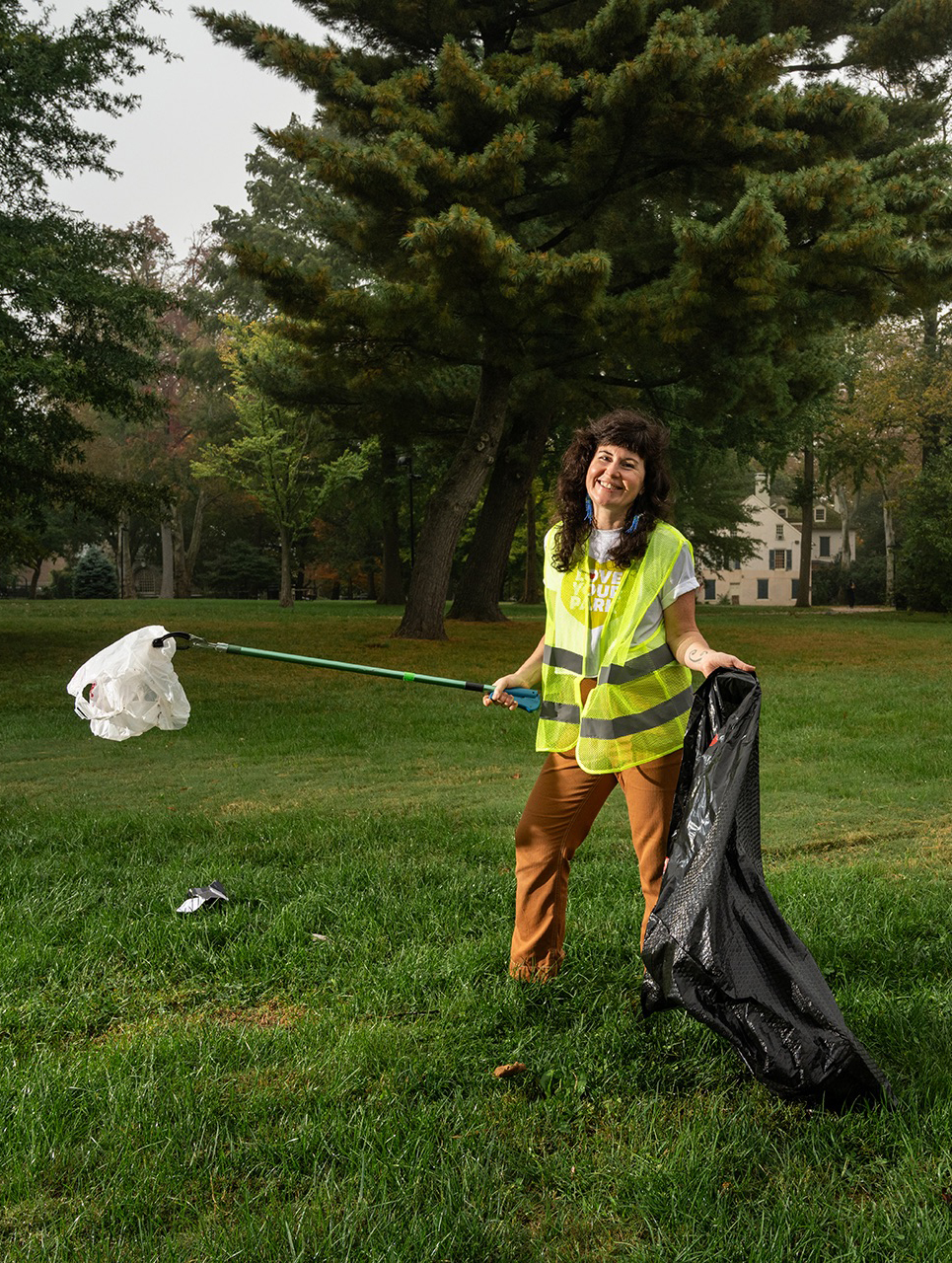
Angela Miles would like to focus on the positive. As president of Friends of Vernon Park and an organizer for Philly Parks United, a loose association of Friends groups formed to share ideas and resources, she knows how easy it is to burn out. “A common feeling among volunteers … is that sometimes we can really focus on what we’re not able to do instead of feeling really proud of the things that we are doing. So we’re there to affirm each other and have each other’s back.”
Miles and other members of the Friends group devote long, unpaid hours to Vernon Park. They organize park cleanups as well as festive events. They pick up litter and tend trees. They alert Philadelphia Parks & Recreation to any repair needs and nag the right people until the work gets done. “We’re kind of the eyes on the ground,” Miles says, and lists challenges that have popped up over the last two years. “We’ll report to our stewardship coordinator if a huge tree branch has fallen, or if a car drove through the fence and crashed into the playground, or if teenagers are climbing the light posts and surfing them down so they snap like an asparagus.”
Philadelphia relies on outside groups and volunteers for 24% of parks spending (including the value of volunteer hours), according to the Trust for Public Land’s ParkScore. Among the 100 most populous cities, the average is 7%. Miles knows that the department depends on and appreciates the labor of groups like Friends of Vernon Park, but she wishes it didn’t rely on them so much. “When things are said like, ‘This department wouldn’t function without all the hardworking volunteers,’ that is so thankful and kind, but it is extremely concerning,” she says. “I don’t know what other City agency would put so much reliance on a volunteer base.” Now Friends groups, parks advocates and City leaders are starting to ask if there’s a better way.
The ParkScore numbers show that the City spends much less on park maintenance than most peer cities. For the 2026 ParkScore, Philadelphia reported spending $33 per capita in City funds on maintenance and administration, which ranks it No. 89 out of the 100 most populous cities in that category. Philadelphia would have to roughly triple its spending to beat what Pittsburgh spends ($96) in the same category and more than quadruple it to pass Minneapolis ($154). To match Boston, which sits at the middle of the pack (spending $60 per capita), Philadelphia would need to budget $95 million.
These are only rough comparisons. “The complicating piece is no park system is the same. It’s not cookie-cutter,” says Jayne Miller, a principal at PROS Consulting, a firm that specializes in parks and recreation best practices. But there are more precise benchmarking tools. “Our industry has maintenance standards for all the different kinds of assets — mowing cycles, tree pruning, playground maintenance, ball fields — and so meeting those industry best practices from a professional standpoint is what makes a well-maintained park system.”
No park funding or maintenance system is perfect. “There is not a park system in the country that does not have a backlog,” Miller says. “The question is, what’s the size of that backlog?”
Parks & Rec declined to make leaders available for an interview and instead sent a statement by email: “Philadelphia Parks & Recreation works to leverage City funding with external resources, including state and federal funding and private partnerships, to support our facilities, programs, and public spaces. We manage our operations and priorities within the budget approved by City Council and remain committed, as One Philly, to partnering across government and with external organizations to make the most of available resources for Philadelphia residents.”
The William Penn Foundation, which funds a parks advocacy position at PennFuture, is trying to help Friends groups and others organize to demand more money for the system, says Nathan Boon, the interim program director for environment and public space at the foundation. “Since the Philly Parks Alliance disbanded in 2024, there’s really been a lack of a coordinated voice that we believe the city warrants around parks and parks funding.”
The Fairmount Park Conservancy raises money for the park system but does not advocate for more public spending. “We’re not that advocacy group,” says Tony Sorrentino, the organization’s CEO. “But we all care about parks, and there’s a kind of unification around that.”
I don’t know what other City agency would put so much reliance on a volunteer base.”
— Angela Miles, Friends of Vernon Park
Many municipal parks systems rely on private fundraising organizations to augment public funds to some degree, a model pioneered by New York City’s Central Park Conservancy in 1982, Sorrentino says. Recently, the Fairmount Park Conservancy wrapped up a five-year fundraising campaign that yielded $115 million. “Since its inception in 1998, the conservancy has raised $185 million for parks,” Sorrentino says. Along with running parks programs like We Walk PHL and TreePhilly, the conservancy handles big capital projects for Parks & Rec, including the Trolley Trail renovation and the FDR Park master plan. It also supports Friends groups with coordination and supplies for events such as Love Your Park week.
Parks & Rec’s reliance on private groups can yield inequitable outcomes, as residents of wealthier neighborhoods chip in with dollars and spare time that residents of lower-income areas can’t afford. Cobbs Creek Park has no Friends group at all. The Friends of Vernon Park in Germantown is run entirely by volunteers, and its annual revenue is usually under $1,000, according to Miles. The Friends of Rittenhouse Square has two staff positions and reported more than $1.2 million in revenue on its 2024 IRS Form 990.
Advocates and City leaders agree that the parks system doesn’t just need more money; it needs a new way to raise money. On May 28, City Council adopted a resolution introduced by Councilmember Anthony Phillips calling for a hearing on the park system, “including funding, maintenance, infrastructure, staffing, safety, and opportunities to establish sustainable long-term revenue streams.” The hearing is scheduled for Dec. 1.
“We’ve been chronically underfunded for years,” says Tom Forkin, chief of staff for Councilmember Mike Driscoll. Forkin was previously a deputy director in Parks & Rec. “The people that are in the maintenance section of Parks & Rec do yeoman’s work. I’ve got nothing but the greatest respect and admiration for that team,” he says. “But they need a more robust financial structure.”
Philadelphia Parks & Recreation competes with other City departments for its annual operations budget (including maintenance), but other funding models exist. The Minneapolis park system receives funds appropriated by the city council, but the independent parks and recreation board levies its own property taxes as well. In 2019, Pittsburgh voters approved a referendum to introduce a property tax that generates about $10 million per year for a parks trust fund.
Philadelphia actually has a dedicated funding mechanism for some capital spending (new construction and renovation) through the Rebuild program. Rebuild borrows its funds by issuing bonds, and the City’s beverage tax helps pay the money back. Could the City also find a way to shore up operations?
“It became very important to me that we need to figure out how we have an appropriate funding mechanism that will be consistent with the need for making sure that we have the best parks and recreation centers in the nation,” says Phillips, who chairs City Council’s Committee on Parks, Recreation, and Cultural Affairs.
Phillips says he went on a tour of recreation centers when he assumed the chair of the committee in 2024. “We found common themes that were at every rec center,” Phillips says. These included sidewalks in poor repair and broken lights and security cameras.
Money won’t fix everything; Parks & Rec’s systems need to be modernized, Miles says. The department wrestles with “outdated asset management systems, software and technology that the City uses for project management around repairs, dispatch and stuff like that,” she says.
Phillips says a repair to a security camera might seem simple. “But then you start asking questions: who’s responsible for repairing it? Is there an inventory showing which cameras work? Is funding available for replacement? How quickly can procurement happen?” He says the difficult part is “creating a system that consistently solves the problem and makes sense in an efficient, effective way.”
Staffing is another thorny issue. The department struggles to fill positions in its budget. Parks & Rec reported a 19% vacancy rate in its testimony for budget hearings in April. “I think it’s true for just about every department, but [staffing] is just a more onerous, cumbersome process, and it just takes way longer than the average person can imagine,” Forkin says. “The necessary training to do the job is not something that happens overnight either.”
The upcoming hearings fit into what Phillips sees as a need for the park system to be strategic rather than react to problems as they pop up. “The problem … right now is that we are very reactionary. We’re reactionary to every single issue as opposed to thinking proactively about what we need to be successful.” he says. “The advocacy groups and the Friends groups, all these coalitions of people who care about parks and rec centers, we’re just trying to make sure that we have a vision and we strategically operate the vision.”