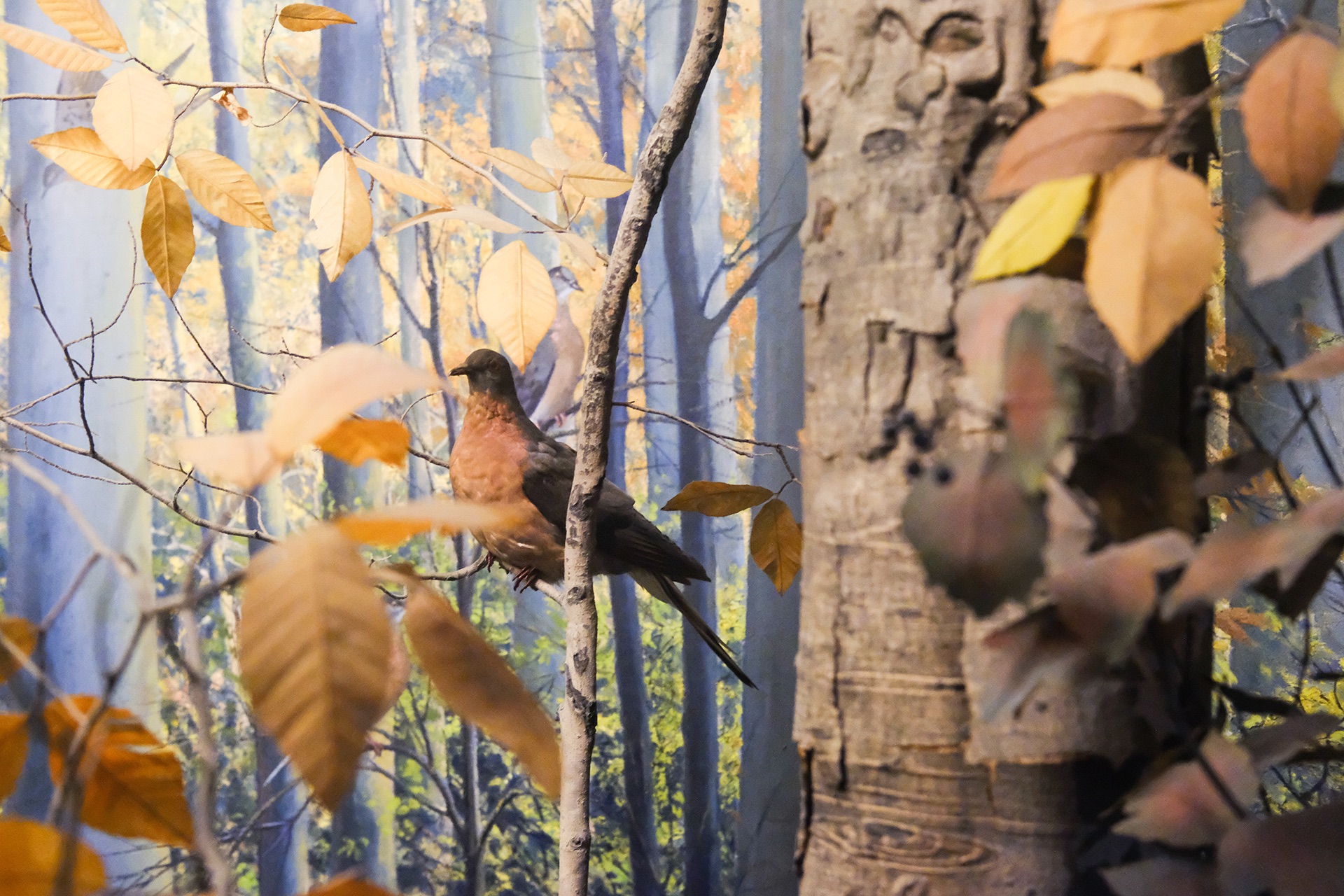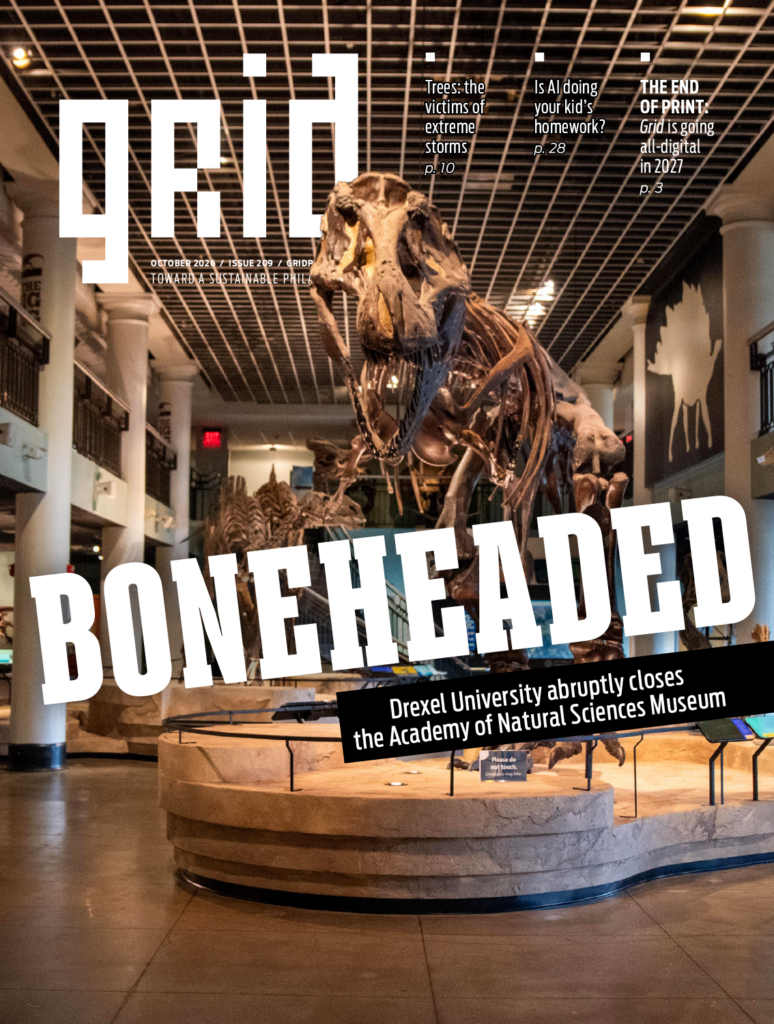
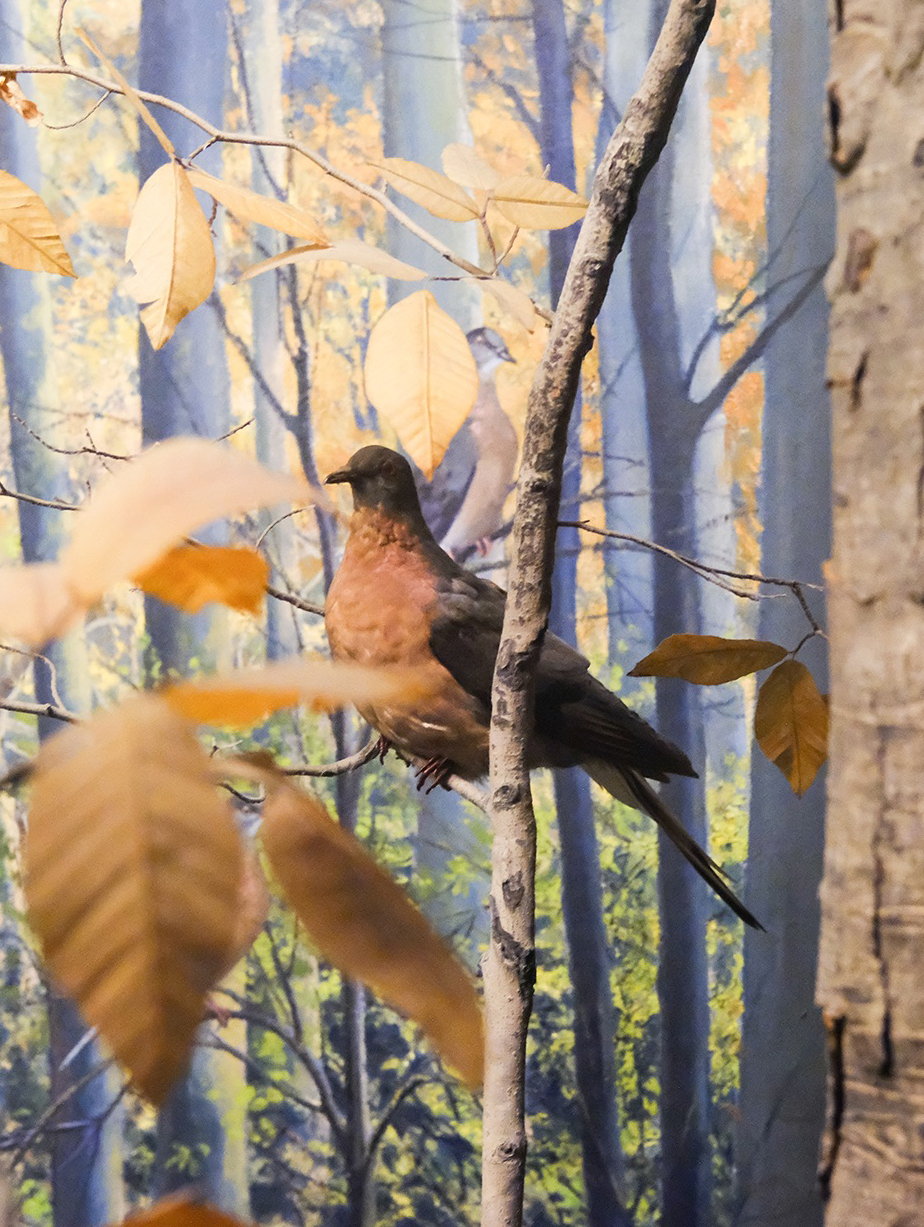
A flock of passenger pigeons rests frozen in time on the third floor of the Academy of Natural Sciences of Drexel University. The birds feed on the ground, rest on twigs and raise their wings to take to the air in a beech forest whose colonnade of gray trunks recedes into the diorama’s painted background. The mounted skeletons in Dinosaur Hall help visitors picture a T. rex treading the earth, a predator with no contemporary counterpart. The same is true of this display for the extinct passenger pigeons that once flew in the billions.
“The Pidgeons in such numbers we see fly, that like a cloud they do make dark the sky; and in such multitudes are sometimes found, as that they cover both trees and ground,” says Keith Russell, program manager for urban conservation at Audubon Mid-Atlantic, quoting early Pennsylvania settler and poet John Holme. Russell says that thanks to centuries of written accounts, as well as Philadelphia’s role as a hub for natural history exploration, “there is a longer timeline of records for Philadelphia than there is for any other place.”
Hannah Michelle Brower and Aspen Simone of Philly Pigeon Tours highlighted that connection in a special program they offered for the nation’s 250th. The tours usually focus on urban pigeons (aka rock doves), free-flying members of a domesticated Eurasian species. “We talked about the rock pigeon and the history with them, but focused more on passenger pigeons because they were native to America,” Brower says. “We talked about the whole history of early colonist records of their abundance and how people caused their decline and extinction.”
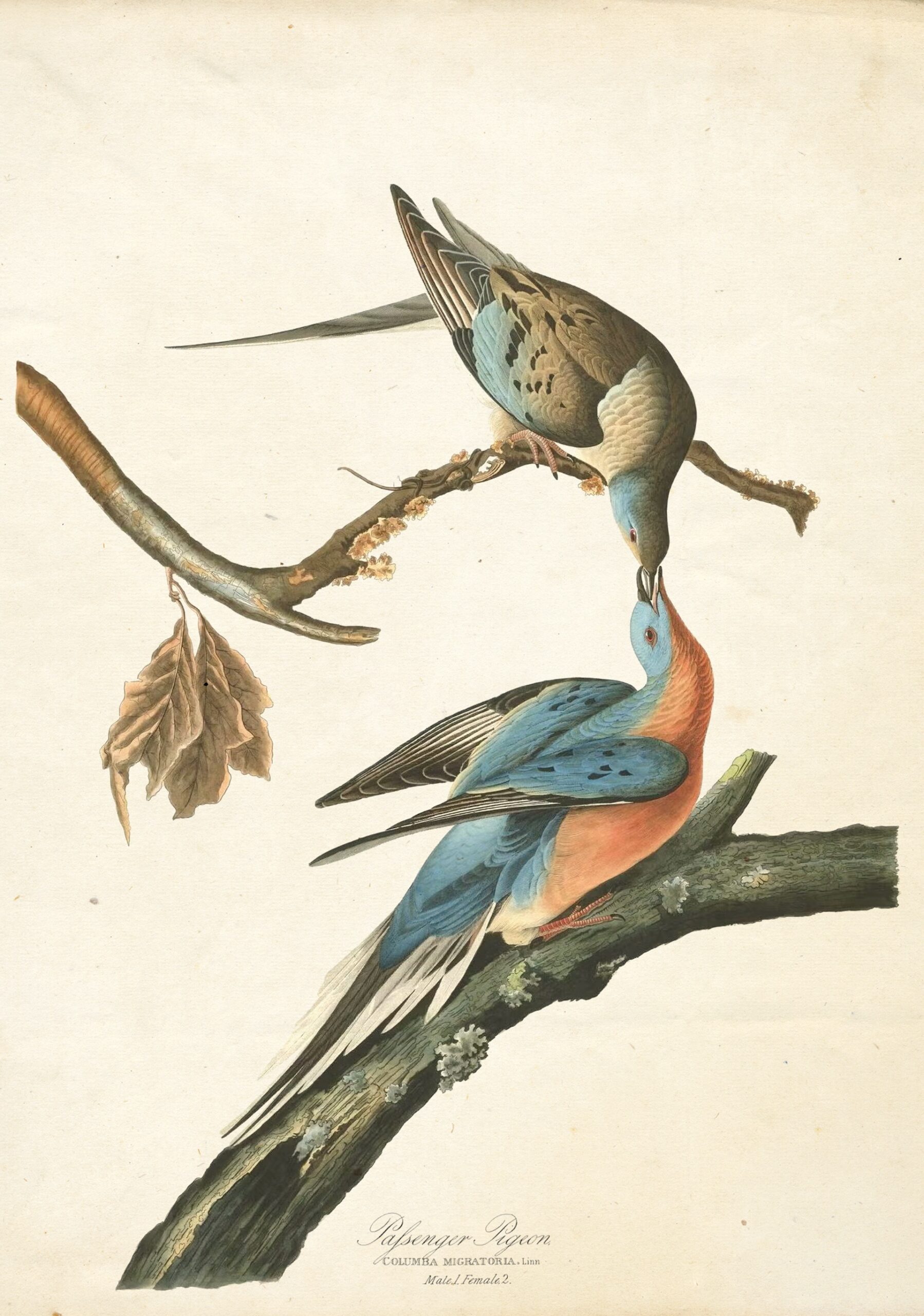
People took advantage of the abundant pigeons long before Philadelphia was founded. Peter Lindeström, who served as a military engineer with the New Sweden colony from 1654 to 1655, described the Lenape technique for catching the birds. During the day, the hunters would cut most of the way into the trunk of a large tree where the pigeons spent the night. In the evening, the weight of the returning birds would topple the tree, killing many of the pigeons, “for many cannot save themselves in such a fury of branches and leaves, nor fly away,” Lindeström writes.
In American Ornithology, Alexander Wilson describes flocks in Kentucky that have no equal today. Luckily, we have his prose to immortalize them. One that he saw, “with its glittery undulations, marked a space on the face of the heavens resembling the windings of a vast and majestic river.” Another flock flew overhead for four hours. Based on the speed and the width of the column of birds, he estimated their numbers at more than 2 billion. Another time, while inside a house, Wilson grew alarmed at a roaring wind outside and sudden darkness. He thought a tornado was coming. “The people, observing my surprise, cooly said, ‘It is only the pigeons.’”
In the early 1800s, as Wilson wrote from his base in Philadelphia, passenger pigeon flocks were not as vast in the Mid-Atlantic as they were in Kentucky. However, he writes, “they are sometimes very numerous; and great havoc is then made amongst them with the gun, the clap net, and various other implements of destruction.”
The Pidgeons in such numbers we see fly, that like a cloud they do make dark the sky; and in such multitudes are sometimes found, as that they cover both trees and ground.”
— Excerpted from “The Wild Fowl” by John Holme
Even when passenger pigeons flew far from the Delaware Valley, Philadelphians still benefited from the havoc made amongst them. “These numerous birds are found in our markets, both alive and dead, very plenty, and generally cheap in the latter part of September and October,” writes Thomas F. De Voe in his 1867 book, The Market Assistant, which catalogues the foods sold in New York, Boston and Philadelphia.
They weren’t numerous for much longer. “It would have been in the 1870s when everything was coming to an end,” Russell says. The slaughter — boosted by demand from growing cities on one hand, and innovations in communication and transportation on the other — was too much for the pigeons. As Joel Greenberg describes in his 2014 book “A Feathered River Across the Sky: The Passenger Pigeon’s Flight to Extinction,” professional market hunters would read the telegraphed reports and could hop on a train to arrive within days of a flock appearing. “Once the pros and local talent converged on the birds, the proximity of rail lines made transferral of the pigeons to larger regional and national markets easier and cheaper,” Greenberg writes.
“From the nesting grounds at Kane, PA., from three to twelve tons of pigeons were sent daily to Baltimore, Philadelphia and NewYork markets,” writes a taxidermist in Williamsport, recalling the 19th century pigeon trade in 1919’s “The Passenger Pigeon in Pennsylvania.”
Passenger pigeons, which needed to breed in large groups, couldn’t recover. “Everything collapsed, because the birds were really dependent on these mass colonies to be able to reproduce,” Russell says.
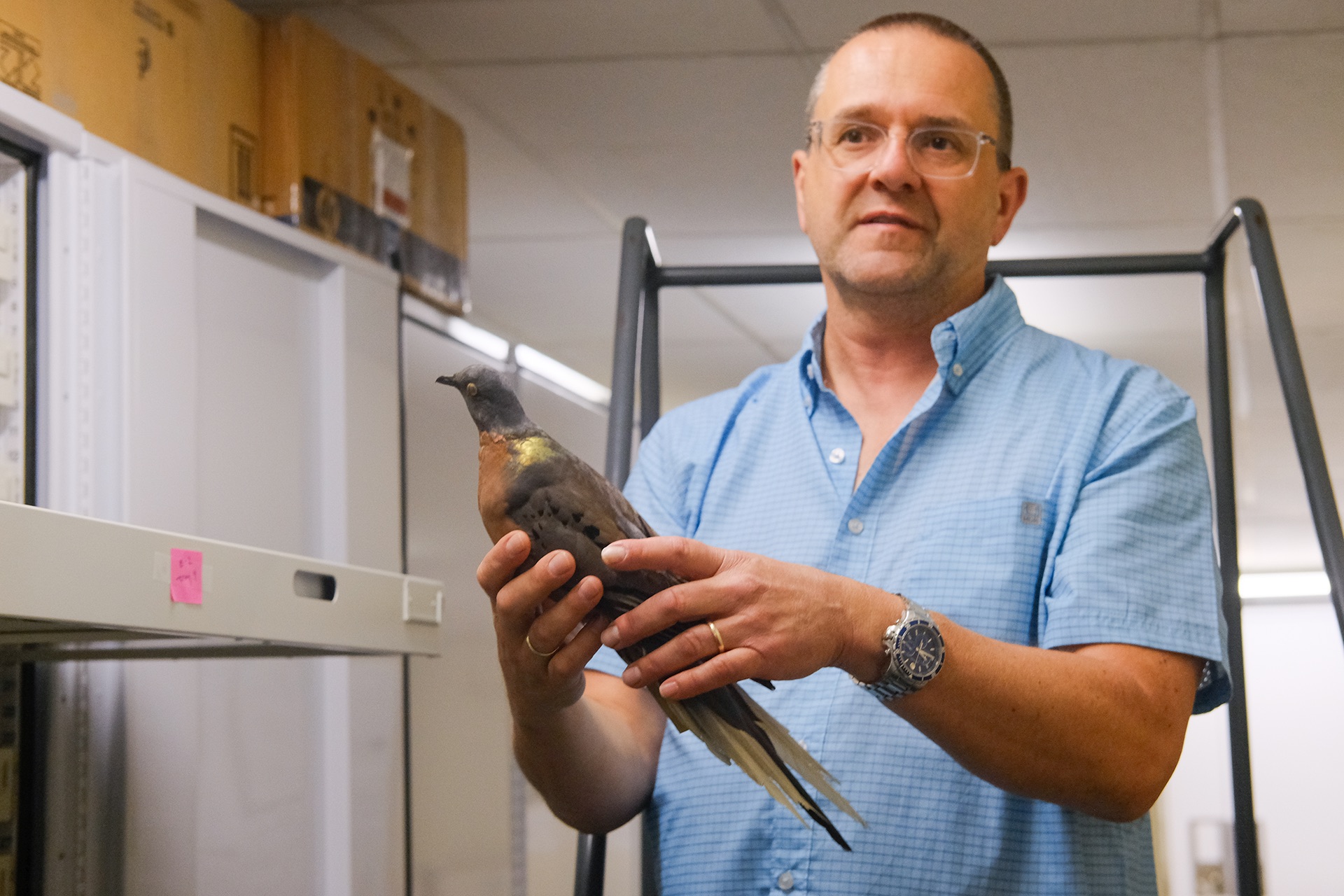
The Academy’s collection includes 38 passenger pigeons among about a quarter-million bird specimens. Ornithology collections manager Nate Rice took Grid back to the tall metal cabinets where the museum keeps specimens of endangered and extinct birds as feathered skins packed with cotton. To the left of the heath hens and to the right of the Carolina parakeets, a drawer holds passenger pigeons, gray with rose breasts. Some were collected by William Abbott from a flock that landed across the river in Haddonfield in 1877. Others came from the local markets. Rice reads from the label of one rather beat-up-looking pigeon skin, also collected by Abbott: “‘Purchased from Philadelphia market December 13th, 1877.’” Rice says, “Abbott bought it, maybe he ate it, but he also skinned it.”
The Academy’s vast collection of specimens doesn’t gather dust in drawers. Today, researchers study them using genetic analysis and other techniques that Abbott and other collectors couldn’t have imagined. “Every part of that bird’s body is built and assimilated from what it took from its local environment,” Rice says. The chemical traces in a feather can teach scientists about environmental conditions at the time the bird grew it.
But it’s not just scientists who can learn from the Academy’s passenger pigeons. The birds offer everyone a window to the past. There is nowhere on Earth today that humans can hear the roar of an approaching flock of passenger pigeons and see the light fade as they block out the sun, but the birds in the diorama offer a portal: examples to multiply by the billions in the mind’s eye. The Lenape, Lindeström, Holme, Wilson: All experienced one of the most stupendous natural phenomena North America has ever offered. As the Academy’s museum closes its doors, we lose a link to a species they never imagined could disappear.