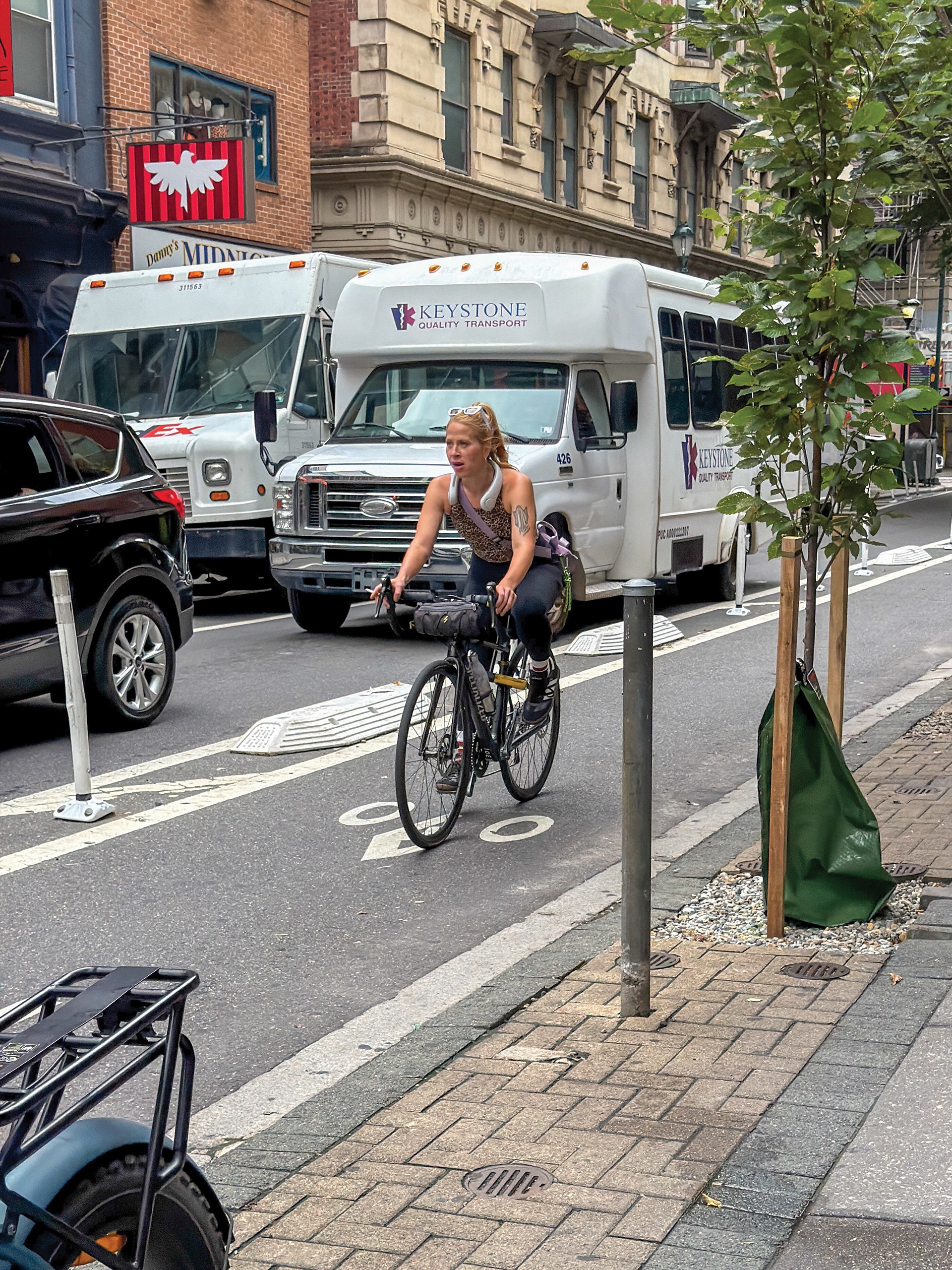
Since May, the 13th Street bike lane has sported some new protective infrastructure: a series of plastic modular curbs. Between Locust and Chestnut streets, 18 of these curbs have been installed along the bike lane, stationed between existing flex posts, which have lined many of the city’s bike lanes for years.
The new protectors were inspired by a trip to Mexico City. When Prema Katari Gupta, president and CEO of Center City District (CCD), vacationed in Mexico’s capital, she noticed bike lanes protected by small, sturdy plastic modular curbs.
“Seeing this really simple curb product they installed, it seemed like something that Philadelphia could do and scale quickly and maybe save some lives,” Gupta says.
CCD bought and donated the curbs to the City, and after working with the Office of Transportation and Infrastructure Systems and the Department of Streets, they began a pilot phase ahead of potential wider use throughout the city. With just anchor bolts required to secure them to the pavement, the curbs are easy to install, says Andrew Jacobs, the vice president of planning and public realm at CCD.
The choice of 13th Street from Locust to Chestnut was “intentional,” according to Clint Randall, CCD’s vice president of economic development. It is fully within the City’s jurisdiction, which means fewer stakeholders are involved, making the installation process faster, and it provides a microcosm of the difficulties of cycling in the city.
Seeing this really simple curb product they installed, it seemed like something that Philadelphia could do and scale quickly and maybe save some lives.”
— Prema Katari Gupta, president and CEO, Center City District
“It exemplifies everything that’s challenging about sharing the road in Philadelphia,” Randall says. “Incredibly narrow streets, not much real estate to work with, and this stretch of 13th Street in particular not only experiences roadway congestion, but also sidewalk congestion. It’s a very busy part of town with lots of competing interests.”
Local cycling and bike lane experts see the installation of the curbs as a step in the right direction.
“They are certainly the type of high-quality, protective infrastructure that Bike Action wants to see on bike lanes,” says Jacob Russell, a District 1 organizer with Philly Bike Action!. “They certainly improve safety in the couple of blocks where they exist on 13th Street. Any substantial buffer is what we want to see.”
While flex posts provide only a visual barrier between a bike lane and the rest of the street, the curbs are more likely to disrupt a car’s path and slow a vehicle, Russell says. They can help physically keep cars out of bike lanes, adds Lana Harshaw, executive director of the Bicycle Coalition — a goal the 2024 Get Out the Bike Lane Bill also aimed to achieve through the deterrent of increased fines for violators.
Both Russell and Harshaw said that while the modular curbs are an upgrade over flex posts alone, they would prefer lanes separated from traffic by concrete barriers. Harshaw sees the new curbs as a short-term solution and a “stepping stone” toward installing more protected bike lane infrastructure across the city.
A modular curb does “more to disrupt a car than a flex post, but it is not as good as a concrete barrier,” Harshaw said. “The buffer between car and bike lanes is very narrow. I think it’s a minor upgrade compared to just the flex posts, but we would prefer to see concrete over a lane separator or flex post.”