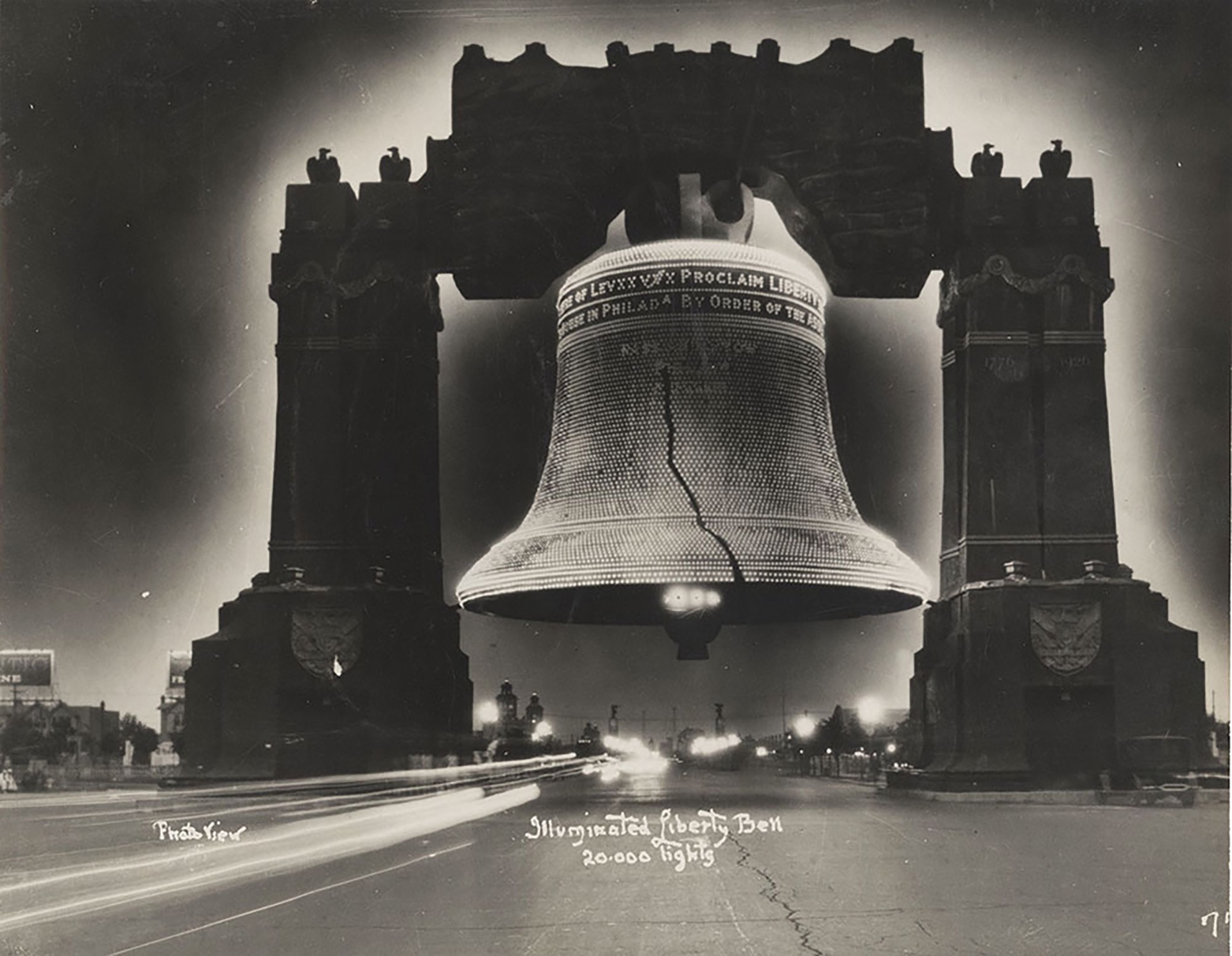
On June 5, 1926, a family of five from Iowa, the McHenrys, arrived in Philadelphia to visit the recently opened Sesquicentennial International Exhibition. John Wanamaker, who had proposed the idea 10 years earlier, envisioned the greatest world’s fair in history — an “astounding presentation of the capacity and productive power of the United States,” he wrote in The Philadelphia Inquirer — in celebration of the 150th anniversary of the signing of the Declaration of Independence. On the day of the McHenrys’ visit, the “Sesqui,” as it was colloquially called, had been open in South Philadelphia for about a week.
With a reporter from The Philadelphia Bulletin tagging along, the McHenrys breezed through the two exhibition halls, where only 5% of all pavilions had been constructed, in under 30 minutes. After that, they visited the few completed exhibits scattered across the fairgrounds — a model post office, a replica of the Washington family home in England. By early afternoon, the family had seen all there was to see.
Mr. McHenry was quoted in the Bulletin, saying:
This thing reminds me of a guy I knew in Ioway [sic]. He invited a raft of friends and family to a big birthday dinner and surprise party one time. He got so darned excited about how many he was going to have, invitations, his speech of welcome, and the program of entertainment, he plumb forgot to order any grub. When he thought of it, everybody was there, the stores closed, and he in a heck of a fix! But the fellow had a sense of humor. “Come around next birthday and we’ll have something to eat,” he said.
The underwhelmed Midwesterner’s anecdote is one of hundreds dug up from the archives and compiled by historian and Temple University professor Thomas H. Keels in his 2017 book, “Sesqui! Greed, Graft, and the Forgotten World’s Fair of 1926.” Keels’ “Sesqui” is a kind of tragicomedy of idealist ambition and chutzpah: a noble idea delayed by war, hamstrung by infighting and undermined by outside interest groups; propped up and milked for cash by corrupt politicians and their business cronies; shoddily thrown together months behind schedule; and finally, soon after the gates closed, bulldozed and forgotten.
The numbers reflect the chaos of the event. By opening day, less than a third of all buildings had been completed, note E. L. Austin and Odell Hauser in the fair’s official record, published in 1929. According to the Encyclopedia of Greater Philadelphia, it rained on 104 of the 187 days the fair was open to the public, and by closing day, only 4.5 million of a predicted 30 million visitors had actually bought tickets. When all the fun was over, the Sesqui owed creditors a total of $5,098,172. (Keels’ own estimated total losses, in today’s dollars, is close to $400 million.) A 1926 New York Times headline put it bluntly: “Philadelphia Fair Never Had Chance.”
Fairs have existed since antiquity, for as long as people have been buying and selling goods and traveling from place to place. World’s fairs, on the other hand, are relatively new.
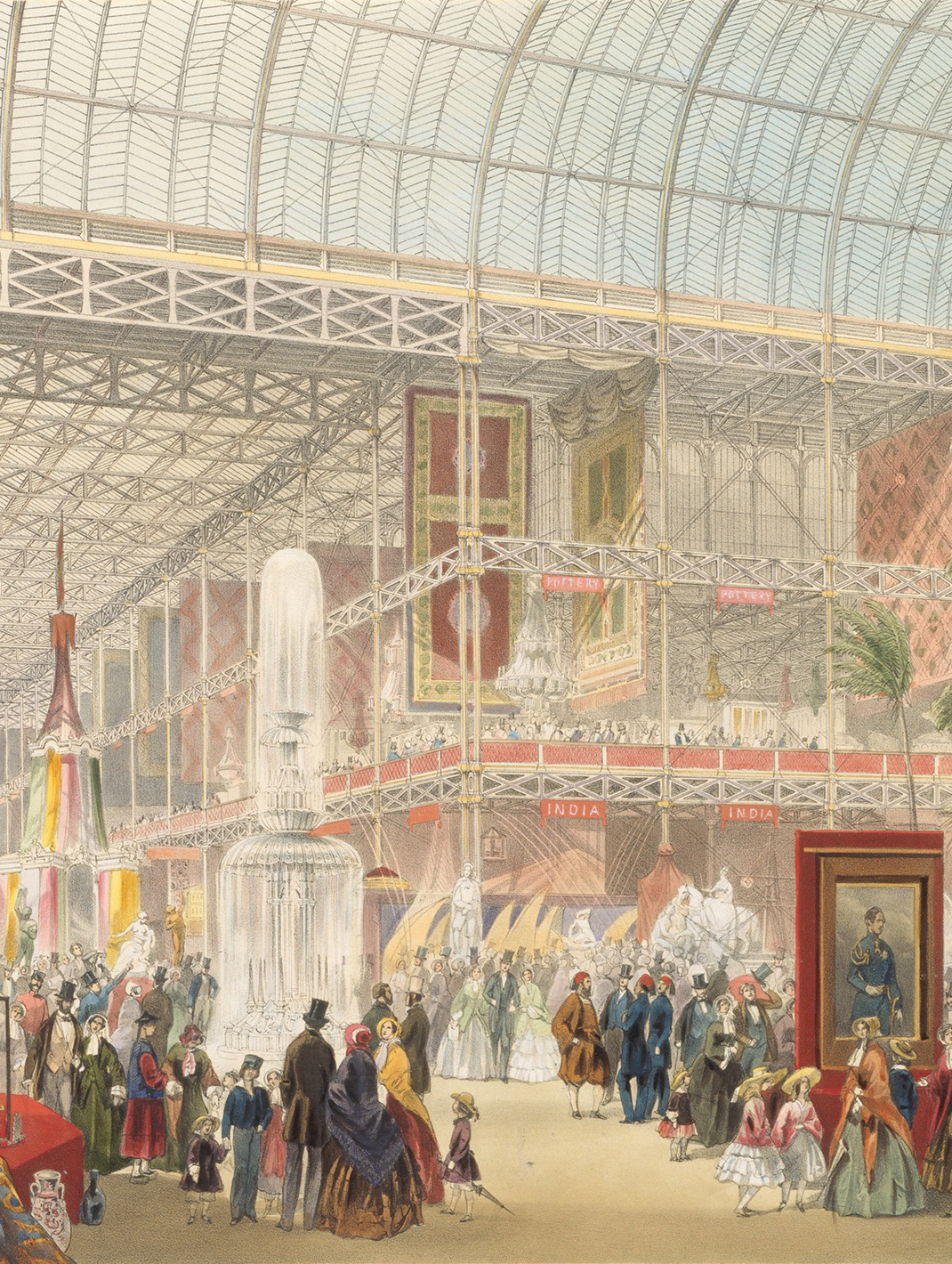
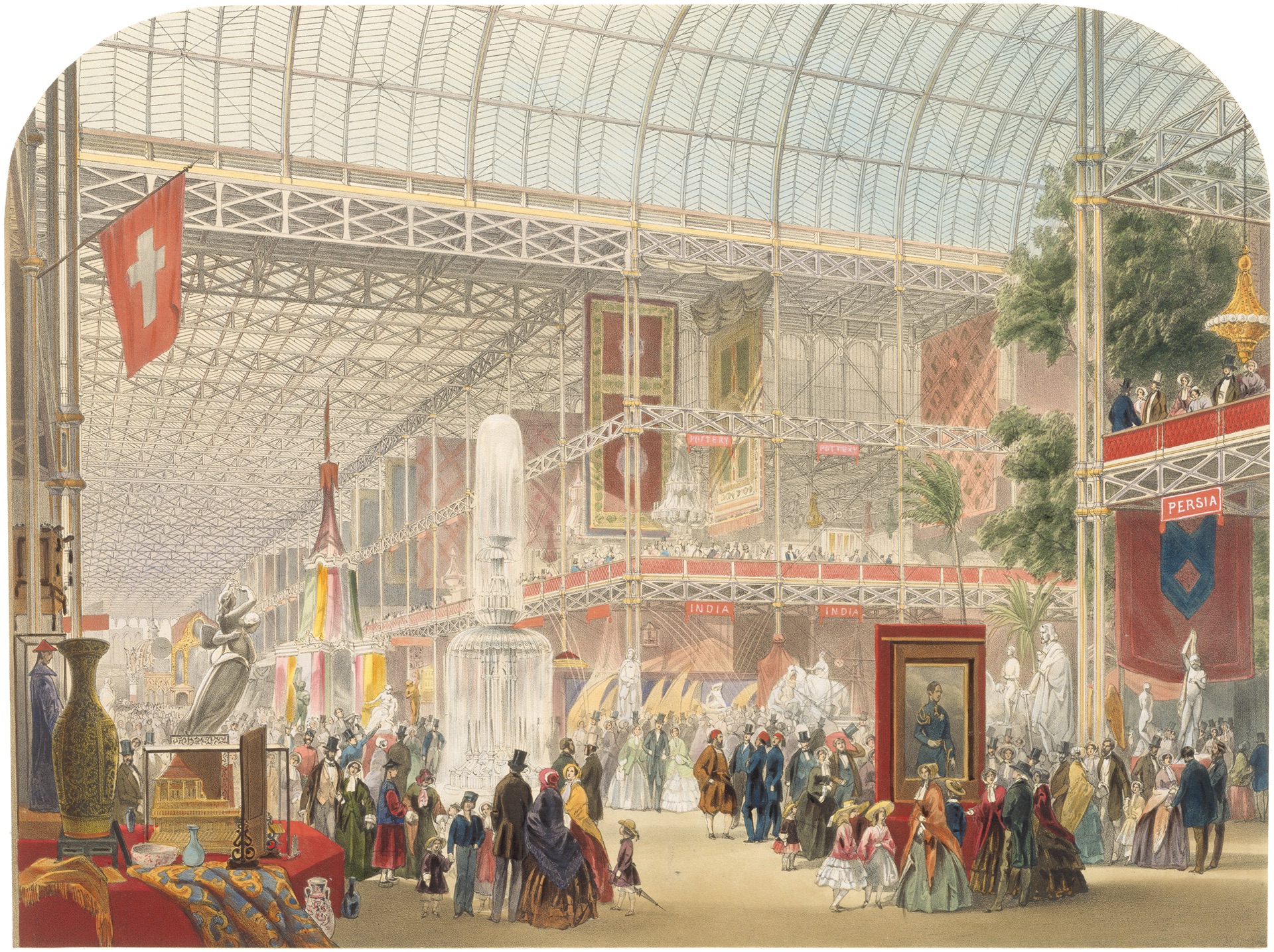
The “Great Exhibition” of 1851 in London’s Hyde Park was the first of its size, international reach and cultural importance. From June to December, some 100,000 objects from 44 countries and colonies were put on display for 6 million visitors, equivalent to one-third of Britain’s population at the time, according to The Gazette, the U.K.’s official public record.
“It is a wonderful place,” Charlotte Brontë wrote in a letter to her father. “Vast, strange, new and impossible to describe. Its grandeur does not consist in one thing, but in the unique assemblage of all things.”
More valuable than its 186,000 pounds in profits — about 20 million pounds today, or $27 million — was the narrative that the fair successfully pushed to the public, one in which Britain’s technological and cultural supremacy dwarfed the rest of the world and justified its imperial ambitions. According to historian Sylvi Johansen, the Great Exhibition sold the general public on the destiny and logic of industry at a time when large-scale industrial production was still rather novel. “The show was therefore rhetorical and argumentative in intention,” she writes in an article in Victorian Review. It was never “a neutral documentation of the state of Britain. It intended to persuade.”
Soon after the Great Exhibition closed its gates, the world quickly realized that these kinds of spectacles could change attitudes and shape discourse. Hundreds of fairs followed.
By 1920, much of Europe was busy reckoning with the uncomfortable idea that industrialization and progress could also lead to novel, large-scale and extremely efficient ways to kill and destroy. But fairs and exhibitions did not die with the war. At home, after a four-year pause, Wanamaker led Philadelphia civic and business leaders in support of a reimagined Sesquicentennial celebration in the spirit of postwar international amity.
Over the next five years, competing factions within the Sesqui-Centennial Exhibition Association (SCEA) — the Sesqui’s official governing body — argued over how, when and where the fair would take place. With Wanamaker’s death in 1922, the SCEA lost its most spirited advocate and best fundraiser. By early 1925, with a bit over a year to go before opening day, they had yet to decide on a location.
Not long after W. Freeland Kendrick was elected mayor, the Sesqui was officially moved from the Benjamin Franklin Parkway, Fairmount Park and the banks of the Schuylkill River to the swampy flats of South Philadelphia — an act widely understood as blatant political patronage. The New York Times, for example, derided the move, calling it “a giant real estate scheme” to line the pockets of the machine bosses who helped win Kendrick the mayor’s office.
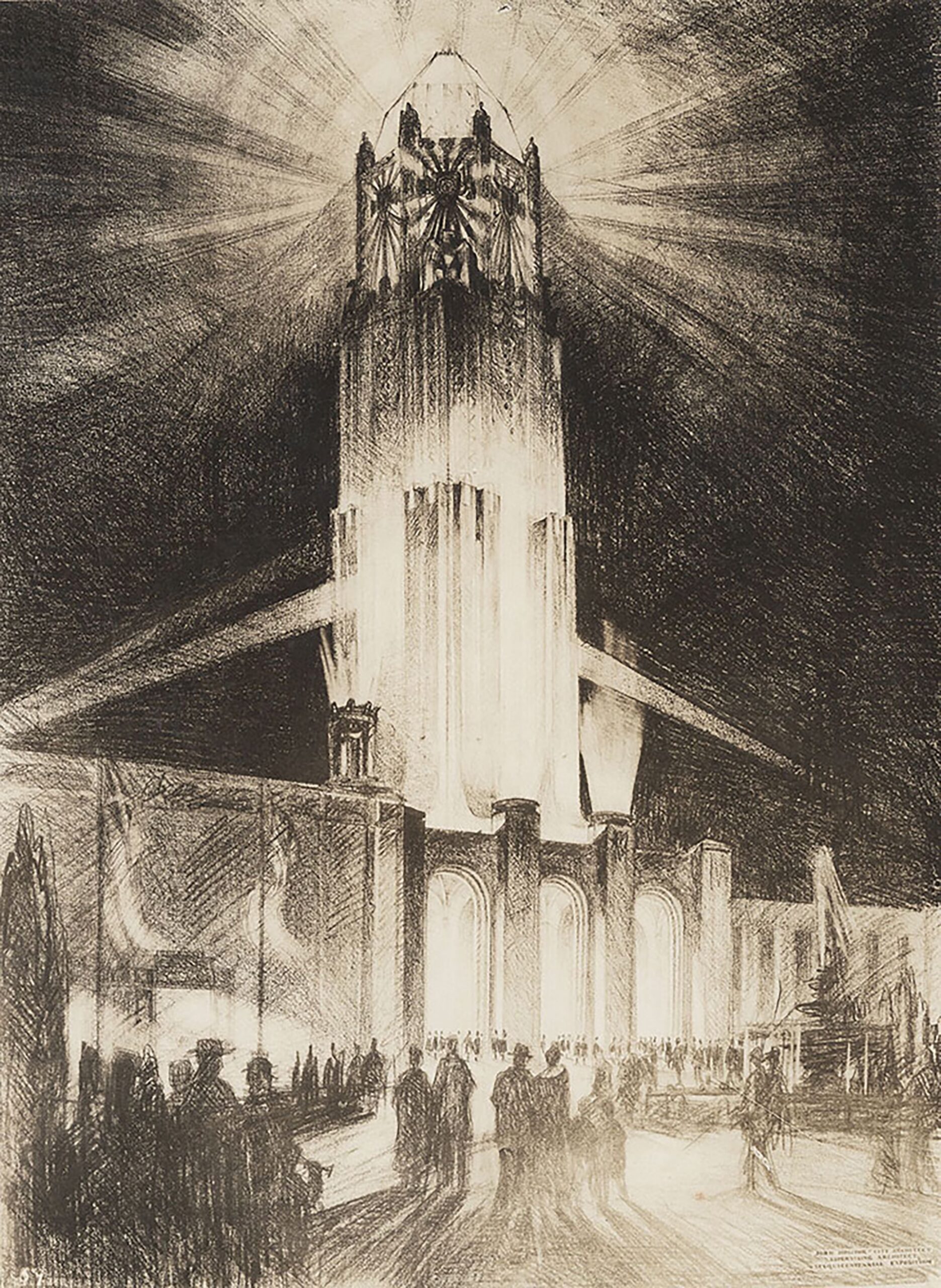
After five years of false starts, the Sesqui’s architects and designers were suddenly faced with the impossible task of building halls, structures, monuments and fairgrounds that were grand and spectacular enough to dazzle visitors, yet cheap and spare enough to build on a squeezed construction timeline. Final plans still called for two hangar-sized main halls, a 100,000-seat stadium and 10,000-seat auditorium, several smaller exhibition palaces and administrative buildings, a colonnaded Forum of the Founders, manicured gardens and lakes, aviation fields, public transit infrastructure and parking lots. In the very center, a Tower of Light would be built “of such searing intensity,” wrote a Philadelphia Bulletin reporter, “that it would instantly ruin any human eye accidentally touched by it at close range and would burn the skin far worse than any tropical sun.” Kendrick, refusing to postpone the Sesqui, gave everyone just over a year.
By early 1926, there was little evidence that the site would soon host upwards of 30 million visitors. Keels illustrates this well: “Aside from the half-finished Stadium, the Sesqui grounds were a barren plain, interrupted by gaping foundations for the main structures and mounds of landfill trucked in to bolster the waterlogged soil.”
And yet, in an “almost miraculous achievement by engineering staffs,” as then-former Mayor Kendrick wrote in his 1929 brief forward to the official record, most of the Sesqui’s buildings, monuments and attractions were completed and open to the public by July 4. In the Palace of Liberal Arts and Sciences, visitors encountered a celebration of all things new and available for purchase. Austin and Hauser, waxing a bit poetic, list some of these items:
machines making women’s silk hosiery; furniture in the making; caskets that would make King Tut envious; the giant “loud speaker” of the ill-fated dirigible Shenandoah, wrecked near Columbus, Ohio, September 1, 1925; a reproduction of “Tom Thumb,” the first American built locomotive; an electric safety razor; bathrooms de luxe; a statue of the modern ice man carrying a cooling coil instead of a cake of ice…
Many of the items on display were couched in allusions to the past. According to the official record, the Monroe Calculating Machine Company exhibited a contemporary office furnished with “all the appliances of today” alongside a reproduction of an office and its wares from 1776. The Underwood Typewriter Company looked back even further. Its latest portable typewriter was the final of seven stages of “writing history,” beginning with the Stone Age. One company exhibited its goods in a “log cabin, the typical home of the early settlers and pioneers of this country,” to “emphasize the fact that the medical preparations of Dr. David Jayne have been used in America for more than a century.”
Across the 250-foot colonnaded Forum, the Palace of Agriculture and Foreign Exhibits housed the latest innovations in agribusiness and processed foods alongside art and artifacts from 17 foreign countries. The Battle Creek Food Company’s booth, in the words of Austin and Hauser, featured “one hundred varieties of health foods such as crackers and biscuits, beverages, cereal foods, confections, diabetic and reducing foods, laxative foods, marmalades, nut butters, vegetable meats, malted nuts, vegetable gelatine, fruits, and vegetables.” One of the foreign exhibits from Tunis, then a French protectorate, was the “quaint booth of Allala Belhadj Bey,” where “exotic perfumes” were on display alongside “preparations for whitening the teeth and reddening the gums and lips, brightening the eyes, hair dyes, musical instruments, wooden shoes, jewelry and charms.”
Up Broad Street stood the Palace of United States Government, Transportation, and Military, filled with planes, trains, trucks and tanks alongside pulleys, pistons and valves. Outside, the pavilions of a few foreign nations and six U.S. states were located between the lakes and footpaths of what is today Franklin Delano Roosevelt Park. A Palace of Fine Arts displayed some 12,000 works, including about a hundred of “the finest Rodins,” according to the record. Most of the art on display was traditional and representational. (For reference, Cubism was nearly 20 years old by 1926.) The Palace of Education and Social Economy seemed, according to Keels, “bathed in a nostalgic haze, as if the mass slaughter of 1914-1918 had never occurred. Inside the palace, the early twentieth-century Progressive vision of a steady and earnest march toward human perfection was still an engaging reality.” Nostalgia, of course, is one of the most soothing of soporifics.
Gertrude Stein, in a book on Picasso, discusses the artist’s anticipation of the truths of modern living later made conscious by World War I. People are always the same, she says, but everything surrounding people — buildings and the natural world, modes of transportation and communication — these things all change, and Picasso saw this. With every passing generation, “a change, a complete change, has come about, people no longer think as they were thinking but no one knows it, no one recognizes it, no one really knows it but the creators,” she writes. “War is a means of publicising the things already accomplished.”
If Stein is right that great art reveals what is known but has never been articulated, then the inverse can be said of the Sesqui: Perhaps it failed because by the time the gates were opened, the truths revealed by World War I had become common knowledge, and the fair’s planners and participants instead chose to ignore them. Even if you can’t fully articulate the way things are now, you can still know, intuitively, that what you’re looking at is not it.
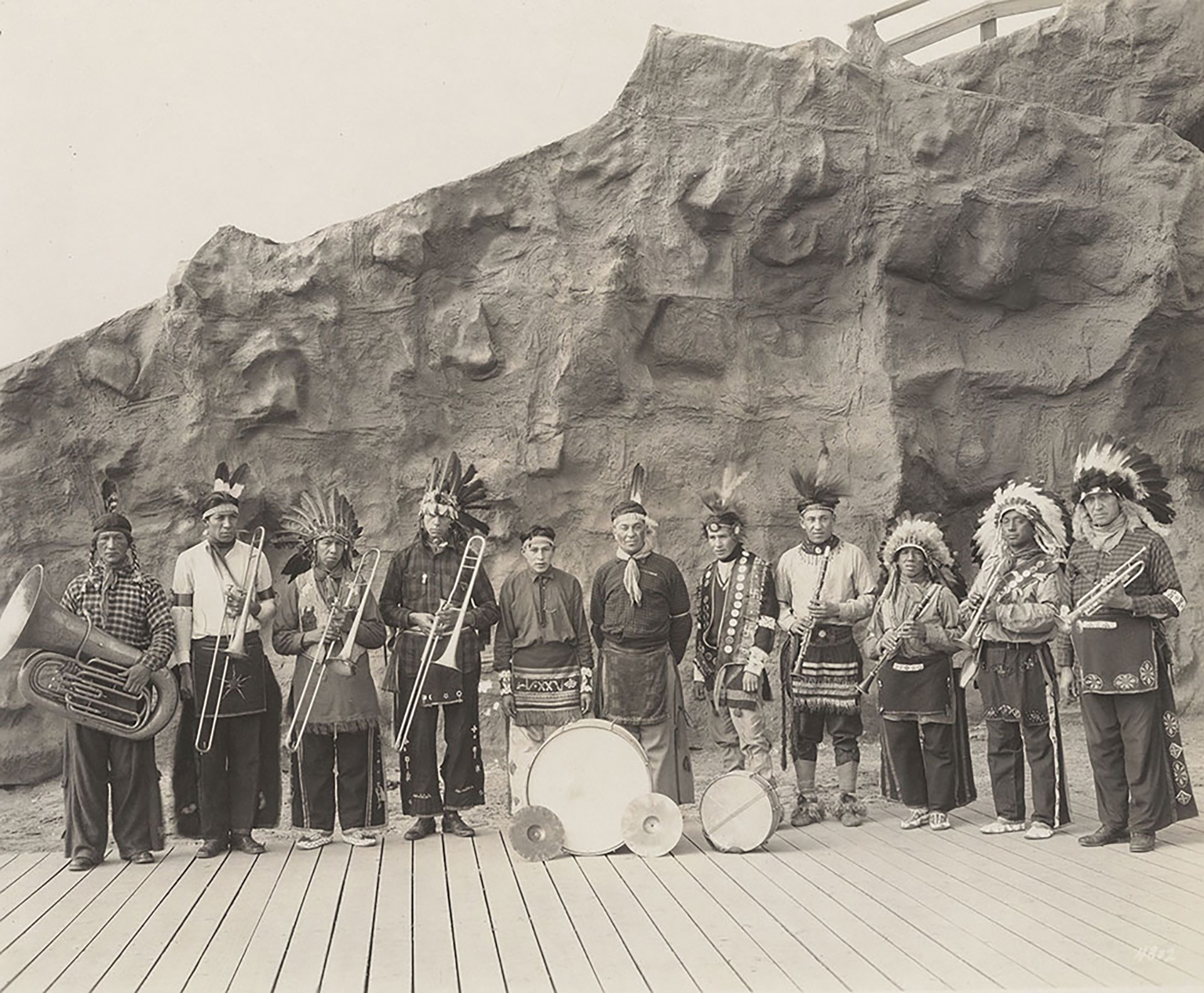
The Sesqui closed its doors on Nov. 30, 1926. By the early ‘30s, nearly all of the fair’s exhibition halls and buildings, besides the Stadium and a few smaller structures, were torn down.
Now, 100 years later, Philadelphia is gearing up for its Semiquincentennial summer. There will be new museum exhibits, parades, concerts and a “Rocky Fest,” among other events. The MLB All-Star Game and FIFA World Cup matches, held in stadiums built on the former fairgrounds, will attract sold-out crowds. The “Semi” is everything the Sesqui wasn’t: The choices are safe, the costs low. It uses mostly existing infrastructure. If it fails, it will do so quietly.
It might be a stretch to say that the humiliation of the Sesqui lingers in Philadelphia’s collective memory like a traumatic event — long repressed and plunged into the city’s subconscious, it nonetheless still affects behavior and character, for better or for worse. It could explain the skepticism many still feel towards grand and ambitious projects, why your average Philadelphian always checks twice for grift or corruption in the shadows of big promises — the nixed Center City 76ers arena and the forever-delayed Roosevelt Boulevard subway extension being just two more recent examples. But the Sesqui would never fail today, because it would never happen at all. There is something lost when ambition and imagination always lose out to cold pragmatism. Messy failures, at the very least, are interesting.
Kendrick, for one, was glad the Sesqui happened. He concludes his forward to the record thus: “To the many it has brought imperishable memories of colorful events and delightful associations. These memories persist and gradually obliterate the recollections of the difficulties, as is the way with humankind.”