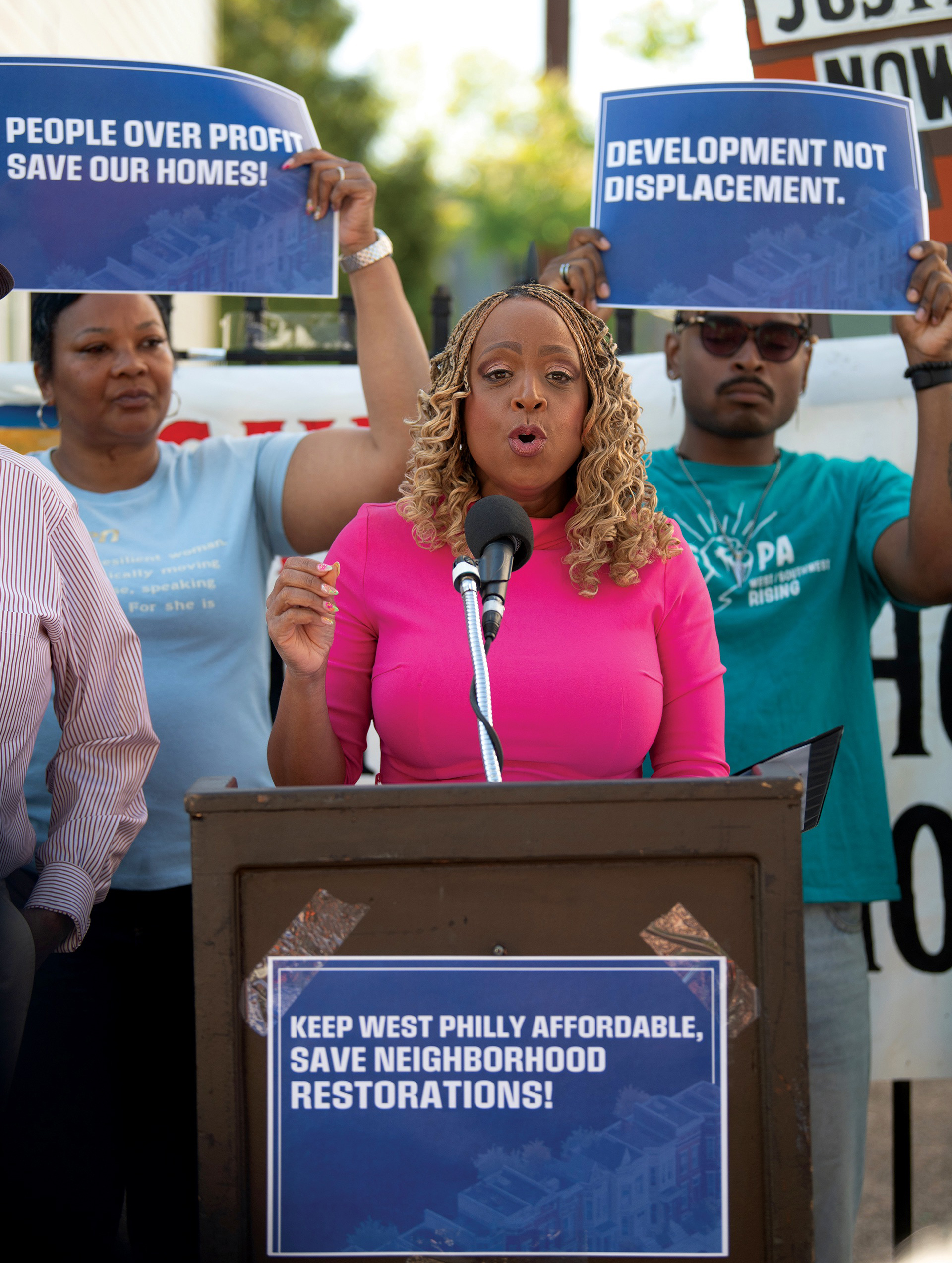
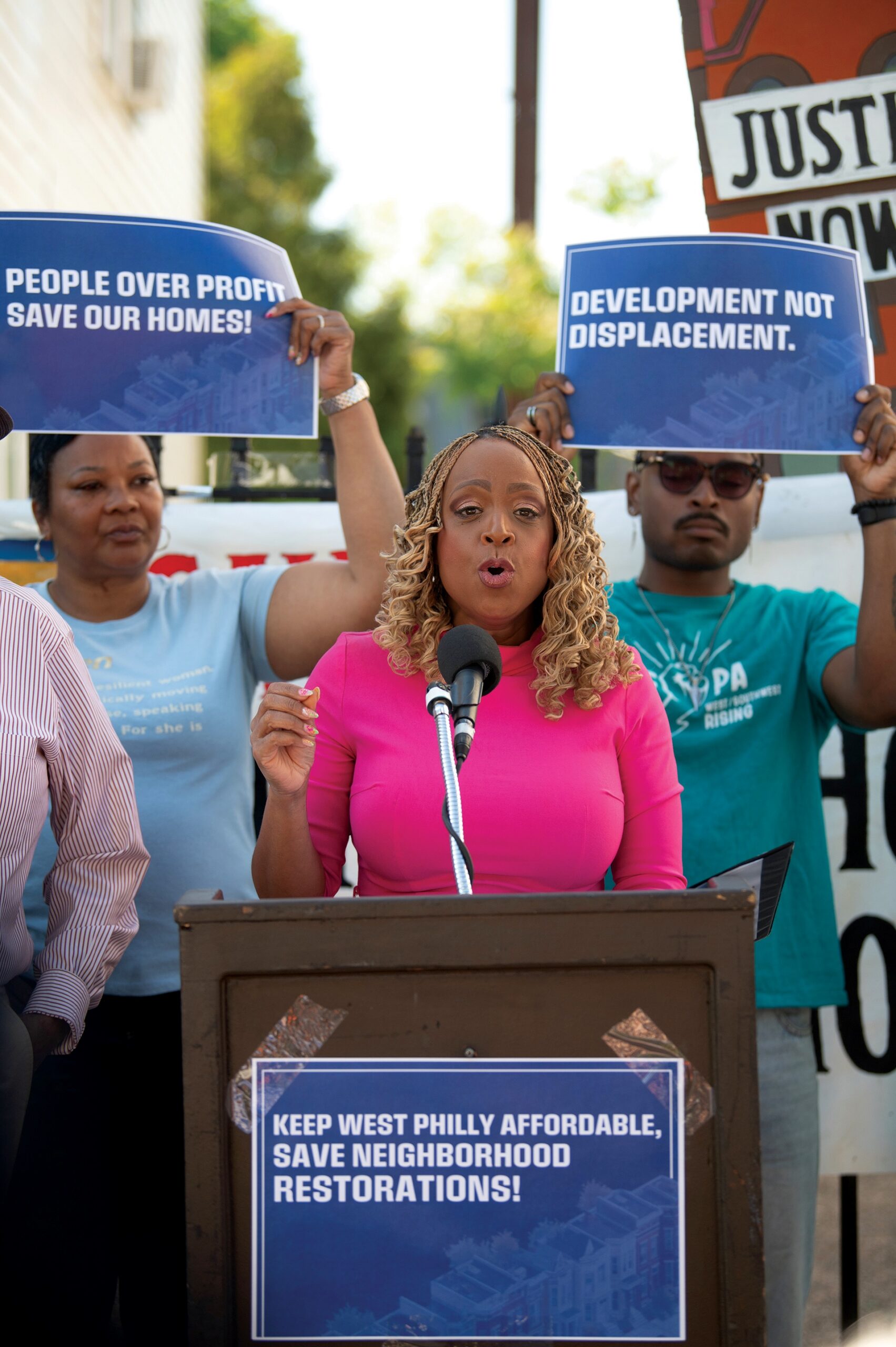
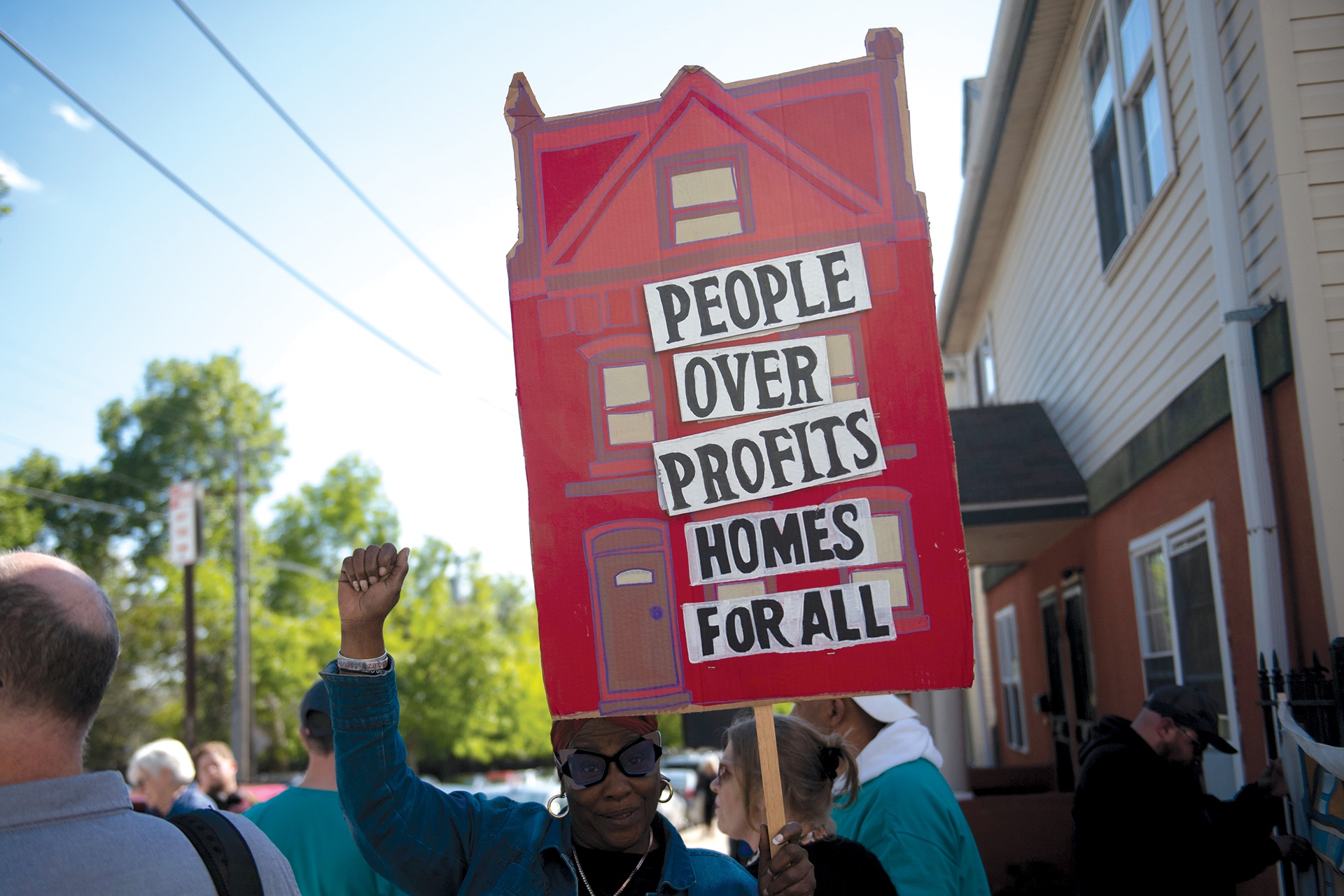
When a crowd comprised of more than 60 renters, homeowners, organizers and representatives gathered on May 7 in Southwest Philadelphia’s Kingsessing neighborhood, they had one message: “The renters united will never be defeated.”
Led by One PA, a statewide community organizing group, the rally was the latest move in the ongoing effort to secure 925 affordable rental units managed by Neighborhood Restorations, a private developer. The units, spread across West and Southwest Philadelphia, were cast into the spotlight last July when Neighborhood Restorations released a letter announcing its intentions to sell the properties as a single portfolio in the near future.
Such a sale could result in major displacement for the approximately 3,000 people who call Neighborhood Restorations properties home, according to Councilmember Jamie Gauthier, who represents Philadelphia’s Third District, where most of the units are located.
“These are long-term tenants that are very rooted in their communities,” says Gauthier. “This is about people who have been contributors to their blocks, to their communities, asking their city, asking their government to help them from being displaced and having their lives shattered.”
Gauthier and One PA are advocating for the City of Philadelphia to purchase the portfolio with the goal of making the properties permanently affordable.
“We need [the City] to be able to say, ‘We will purchase the 925 units that will make this city affordable,’” Neighborhood Restorations resident Carlos Booth said at the event, which came after months of mobilization and organizing.
The Neighborhood Restorations portfolio differs from much of Philadelphia’s affordable housing in that the units are mostly single-family rowhomes and duplexes integrated into city blocks.
“I had never heard of [Neighborhood Restorations] until this happened,” says Eric Braxton, project director for One PA West/Southwest Rising, a local chapter. “But I now know that many of my neighbors — people that I’ve worked with in the community for a long time — live in these properties.”
Following the letter’s release, members of One PA West/Southwest Rising, representatives from Gauthier’s office and volunteers from other community advocacy organizations went door to door informing tenants of the impending change to their housing situation.
“Only about half the tenants we spoke to actually got the letter, and nobody understood what it said,” Braxton recalls.
Christie Davis, who has been a resident of a Neighborhood Restorations home for 21 years, was one of those confused tenants.
“You had to be a rocket scientist to figure out the terms and the different codes that were used,” says Davis, adding that she “didn’t think anything of it” until approached by a One PA representative.
“I was like, ‘Why would this stranger come knock at my door and give me this message about the home that I’ve been living in for 21 years?’” says Davis. “So I stuck in there with One PA, and I went to the meetings, and the eyes just got wider and wider into what really is going on.”
The Neighborhood Restorations properties were developed using federal low-income housing tax credits as part of a push to encourage private development through time-restricted tax incentives, according to WHYY News.
“All of these low-income housing tax credits get started in the ‘80s, and most of them had 30-year expiration dates, so guess what? They’re all expiring,” Braxton explains.
The Neighborhood Restorations properties account for approximately 12% of the affordable housing in Philadelphia that have subsidies set to expire within the next decade, according to Gauthier. Some of them have already expired, but Neighborhood Restorations has chosen to keep them affordable. There is no guarantee, however, that rents of these properties wouldn’t be raised to market value if they were sold to a different developer, making them inaccessible to most current residents.
The influx of subsidy expirations comes in conjunction with a significant rise in property prices. Many of the Neighborhood Restorations properties are in rapidly gentrifying parts of the city where prices have gone up “by hundreds of percents,” according to Gauthier.
Booth, who lives in a Neighborhood Restorations-managed apartment building for older adults, worries about what would happen if it were sold to a developer. “This building would present a developer or a speculator with a gold mine,” he says. “They really know that they can get market value for rent here, and that would really displace a lot of seniors and elders.”
While the median income in Philadelphia has risen only 7% since 2000, the median home value rose 120%, according to a March report from The Philadelphia Coalition for Affordable Communities.
“Gentrification and displacement is not just some ideological talking point: it is happening in West and Southwest Philadelphia,” Gauthier says. “We need to use the resources available to us to make sure that people aren’t displaced from the communities that they’ve stewarded and called home for decades.”
Davis, who grew up in West Philadelphia, recognizes that change in the neighborhood is inevitable, but hopes it doesn’t have to come at the expense of the long-term residents.
“This is where I grew up,” she says. “This is all that I know. This community is changing. It’s changing right before my very eyes, and it can be for the good, if we’re also included in the change.”
Just over a mile from the rally, a fenced-off vacant lot at 39th and Market streets exemplifies the ongoing process of displacement in West Philadelphia. The block was occupied by the University City Townhomes, a 70-unit complex constructed to provide affordable housing for largely Black and working-class residents who were displaced when the City demolished homes in the 1960s and ‘70s to build a science and technology campus, WHYY News reported.
The complex made headlines in 2021 when the property management company announced that it would not be renewing the site’s affordable housing contract. After a protracted legal process, those residents were relocated and the structures demolished on the condition that a half-acre of the property would go to the City to serve as the future site of 70 permanently affordable units.
Responding to the University City Townhomes demolition, Gauthier worked with the City to pass the People’s Preservation Package, which requires owners of government-subsidized affordable housing to give a year’s notice to tenants and the City before putting properties up for sale. Hypothetically, the City could use this time to secure funding through the Housing Opportunities Made Easy (H.O.M.E.) initiative, designed to enable the City to purchase more housing for low-income residents.
“By the time we found out what was happening [with University City Townhomes], it was too late,” Braxton reflects. “What we hope is different this time is that we had time for the community to come together and for elected officials to come together and build a plan.”
The City has until early July to make an offer on the Neighbor Restorations properties.
Neighborhood Restorations owner Jim Levin told WHYY News that his first choice would be to sell to the City so the properties can remain affordable.
“I want to be clear that if the City doesn’t come to the table with the H.O.M.E. initiative, then we probably can’t do this,” Gauthier says. “Parker and her administration need to look people in the eye and say, ‘Why do we do H.O.M.E.? If we’re just going to let 3,000 people get displaced from some of the most gentrifying neighborhoods in the city, what was this all for?’”
Jamila Davis, communications supervisor for the City’s Department of Planning and Development, commented that there are “no current plans” to work with the H.O.M.E. team, adding in a written statement that the City is “collaboratively working with [the Local Initiatives Support Corporation] and other housing leaders … to come up with various scenarios.”
A mayoral spokesperson did not respond to Grid’s request for comment.
To Christie Davis and many other Neighborhood Restorations residents, the only option is to continue organizing with the hope that the City comes to the table.
“It feels good going to City Hall and meeting with these politicians and sitting with them and bringing this awareness to them,” Davis says. “I’m in it for the long haul to see what we can do to save these properties.”