Most birders have a “spark bird,” the species that ignited their passion for nature. Visual artist Deirdre Murphy, whose work blends scientific data with bird observations, has a “spark ornithologist.”
Murphy credits John James Audubon, who revolutionized the field of ornithology with his detailed illustrations, as an early source of inspiration. “He’s my spark for giving myself permission to delve into art and science through ornithology,” she says.
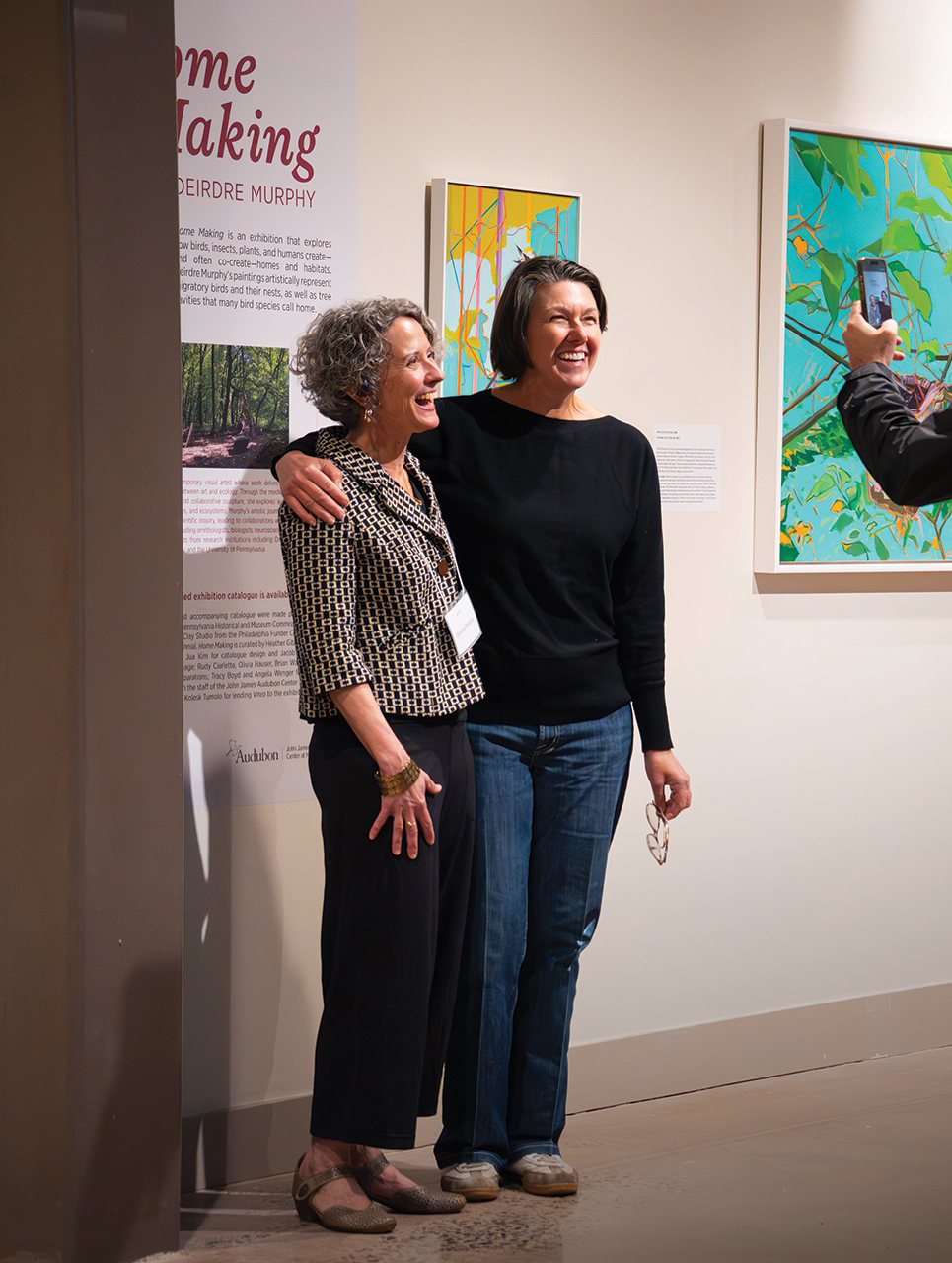
Considering Audubon’s influence on Murphy’s artistic journey, it’s fitting that her work is now on display at Montgomery County’s John James Audubon Center at Mill Grove. Titled “Home Making” as an homage to bird nesting practices, the exhibition sits on the very land where Audubon first honed his craft.
“This Audubon Center is unique because it’s sited on the place where one of the foremost figures in the history of ornithological art lived,” Heather Moqtaderi, senior coordinator of museum and collections for the National Audubon Society, explains. “So we have a unique confluence of art and bird studies as part of our interpretation.”
When Moqtaderi needed a lead artist for the spring-summer art exhibition series at the Center, she instantly thought of Murphy.
“Deirdre’s art has this wonderful balance of artistic expression and emotive feeling conveyed through color and design paired with accuracy in interpreting bird biology,” Moqtaderi says.
Steps from a display of one of the few complete volumes of Audubon’s celebrated book, “The Birds of America, visitors to the center can view Home Making’s centerpiece, “Trill for Tomorrow,” commissioned by the National Audubon Society. The painting features a golden-winged warbler, its beak open wide in territorial alarm, set against a map tracing its 800-mile migration from South America up the Eastern Seaboard.
Knowing that she wanted to represent data reflecting the bird’s journey, Murphy incorporated colors used by scientists modeling migration routes. “With each painting, I like to take a color problem to try and riddle or solve.”
Like the brilliant feathers of the tanagers and warblers that congregate in the woods surrounding the center, the dynamic jewel tones in Murphy’s painting draw the eye, while the bird itself, depicted “sounding the alarm,” encourages conversation about environmental conservation.
“My work’s about art and climate change, so I always feel like, by making beautiful paintings and prints, that will kind of lure the viewer in with honey,” Murphy says. “Then, when they hopefully sit with the work enough … they’re like, ‘how might I change my behavior, change our human behavior so that we can better help all species?’”
Adjacent to the visitor center, the three-story 1762 farmhouse where Audubon lived from 1803 to 1806 serves as a secondary gallery space featuring “Field Notes: Learning to See,” a collaborative three-dimensional installation by Murphy and sculptor Yvonne Love. Alongside antique egg collections and ephemera from Audubon’s time at the property, “Field Notes” highlights a pivot toward conservation-based bird appreciation, inspired by birdwatching checklists maintained by Love’s father and stepmother.
For a year, the two artists exchanged the checklists, painting, cutting and sewing into the canvases on which they were printed. “The only rule was that there’s no rules,” Murphy says of the collaborative process. “It was just really freeing to work with [Love].”
Coming on the heels of 2025’s “State of the Birds” report, which indicated that more than one-third of American bird species are of “high or moderate conservation concern,” there is an emphasis on conservation across the four spring-summer exhibitions, each of which explores the relationships between birds and humans, considering our shared fates amid ecological upheaval.
“I think there’s a sense of sadness about climate change and environmental degradation, but also a hopefulness,” Moqtaderi observes.
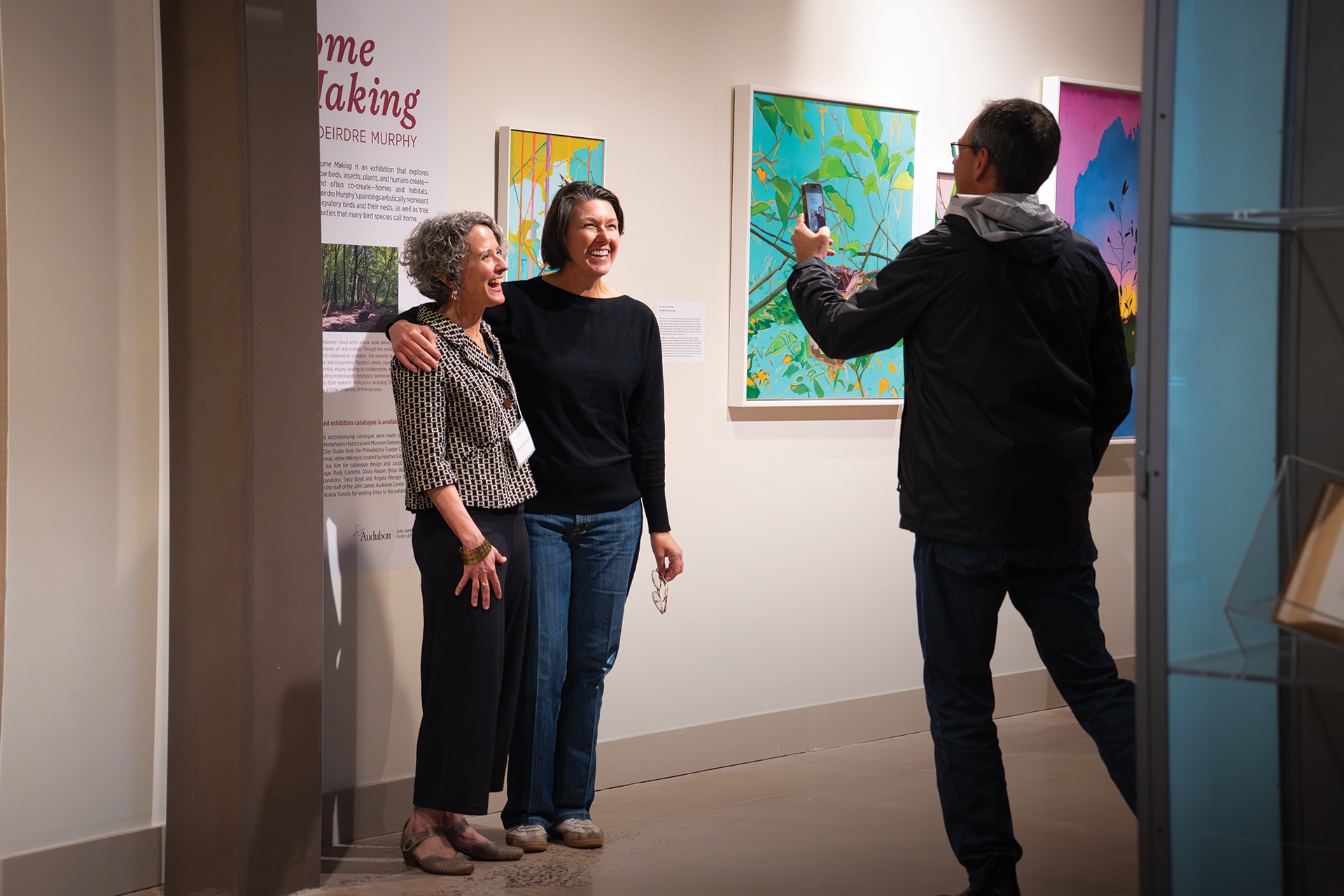
The exhibitions are on display at the Audubon Center at Mill Grove through August 16.