While Philadelphia Mayor Cherelle Parker’s ambitious Housing Opportunities Made Easy initiative (H.O.M.E.) sets out to close the city’s affordable housing gap, some area nonprofits have begun working against an unintended consequence they foresee: the illegal act of short dumping demolition waste, often in known dumping hotspots in Black and Brown neighborhoods.
The community “collaboratory” Trash Academy is one such group that has devised a proposal for how to manage the construction and demolition waste produced by the proposed 30,000 homes that Parker has committed to.
Trash Academy proposes that H.O.M.E. contracts require contractors to prove that they have brought demolition waste to a recycling center or repurposing facility in order to receive funding and count as one of the 30,000 builds. The group also wants oversight from the mayor’s office to ensure compliance by developers.
“[The proposal]’s not setting anything new up. It’s just saying use the recycling facilities … to ensure that it’s not dumped somewhere random or just everything sent to the incinerator,” says Dallas Herbert Sr., a longtime member of Trash Academy and 215 People’s Alliance. “This is something the City already wants to do — everything we say is about clean and green. It’s about safety. It’s about what the mayor says she wants.”
Herbert’s initial frustration with short dumping occurred when he encountered a pile of garbage in the middle of the street, causing him to drive his Cadillac up an off-road dirt hill. He became a passionate crusader against illegal dumping citywide after learning the scale of the problem — “They’ll be on people’s corners. They’ll be in parks. They’ll be in neighborhoods. They’ll be behind people’s houses,” he says of legacy dump sites. “This is not clean and green like [Parker] wants. So we fighting to make it that way.”
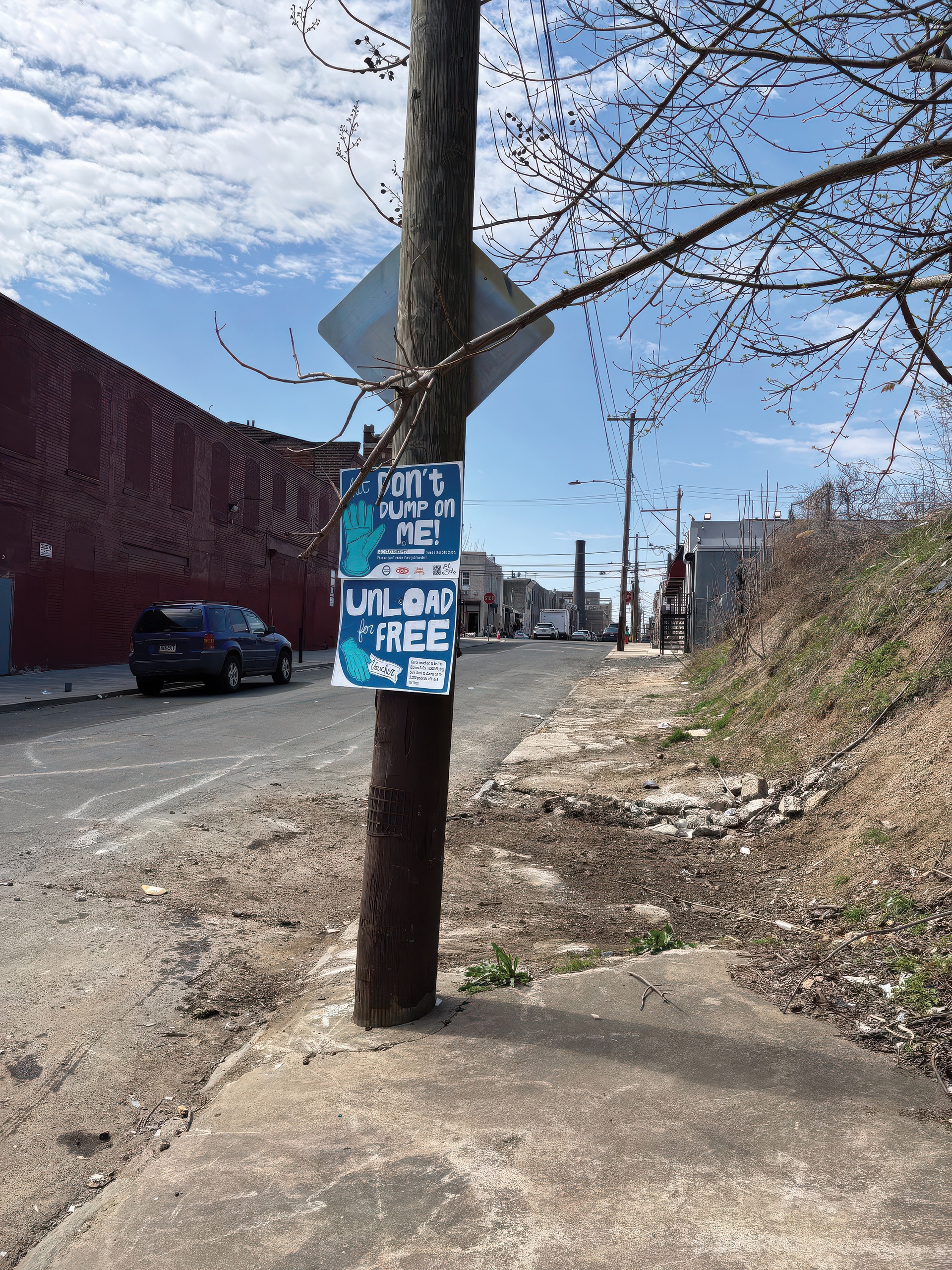
The idea is similar to a voucher program run by North10, a community development nonprofit based in Hunting Park and East Tioga and a member of a nonprofit coalition that also includes Trash Academy. The program is a partnership between North10 and Burns & Co. Waste Recycling Center in North Philadelphia. Would-be illegal dumpers can dispose of up to $120 worth of materials (one ton) for free. Between its launch last October and this June, 85 vouchers had been distributed, accounting for 215,000 pounds of waste dropped at Burns rather than on the street or elsewhere, according to North10’s Chief of Staff Avarisse Crawford.
Crawford says the organization has found that when some of the load cost is paid by the voucher, dumpers will pay for the remaining balance out of pocket.
“Once people have an incentive, they will actually pay the difference themselves. They just have that incentive to get in the door and make that change,” Crawford says. “We have provided $10,000 in vouchers. … People spent an additional — out of their own pocket — $4,250. It’s not that people can’t afford to pay.”
The to-date success of the voucher program shows that dumping behavior can change. And Herbert, who is a retired and experienced construction worker, says that there are established channels to divert materials from being left on street corners or sent to burn in the incinerator in nearby Delaware County.
“I know that if somebody goes in to tear down several houses, and if they send a crew in to take down all the Sheetrock and put it in one container, those materials can be recycled,” Herbert says. “That takes a little time — I understand. And it takes a little expense, ‘cause you’re training somebody to do that. But if you do, that material can be recycled and used again instead of only one time.”
“As long as they do that, they’ll have no problem with the City,” he says. “But if they can’t show, it looks like they illegally dumped the material, now we got a problem.”
To move the proposal forward, Herbert says Trash Academy members have been meeting with members of City Council and hope for a supermajority passage of a bill that establishes the recommended guidelines as City rules. Herbert says they have yet to meet with Parker directly, although he says he had a strong relationship with her through 215 People’s Alliance when she was a councilmember.
A presentation prepared by Trash Academy recalls the construction boom associated with then-Mayor John Street’s tax abatement in the early 2000s, which resulted in a parallel surge of illegally dumped construction materials. The City’s 2019 Litter Index Report, which measured the scale of litter and dumping on Philadelphia’s blocks, found that construction debris was present on more than half of heavily littered blocks, the most commonly reported type of litter. Trash Academy also reports that a year of the city’s construction waste could fill a 40-story cube the size of City Hall.
“Any time that there’s development, there should be … a community benefit that happens with business and with development,” Crawford says. “We don’t want the benefit of the city to come at our detriment.”