
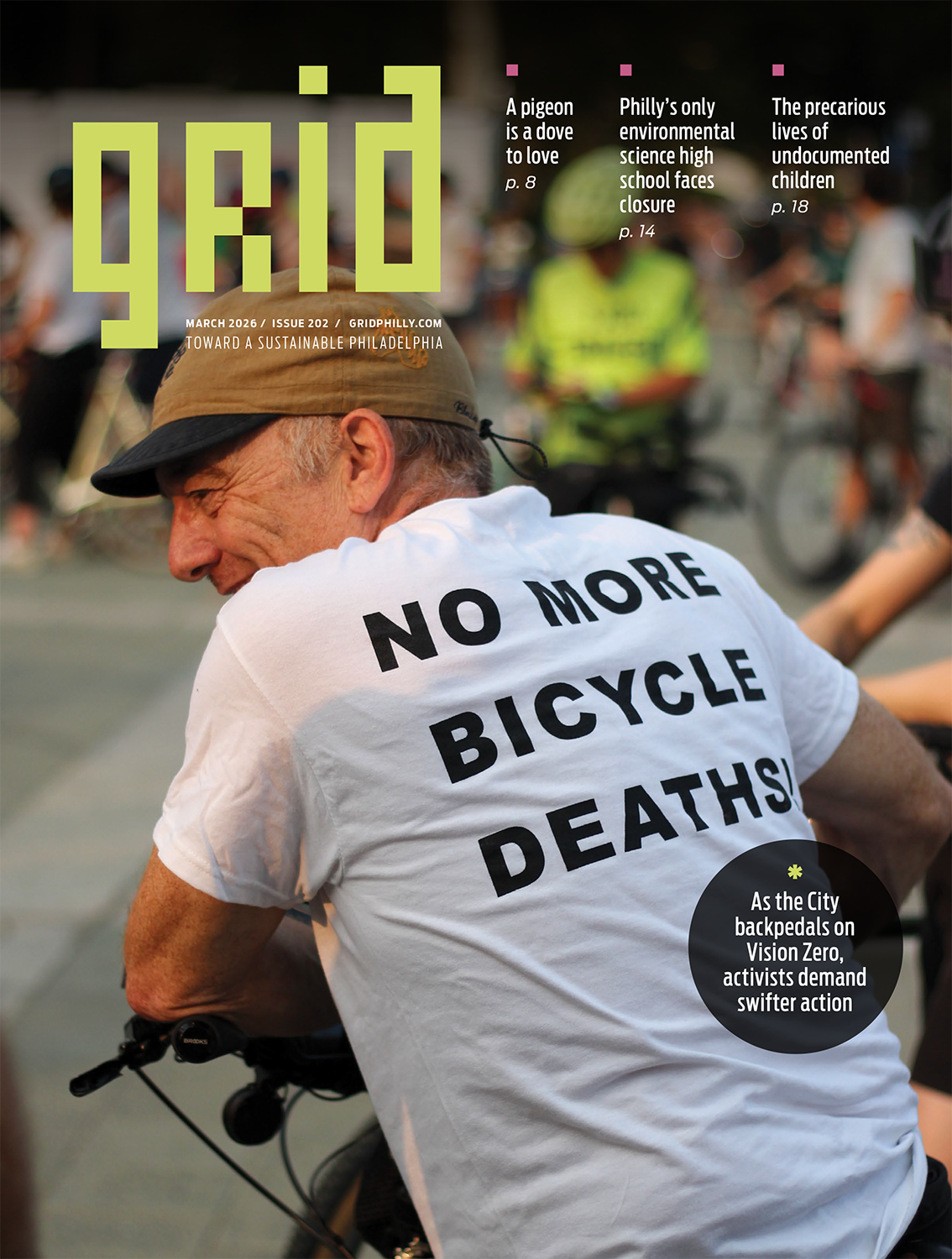
By all accounts, 67-year-old Harry Fenton was a model of safe cycling.
He used hand signals when he was turning and stopped at every stop sign and red light, even when there wasn’t a car anywhere in sight. To be visible, he wore fluorescent jackets, vests and shirts, and he never left the house without his helmet or fully-charged lights. He found routes that felt safe and then stuck to them.
Fenton, in other words, did everything right. But he couldn’t prevent what happened to him on the morning of Sept. 2 while he was riding his bike in Fairmount Park. At the intersection of Belmont Avenue and Avenue of the Republic, a speeding driver struck him and fled. Fenton was taken to a hospital, where he was pronounced dead, making him the fourth cyclist killed in Philadelphia last year, and the eighth person killed in a crash on Belmont Avenue in the past six years.
Belmont Avenue has been part of Philadelphia’s “High Injury Network” — the 12% of roads that are responsible for 80% of the city’s total fatal and serious road injuries — for years. So why have the dangerous conditions there remained unaddressed? The answer is linked to the nearly decade-long history of Vision Zero, the City’s safe streets initiative.
Mayor Jim Kenney launched Vision Zero in November 2016 with a goal of eliminating traffic deaths by 2030. That year, 99 people were killed in crashes. Fatalities fluctuated but remained below 99 for the next three years. But in 2020, after the pandemic started, they surged — not just in Philadelphia, but around the country.
“What happened was just a huge increase in some of the most dangerous types of traffic behavior: speeding, aggressive driving, red light running,” says Vision Zero program manager Marco Gorini. “It just erased a lot of the gains that we had been making. Unfortunately, even though traffic patterns kind of stabilized and lockdowns ended, that change in behavior has proven a lot stickier than we would have hoped.”
As of 2025, the trend is showing signs of declining nationally, and the impact is being felt locally. According to the Bicycle Coalition of Greater Philadelphia, Philadelphia traffic deaths dropped about 16% between 2024 and 2025, from 120 to 100, based on preliminary data — making 2025 the least deadly year since 2019. That coincided with a number of important victories for safe streets advocates this past year. In the spring, City Council voted unanimously to implement automated speed cameras in school zones citywide. In the fall, the Automated Speed Enforcement camera program — which has resulted in a 95% drop in speeding violations and a nearly 50% drop in pedestrian-involved crashes since it first launched on Roosevelt Boulevard in 2020 — expanded to the entirety of Broad Street and a short section of Old York Road. Last year also saw the fifth neighborhood slow zone completed since the initiative’s launch in 2018 to reduce speeding on residential streets.
Yet Philadelphia still has one of the highest traffic death rates among big cities in the U.S. And traffic fatalities were nearly 3.5 times higher in 2024 than the City had projected in 2018. The City is so far behind on its Vision Zero goals, in fact, that in 2024 Mayor Cherelle Parker moved the target of zero traffic fatalities back 20 years — from 2030 to 2050. “Vision Zero is working,” says Jessie Amadio, an organizer with Philly Bike Action!. “There’s just a lot of dangerous roads in Philadelphia, and we aren’t addressing them fast enough.”
Part of the issue, Amadio says, is funding. After pressure from safe streets advocacy organizations, including Philly Bike Action!, Parker designated a record $5 million in City funds for Vision Zero in fiscal year 2026. But Amadio says the City needs to spend more. “Even at $5 million per year, Philadelphia is just spending about $3.22 per resident. In New York, they spend $32.38,” Amadio says. “Philly and New York aren’t operating with the same tax base, but there’s a clear difference in prioritization and spending.”
The consequences of that relative funding deficit, Amadio says, are apparent in the progress of the Neighborhood Bikeways program. It’s intended to give communities the opportunity to co-design safety measures such as painted bike lanes and sharrows on streets where a high-quality bike lane might not be appropriate. According to a 2017 three-year action plan for Vision Zero, the City had intended to have two neighborhood bikeways completed in roughly two years. But the program didn’t launch until 2023, and while the design progress for bikeways in Germantown, Strawberry Mansion and Fishtown has begun, no bikeways have started construction.
The City has not identified funding for bikeways in Fishtown or Germantown, according to an email from Sharon Gallagher, the senior director of communications for the Managing Director’s Office. In Strawberry Mansion, she says, “the City is working with the neighborhood to address them rather than identify specific bikeways at this time.”
Additional state or federal grant money is necessary to complete 13 of the City’s action items for the next four years, including: restriping every mile of the High Injury Network at least once, closing at least five gaps in the network of safe bicycle corridors, and constructing one new slow zone each year, according to the latest report. Gorini, the Vision Zero manager, says the City is working on a capital plan to identify exactly how much money is needed to meet the mayor’s goal of programming safety improvements on every mile of the High Injury Network by 2030. “We’re trying to set ourselves up so that as funding opportunities become available, we have projects ready to go,” Gorini says.
According to Gorini, projects that focus on community engagement — like producing behavioral safety ad campaigns — will require “at least $1.5 million” in additional funding, which Gorini believes the City is likely to be able to fund through grants. “A lot of the infrastructure, on the other hand, is more of a reach,” Gorini says.
Amadio, for one, believes that the City should not stake the lives of its residents on the possibility of grant funding and that there’s room for the City to spend more. “If they actually are taking the goal of Vision Zero seriously, they’re going to have to start thinking in bigger numbers than $5 million,” she says.
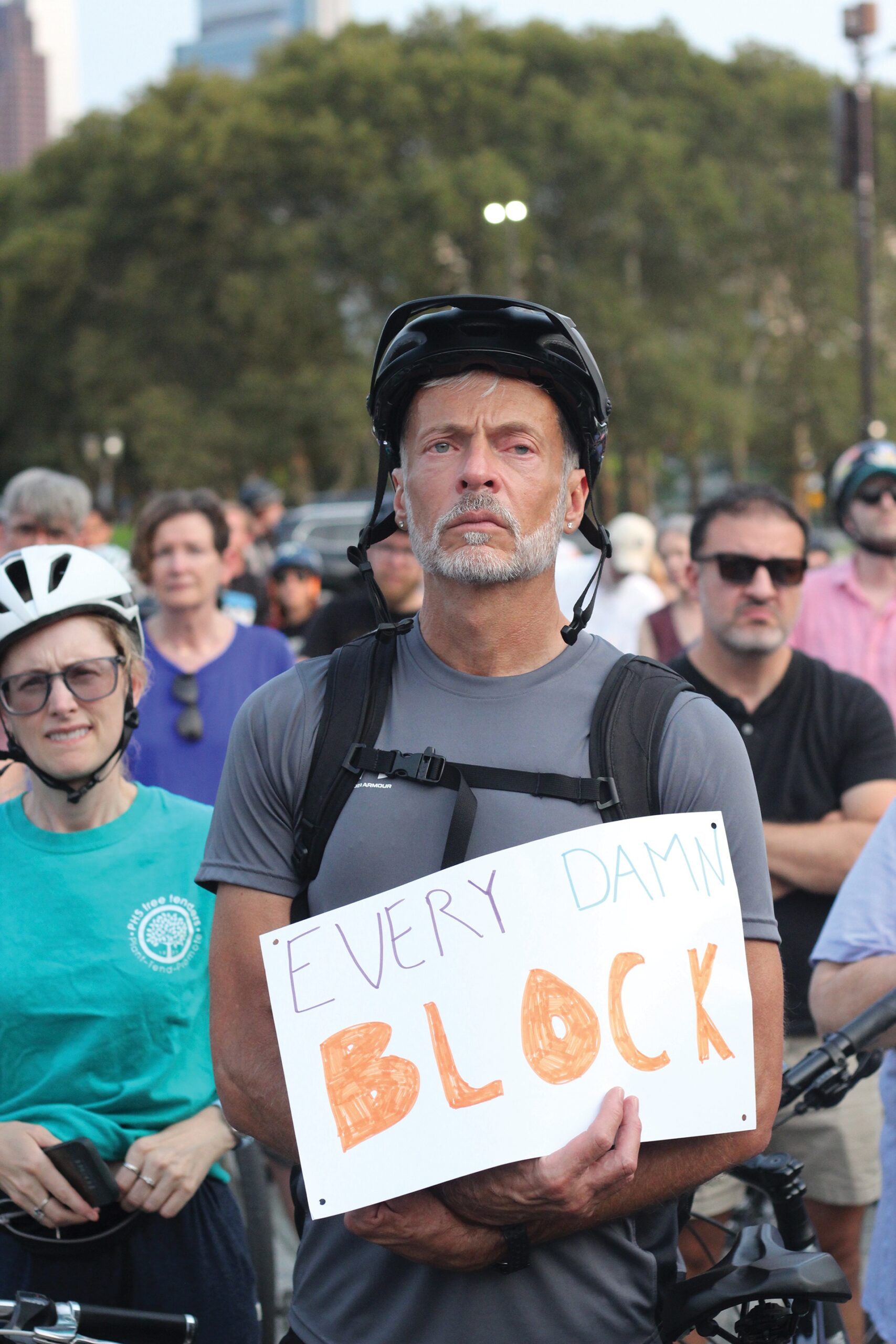
Funding is not the only impediment to safer streets in Philadelphia. There’s also political inertia, says Laura Fredricks. She would know: She has been advocating for safer streets in the city since her 24-year-old daughter Emily Fredricks was killed in 2017 by a sanitation truck driver while cycling to work in Center City. “Emily was on a road with a bike lane. It was not protected,” she says. “We know that paint’s not protection.”
Some of these fixes are so obvious and could have easily been implemented years ago.”
— Ruth Ann Fenton
In 2019, Fredricks and her husband started the advocacy group Families for Safe Streets Greater Philadelphia, and every year since, she’s made an annual trip to Harrisburg to advocate for legislation to legalize parking-protected bike lanes on state roads, to no avail. “I feel the pace of change is terribly slow. Every year that goes by, there are more people that are seriously injured and killed,” she says. “I don’t know how we make things happen faster.”
In 2020, PennDOT permitted a pilot program to demonstrate parking-protected bike lanes on a set number of state roads in Philadelphia, and the City installed them on Market Street, John F. Kennedy Boulevard, Race Street and the Chestnut Street Bridge. The lanes were a resounding success: according to the City, the project led to a 20% decrease in crashes. But the City reached the pilot’s limit, and while it has asked PennDOT to expand it, Gorini doesn’t think that there seems to be an “appetite” for doing so. Krys Johnson, a safety press officer at PennDOT, told Grid that legalizing parking-separated bike lanes on state roads “is a legislative priority” for the department.
Legislation to legalize the lanes has passed the state House three times since it was first introduced in 2017. It passed the Senate in 2022, too, but then-Governor Tom Wolf vetoed it after Republicans added a provision that would have limited the authority of Philadelphia District Attorney Larry Krasner. The bill, Fredricks knows, has bipartisan support, but it has become a bargaining chip, meaning its fate is tied to the finicky political winds in Harrisburg. Still, she is planning another lobbying trip to the capital this summer. “I don’t know if I can keep doing it and asking for the same thing,” she says. “I want to go next year and ask for something else.”
Not all of Vision Zero’s barriers emerge from Harrisburg. Many are a symptom of dysfunction right here in Philadelphia, says Will Tung, an organizer with the urbanist group 5th Square Advocacy.
“We’re kind of beholden to the roadway paving schedule here,” he says. “OTIS very much ties Vision Zero improvements with the paving schedule, mostly for budgetary reasons. They don’t want to implement a roadway change and then have it get ripped out for repaving a year or two later.”
Paving a street should take three to five weeks, according to the City. But it often takes much longer, due to emergency utility work, special events and bad weather. The City aims to pave 131 miles annually to keep the roads in good shape, but since 2002, it has been unable to meet that goal, largely due to staffing shortages.
To Tung, timing street safety upgrades with repaving makes sense to some extent. “But at the same time, if you have a problem today — like, let’s say, on West Market Street, where two people were killed right after another in November — that calls for an immediate solution. Yet we know that the City is not going to do anything robust there until it comes up for paving again, which could be in a decade.”
Gallagher said that the City is currently completing a traffic study, which will “provide recommendations for near-term improvements,” including the potential installation of red light cameras.
There are hyperlocal political obstacles too — namely, the influence of “councilmanic prerogative” — the longstanding political tradition where district councilmembers are assumed to have control over zoning, land use and development projects within their own districts. That means councilmembers can singlehandedly squash a Vision Zero initiative in their district even if all the other stars — funding, paving, engineering — align.
That happened in 2022 in the redesign of Washington Avenue. Like Belmont Avenue, where Fenton was killed, Washington Avenue is a part of the city’s High Injury Network. It runs through the districts of both Councilmember Mark Squilla and Councilmember Kenyatta Johnson. After a decade-long and often heated community engagement process that reached more than 12,000 people, the City arrived at a compromise plan that involved improvements to traffic flow, bicycle safety and pedestrian safety, as reported by The Philadelphia Citizen. Squilla submitted the legislation to enact the proposed changes within his district. But because Johnson didn’t introduce similar legislation, the part of the road in his district went unchanged.
Residents can obstruct Vision Zero projects, too. After Children’s Hospital of Philadelphia physician Barbara Friedes was killed by a car while riding her bike on Spruce Street in 2024, hundreds of Philadelphians demanded bike lanes protected by concrete barriers on the street, a busy commuting route for cyclists. The City agreed to add them and set aside $5 million for the project, but a neighborhood group filed a lawsuit to stop it, resulting in a temporary injunction.
“We have a very balkanized city,” says Tung. “It’s not a lack of political will across the board.”
In an idealized world, after every crash that results in an injury or death, you’d have a team of folks that descend on the intersection and say, ‘How can we prevent this from happening in the future?’” says Tung. “But the City doesn’t have the staff or the budget or the political will for that.”
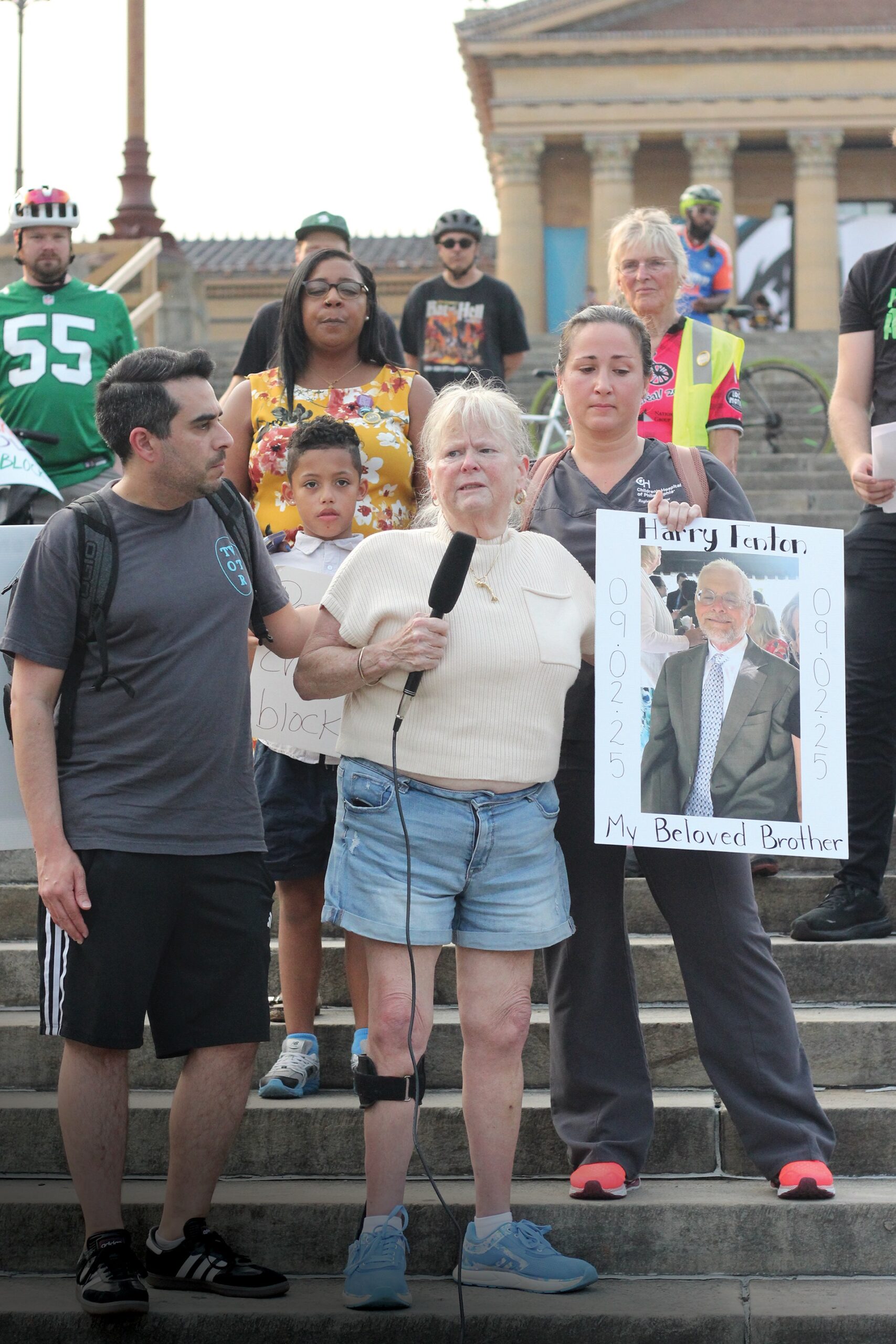
Sufficient political pressure is often the best hope of moving the needle on a particular roadway, Tung says. But it’s not a sure thing. That’s something Ruth Ann Fenton, Harry Fenton’s widow, has experienced firsthand.
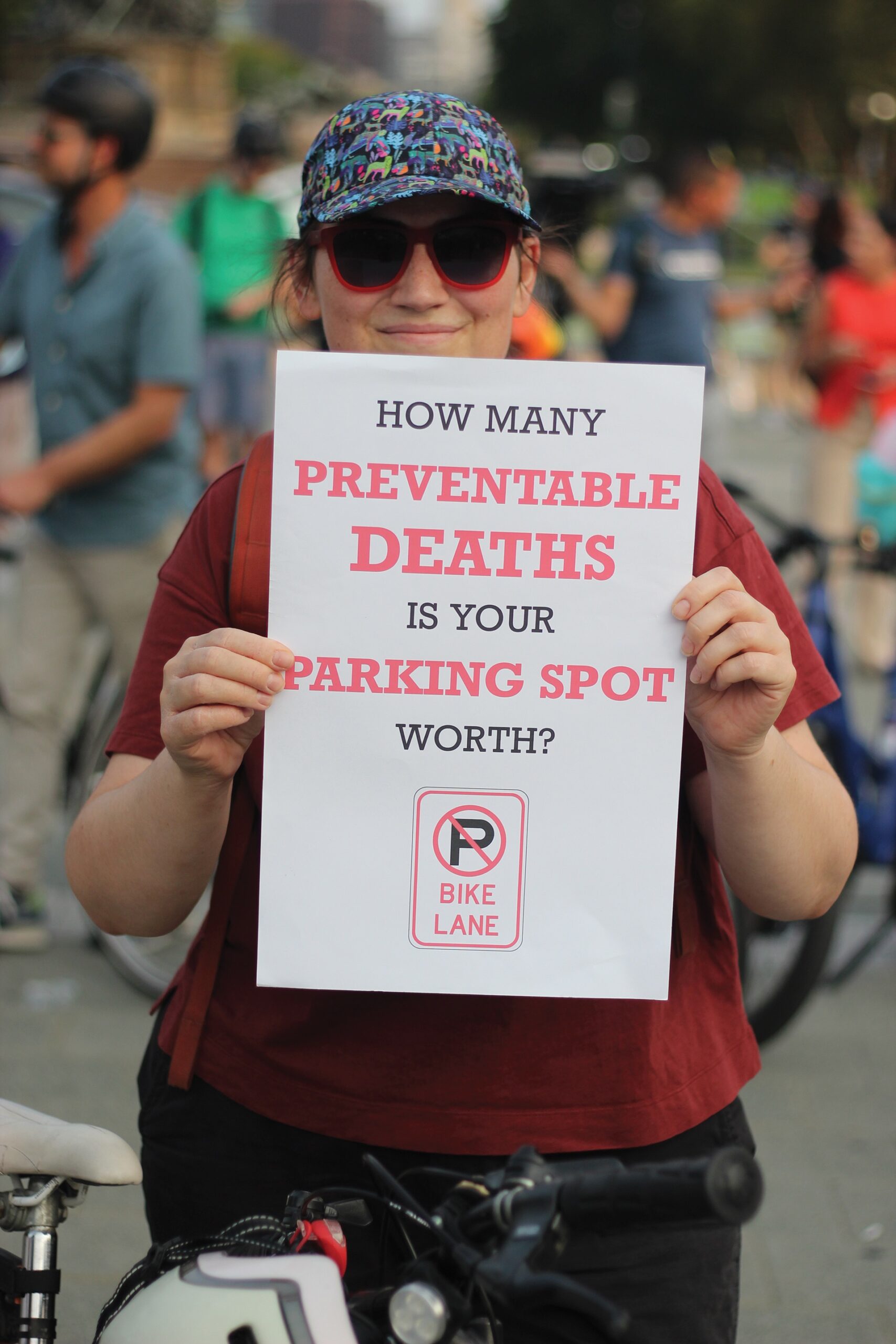
In the weeks following Harry Fenton’s death, more than 1,800 Philadelphians signed a petition calling for safer road design in Fairmount Park, where at least 41 people have been killed in car crashes since 2019. The petition, organized by Philly Bike Action! — of which Harry Fenton was a member — called for several immediate changes, including introducing a road diet on Belmont Avenue, a lower speed limit on all roads in the park, and repairs to the park’s crumbling cycling and pedestrian paths. In January, Ruth Ann delivered the petition signatures to Councilmember Curtis Jones. Jones, who represents the area where Harry Fenton was killed, expressed support for the proposed safety measures. (Jones did not return a request to comment for this story.)
But in the five months since Harry Fenton’s death, the City has not made any changes to Belmont Avenue or any road in Fairmount Park. It plans to restore the sidewalk on the west side of Belmont Avenue and turn it into a shared-use path, expected to begin construction in 2027, according to Gallagher. Adding speed bumps or introducing a road diet, meanwhile, requires the collaboration of PennDOT, since the roads are owned by both the City and the state. So far, a road diet has not been put in place. The City does have the power to control speed limits in the park, but hasn’t indicated any plans to change them. Meanwhile, Krys Johnson of PennDOT said the agency is “awaiting guidance from the City regarding the speed limit” and did not have further updates on any other safety improvements for the park.
Fenton knows infrastructure changes don’t happen quickly in Philadelphia. But she’s frustrated nonetheless.
“Some of these fixes are so obvious and could have easily been implemented years ago,” says Fenton. “How many more families are going to have their lives blown apart because a loved one’s life was lost on that lethal intersection?”

I’m shocked that traffic deaths haven’t been eradicated, when drivers are worse behaved than ever, and enforcement is at an all time low.
There are 650,000 registered passenger vehicles in Philadelphia. If each of those vehicles is driven just 25 miles a week, that comes to 845 million miles a year. 126 fatalities from 2023 is 0.00001491124% of miles driven based on that rather conservative estimate of the mileage people drive in the City. That’s pretty close to Vision Zero as it is.