One warm October night at Temple University’s Liacouras Center, tall, tan rodeo athlete Au’Vion Horton burst out of a high wooden chute on the back of a one-ton bull. As the bull plunged, spun and kicked to throw off Horton, the hum of the crowd at the East Coast premiere of the 8 Seconds Rodeo surged to shrieks.
Horton’s hard spill had a kind of irony. “Bull riding is dangerous, but it saved my life,” says Horton, 24, of Hope, Arkansas, whose rodeo career began at age 5 or 6 when he first competed in “mutton bustin’” — an event in which children ride sheep for as long as possible. “In high school, I tried to get my mom to sign a paper so that I could compete in bull riding,” he says. “She said no, so I lied to my grandmom and said that I needed the paper signed for my grades.”
Bull riding pulled Horton out of depression after his girlfriend, who was on a date with him, was caught in crossfire and died in his arms. He had stopped attending school and working out at the gym, but resumed both when he began rodeoing again.
“Bull riding has taught me to handle myself,” Horton says. “Win, lose or draw, I get up [off the ground] and bow to the crowd, smiling. And I always have a plan B,” says Horton, who attended the University of Arkansas at Monticello. He earned certifications in diesel mechanics, truck and trailer operations, and automotive engineering while studying there.
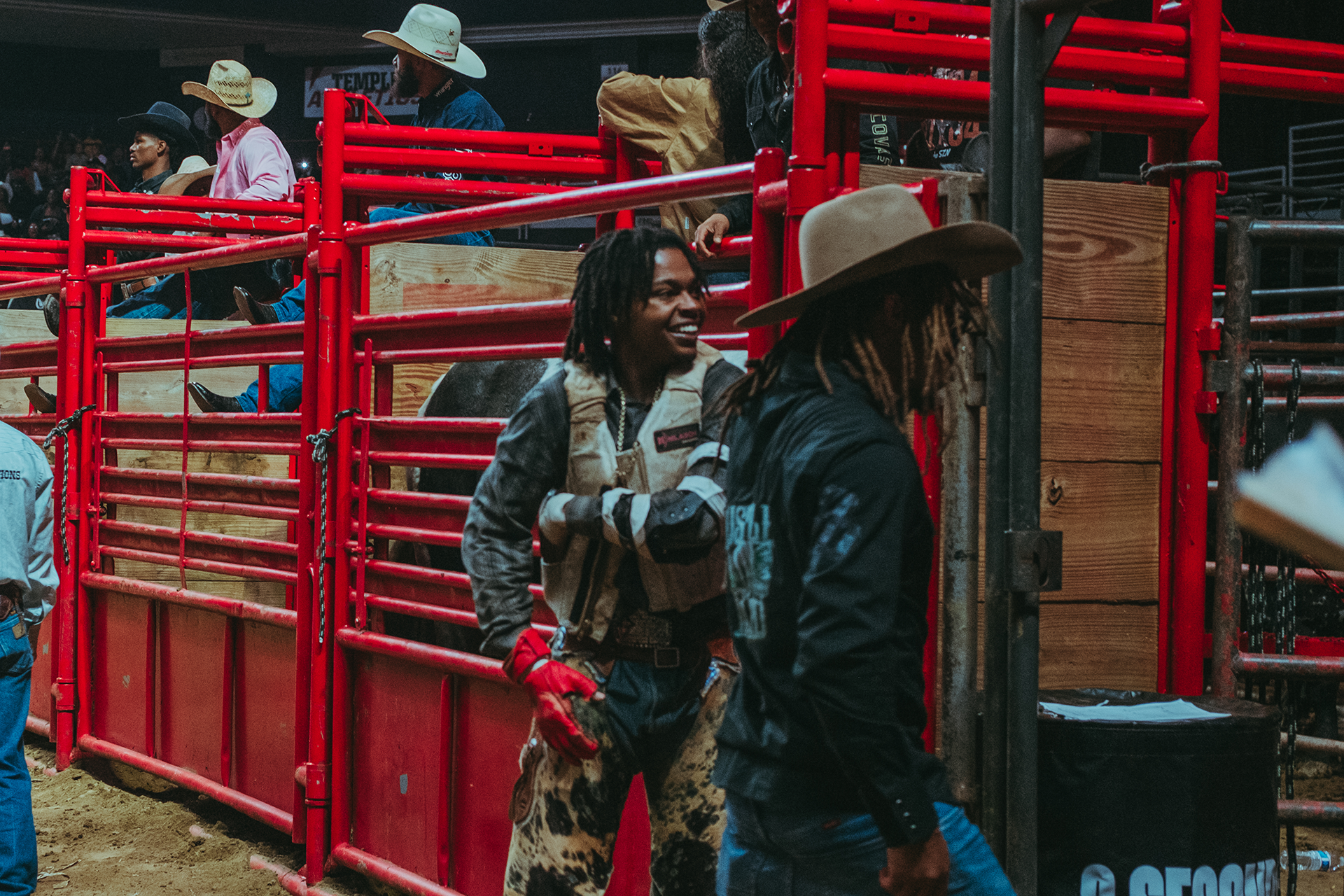
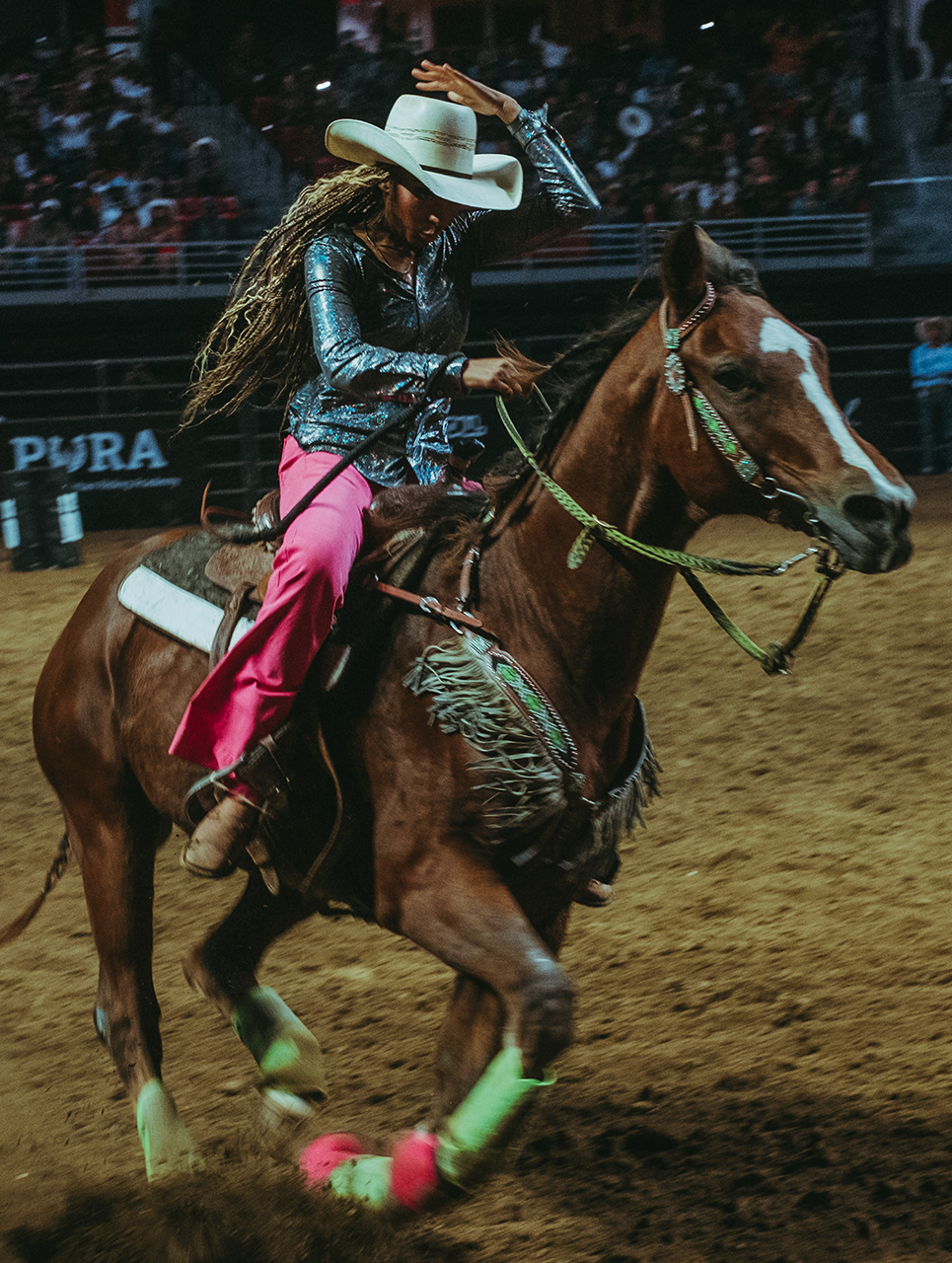
Like Horton, fellow 8 Seconds Rodeo competitor Jhanii “Jayy” Hardin has taken more than her share of risks. A lifelong rodeo competitor and champion at barrel racing — a timed event where a horse and rider race around three barrels — Hardin is also a stuntwoman. “I did stunts for ‘Harriet,’ ‘Game of Thrones,’ ‘The Walking Dead’ and more,” Hardin says. “I do a lot of high falls and fight scenes. My favorite stunt is rolling off the back of a horse. I don’t believe in the word ‘can’t,’ because you’re capable of anything.”
One could only agree with Hardin after watching 10 kids and 24 adults compete in mutton bustin’, barrel racing, bull riding and bronco riding. Founded by photojournalist Ivan McClellan, the 8 Seconds Rodeo, whose name refers to the minimum qualifying time riders must stay on a bull, is an Afrocentric event. The show opened with a prayer from Rev. Dr. Alyn Waller, pastor of Enon Tabernacle Baptist Church, followed by Enon’s choir singing “Lift Every Voice and Sing,” the Black national anthem. The emcee sketched the role of Black cowboys in settling the West. At the show’s start, Erin Brown — a North Philly native, winning rodeo athlete and executive director of the Philadelphia Urban Riding Academy, which provides free riding lessons for children who can’t afford them — rode around the arena carrying the American flag.
America paints its mythic cowboys white, but many historians estimate that about 25% of cowboys were Black. Many of them were freedmen who headed West after the Civil War and made new lives on farms and ranches, and during the big cattle drives between the mid-1860s and the mid-1880s. Informal roping and riding contests among ranches morphed into Wild West shows and rodeos.
Bull riding is dangerous, but it saved my life.”
— Au’Vion Horton
A handful of Black horsemen and horsewomen became legends. Shotgun-toting Mary Fields, aka Black Mary, once enslaved in Tennessee, won a contract to drive a stagecoach for the U.S. Postal Service in Montana from 1895 to 1903. Bill Pickett, the son of freedmen, achieved fame as a cowboy, rodeo star and actor, and became the first Black cowboy inducted into Oklahoma’s National Cowboy Hall of Fame in 1971.
Like their forebears, many of today’s Black cowboys and cowgirls acquire their skills and grit on farms and ranches. “My uncle had land, and I grew up rodeoing every weekend from November to April,” says Tyler Torrey of Convoy, Ohio. “I started riding bulls when I was 18. I did it for seven years. Now I’m a pick-up man. I distract the bull and get it away from the [fallen] rider. One time, a rider’s spur got caught in my leg. I had to have 28 stitches.”
Among the athletes are some daredevil dynasties. Carolyn Carter, 67, of Oklahoma City, a champion barrel racer, competed in 8 Seconds along with her daughter and granddaughter while her 2-year-old great-granddaughter watched. Rodeos offer fat prizes, but competing comes with costs, Carter notes. “There’s the expense of traveling 1,400 miles to Philadelphia, and I just paid $2,800 in vet bills,” she says, slender and spiffy in a snap-button shirt, cowboy hat and rhinestone-studded belt.
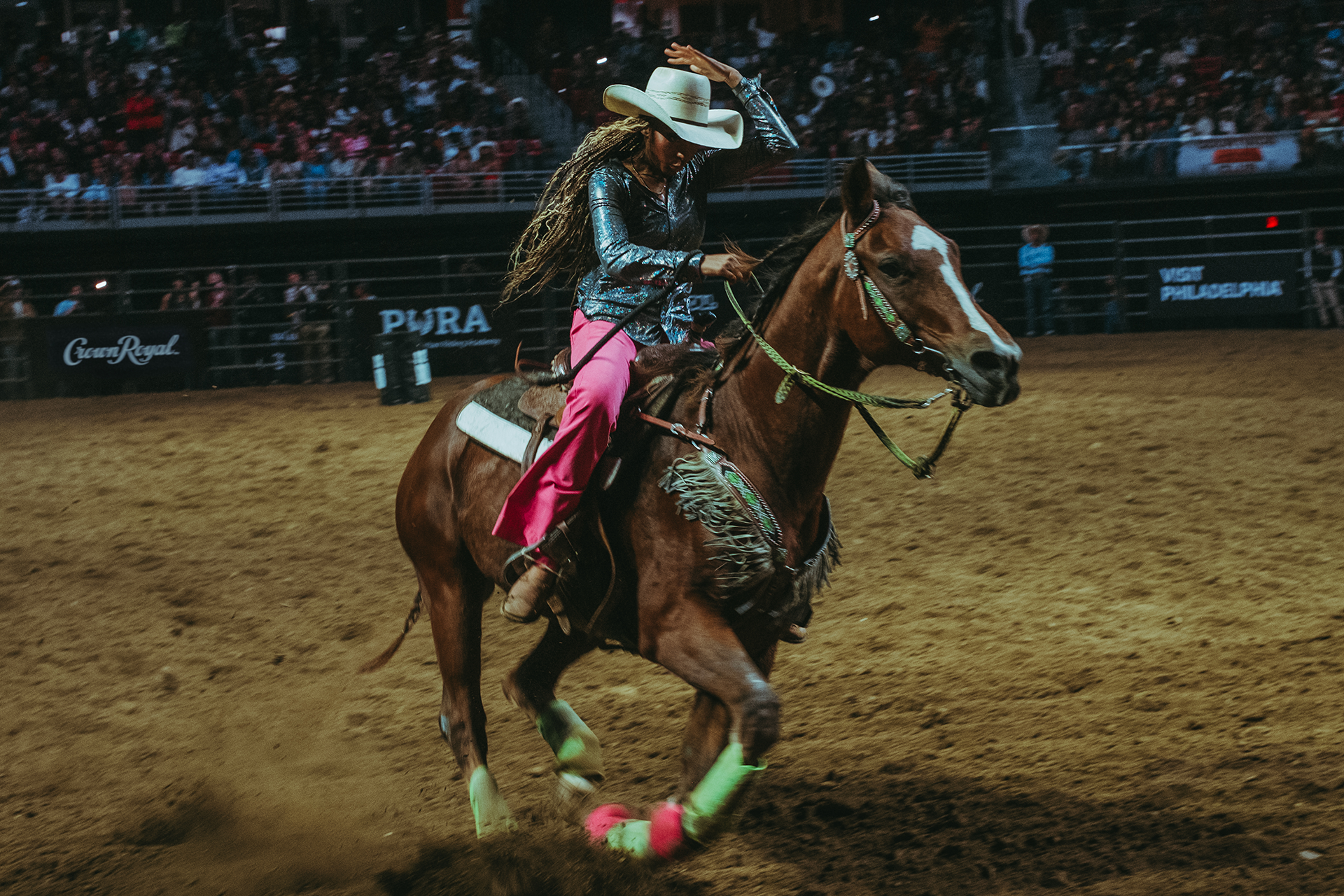
A recently retired registered nurse, Carter worked and competed for years with the Bill Pickett Invitational Rodeo, a national touring event founded in 1984 because Black people were often barred from competing in white-sponsored rodeos. In 2022, Carter played a key role in launching the Midwest Invitational Black Rodeo, which also showcases the contributions of African American equestrians.
Philly’s heritage of Black horsemanship got the spotlight in the 2020 film “Concrete Cowboy.” There have been Black-run stables throughout the city, particularly on Fletcher Street in Strawberry Mansion since the Civil War, says Courtney Berne, professor of geography and urban studies at Rutgers University–New Brunswick. That legacy endures through Ellis “El-Dog” Ferrell Jr., 86, founder of the Fletcher Street Urban Riding Club, who still teaches horsemanship to young riders today.
The number of Philly’s Black-owned stables has plummeted in recent decades. Redlining often prevented stable owners from buying the land, Berne says. Other stables fell victim to what Berne calls “the slow violence of gentrification.” The disappearing stables mean a huge loss. “They help level the playing field in a city fraught with inequities, but that land use doesn’t make money for the city,” Berne says. “I’ve seen kids who are clearly dysregulated walk up to a horse, wrap their arms around its neck. You can watch the kid decompress, see the healing taking place. Every single Black stable is a place of reclamation, of healing, but you can’t give the city a receipt that says ‘This horse saved this kid’s life.’”
At the 8 Seconds Rodeo, the Liacouras Center became one such place of reclamation that put Black horsemanship front and center. It not only recalled a Philly tradition, but also gave spectators good old-fashioned thrills. “I love rodeoing, being around it,” says Torrey. “All that adrenaline. There’s nothing like it.”