
One in 10 Philadelphia public schools had high lead levels in water sources used for food preparation, according to tests conducted by the School District of Philadelphia (SDP) over the past three years.
The dangerously high levels of lead, a potent neurotoxin linked to stunted development and learning difficulties, were found by the district during routine water testing, the results of which were posted to its website. Grid then analyzed the results and the potential exposures to district students, which has not been previously performed by other media.
The high lead results were predominantly taken from water taps found in kitchens or food prep areas, affecting 21 schools out of the 219 tested. In an additional seven schools, high lead results were discovered in several nurses’ offices, a pre-K room and a special needs room. In some cases, the lead levels were more than 10 times higher than the district’s safety level of 10 parts per billion (ppb).
In one high school kitchen, lead was found at 6,200 ppb.
School district officials and documents indicate that contaminated water sources were immediately taken offline until filters could be installed and the water retested. But health and environmental advocates say the data reveals the latest vulnerability in an ongoing districtwide plan to address lead-in-water risks that dates to 2017.
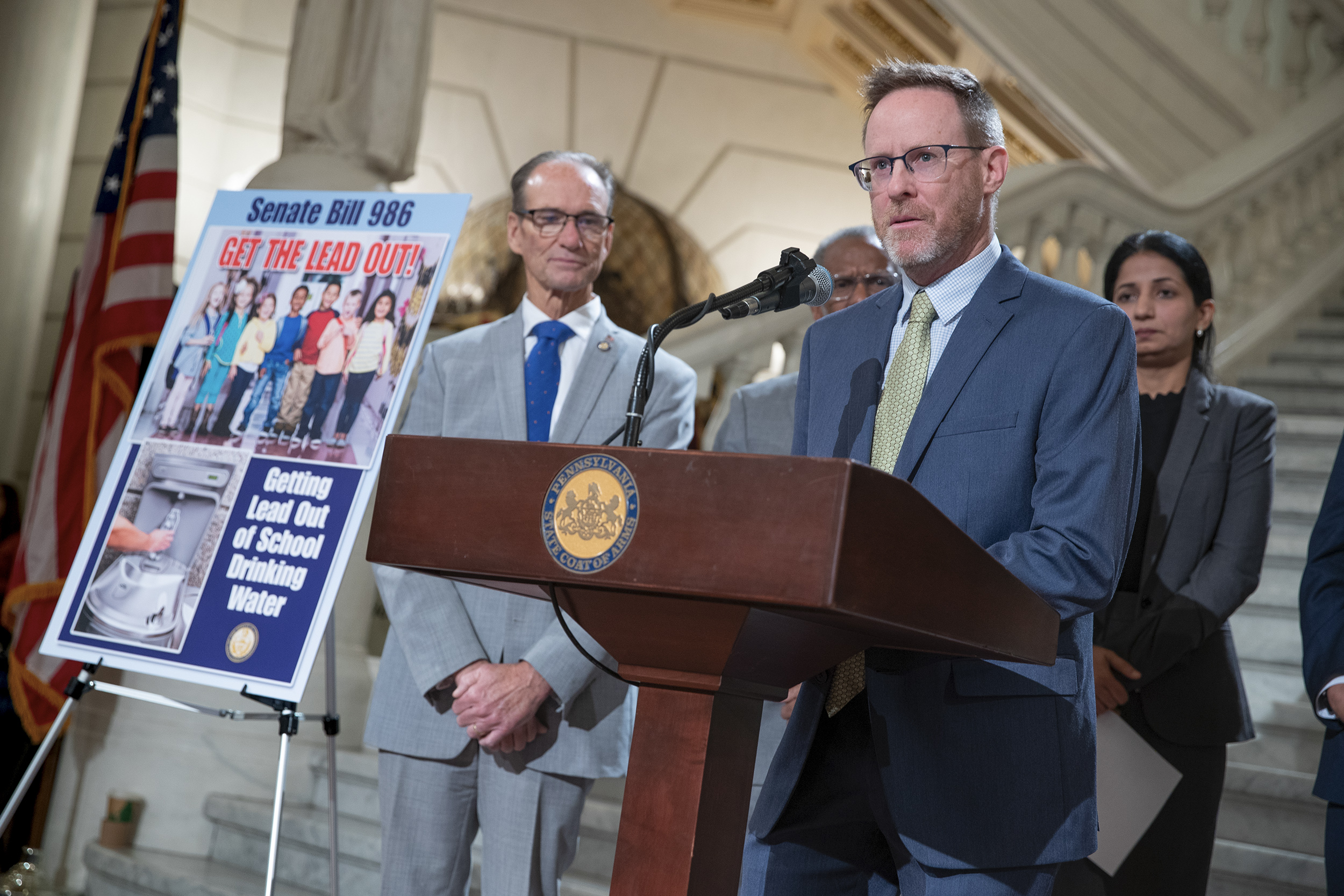
That year, former Philadelphia Councilmember Helen Gym successfully spearheaded a bill to require testing water for lead in every Philadelphia public school in five-year cycles. When that testing began to reveal widespread lead issues in drinking water fountains, Gym and Council passed a second bill in 2022 requiring the district to proactively install filtered water hydration stations in every school, a task that was completed by a June 2025 deadline.
However, the 2022 law did not require filters to be installed on all kitchen faucets, many of which are used to wash or prepare food for students. That is a weakness in the district’s plan and a risk to students that is now being realized, says David Masur, executive director of PennEnvironment, a Philadelphia-based nonprofit that has advocated on the issue.
“The law was silent on other sources of water for drinking and cooking,” Masur says.
State law does not require districts to test for lead, a shortcoming further enabled by a recent change that relaxes requirements for school districts to report results when they do test. Philadelphia, however, operates a robust lead testing system and spends millions of dollars on filters to protect students, making it an outlier in the state.
I appreciate the School District’s quick response when lead is discovered, but we need to be more proactive about this. No parent should have to wonder if the water in their kid’s school is safe.”
— Councilmember Jamie Gauthier
Victoria Flemming, executive director of SDP’s Office of Environmental Management and Services, says the district tests every potable water source — about 3,100 in total — within its roughly 220 school buildings every five years, as required by the 2017 law. That means the district has now sampled every potential source of contamination twice. The 37 faucets found to contain more than 10 ppb during this most recent cycle represent a little over 1% of all faucets.
The district has access to more than $5 million in federal funding to install water filters, and last year successfully completed its initiative to place more than 2,400 filtered hydration stations in the district’s hallways, at a 1-to-100 student ratio, as required by the 2022 law.
The federal funding, made available through a $5 million Environmental Protection Agency (EPA) grant, is also used to pay for “point-of-use” filters where high lead levels are found in places like kitchens and nurses’ offices. These devices are placed directly into the plumbing beneath a sink to filter out lead before it reaches the tap.
“The day we get [high] test results back, the outlet is turned off … and there’s no continued use of it until we’ve come up with a corrective action,” Flemming says, calling the district’s strategy “quite proactive.”
Masur says the district’s approach to drinking water fountains and other water sources like kitchen sinks are fundamentally different, but that they shouldn’t be. As a result of the 2022 City law, the district is required to install filtered hydration stations on every floor of every school building, even if high lead levels were not previously found there. That gives students and staff surety that their water is safe to drink.
Masur says that on the other hand, the ongoing effort to find-and-fix contaminated water in kitchens or other rooms represents a reactive approach to filtration. The problem is exacerbated, Masur says, by the devilish nature of lead, in which a tap that previously tested clean can later become contaminated due to aging pipes, changes in water chemistry, or other factors.
“It’s likely that even kitchen and nurse sinks that tested negative for lead in their most recent round of testing will inevitably have a percentage test positive in the next round,” Masur says.
The latest testing results are cause for concern, current Philadelphia city councilmembers told Grid. That includes Council Majority Leader Katherine Gilmore Richardson, who previously addressed lead issues as a member of the Local Government Advisory Committee for the EPA.
“Hearing that there may be elevated levels of lead in active food preparation areas is deeply concerning, not only as a Councilmember who has worked to ensure our children have access to healthy drinking water, but as a public school parent of children who eat breakfast and lunch at school,” Gilmore Richardson says. “This warrants immediate attention and a thorough review to understand the scope of the issue and ensure appropriate steps are being taken.”
Councilmember Jamie Gauthier, chair of Council’s Environment committee and a co-sponsor of the 2022 bill, says that while the City and district have made “real progress,” the results indicate the work isn’t finished.
“I appreciate the School District’s quick response when lead is discovered, but we need to be more proactive about this. No parent should have to wonder if the water in their kid’s school is safe,” Gauthier says.
Where lead was found
The persistent challenge of addressing lead was revealed in the testing results of schools like Roxborough High School, where the sky-high sample of 6,200 ppb was found in a kitchen sink in the summer of 2025, according to district testing data.
It wasn’t the first time lead was found in tap water in the building, which was constructed more than a century ago. Testing results show that in 2017, lead was found at 27 ppb in its kitchen, and 130 ppb in a field house kitchen. Then in 2022, two more faucets in the high school’s kitchen were found to have lead at 43 ppb and 19 ppb. In all cases, the faucets were immediately taken out of service and notifications sent to the school community, district documents show.
And yet, testing in July 2025 found the hit for 6,200 ppb in what the district’s testing report logs as a “sink in middle of kitchen” used for food prep. Two other faucets in a kitchen by the school’s office also tested at 13 and 23 ppb, the latter of which is the same faucet that tested at 19 ppb in 2022.
Flemming says the 6,200 ppb result was taken from a faucet that investigators later discovered to have its cold and hot water lines mixed up. Hot water is known to corrode lead and thus is not recommended for use in cooking or drinking, even in domestic settings.
“It was an anomaly,” Flemming says, referring to the plumbing mixup that led to the astronomically high result.
But Shanée Garner, executive director of the nonprofit Lift Every Voice Philly and a former policy director for Gym who worked on the 2017 law, was incredulous that such high lead levels are still being found in district schools.
6,200 parts per billion is insane. It’s 10 years later, you know what I mean?”
— Shanée Garner, executive director, Lift Every Voice Philly
“6,200 parts per billion is insane,” Garner says. “It’s 10 years later, you know what I mean?”
District documents show the three Roxborough faucets were shut off and then retested this spring after filtration was installed. The retesting results came in below the district’s 10 ppb safety and action level, with two faucets testing at 4 ppb and the third at 3.2 ppb.
Across all district schools during the most recent testing cycle, high lead results were found at 13 middle schools, 12 high schools and three middle schools. Other results exceeding 100 ppb were found in a culinary arts kitchen at Randolph High School (400 ppb) near East Falls, in the kitchen of Julia de Burgos Elementary School (250 ppb) in North Philadelphia, in the kitchen of Edison High School (100 ppb) in North Philadelphia, and in the kitchen of Thurgood Marshall Elementary School (100 ppb) in Olney.
School District of Philadelphia sites with lead findings above 10 ppb during the most recent testing cycle (2023-2026). Elementary schools are red, middle schools are yellow and high schools are blue. Source: Philasd.org
Other affected elementary schools were: Childs Elementary School, Emlen Elementary School, Thomas K. Finletter Elementary School and Little School House, Ann Frank Elementary School, Hopkinson Elementary School, John F. McCloskey Elementary School, Andrew J. Morrison Elementary School, Munoz-Marin Elementary School, Penrose Elementary School, William Rowen Elementary School, and Steel Elementary School.
Other affected high schools were: The U School @ Ferguson High School, Motivation High School, Northeast High School and Field House, Olney High School, School of the Future High School, South Philadelphia High School, Strawberry Mansion High School and LP Hill, and Swenson Arts and Technology High School.
Impacted middle schools were AMY @ James Martin and Baldi Middle School. The Science Leadership Academy at Beeber, which serves students in grades 5 through 12, was listed as both a high school and middle school in the district’s testing data.
In nearly all cases at all schools, high lead results were found at just one or two taps, while numerous other faucets at the schools — in some cases dozens — tested below the district’s 10 ppb action level. In all instances, the district’s records show, the contaminated water sources were immediately taken offline and the school community notified.
The district maintains a public-facing database that includes test results and notification letters for all district schools, located at www.philasd.org/environmental/#watersafety.
Risks to students
Just how much lead exposure students endured, and any resulting health impacts, would prove tough to pin down. Because the district tests all potable water sources every five years, and these contaminated sources were found during a second five-year cycle, it stands to reason that high lead levels began to appear sometime in between the two testing cycles. But the exact date would be unknowable.
There’s also variability in how district schools prepare food. Lisa Norton, executive director of SDP’s Office of Food Services, says that 147 district schools use “full service” kitchens, meaning food is actually prepared there, and tap water could be used for tasks like making pasta or washing fruits and vegetables. Another 111 locations use prepackaged food that is warmed up for students without the use of tap water.
Health experts say that using lead-contaminated water to prepare food is dangerous because the toxic metal does not boil out of water and can contaminate food like pasta or rice when the water is absorbed. In one instance, researchers found a North Carolina boy who was being exposed to 20 ppb of lead in his home tap water, and calculated that a single serving of pasta prepared with the water contained the same amount of lead as a dime-sized paint chip. Once they began to filter the water, the boy’s blood lead levels decreased.
Marilyn Howarth, an environmental health expert at the Center of Excellence in Environmental Toxicology at the University of Pennsylvania, says that schools are particularly important places to address lead, since children can also be exposed to the metal in tap water or peeling paint at home, in soil on playgrounds, and other environments.
“That adds up, and is why I would say we have a public responsibility to protect them in schools,” Howarth says.
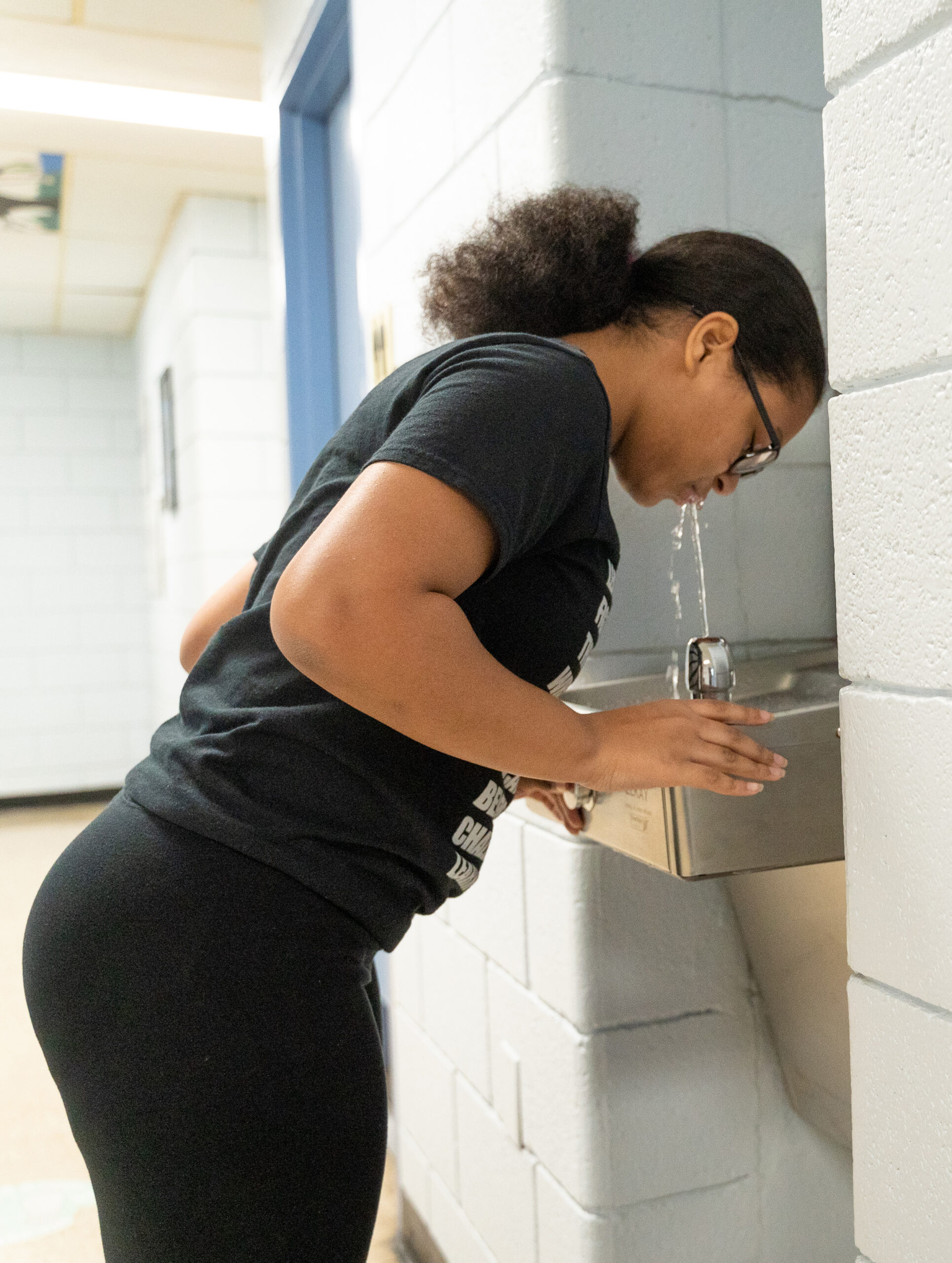
Howarth agrees with most public health experts that there is no safe level of lead, and that the goal for exposure should always be zero. Children exposed to lead can suffer from irreversible harms including lowered IQ, damage to the brain and nervous systems, learning and behavioral difficulties, slowed growth, hearing problems and headaches, according to the EPA.
“Lead is a toxic metal that can be harmful to human health even at low exposure levels,” the EPA’s website reads.
Adults can also suffer reproductive harms, high blood pressure, nerve disorders, cognitive issues and muscle joint and pain. Long-term exposures, such as through contaminated drinking water, food sources or lead paint, present the most risk.
Policy problems
Because lead was widely used in plumbing and paints prior to the 1990s, it remains a challenging public health threat nationally, in both homes and buildings that are even just a few decades old. Policymakers often struggle to respond.
Masur, with PennEnvironment, is a critic of Pennsylvania state law, which does not require school districts to test for lead, so long as school administrators discuss the topic at a public meeting at least once a year. Through a provision tucked into this summer’s state budget negotiations, lawmakers weakened protections further, requiring districts to only report lead results to the state if they test above 5 ppb, whereas they previously had to report any results above zero.
Masur was already skeptical of school districts’ compliance with the law, saying it wasn’t clear if the state is actually tracking and enforcing whether districts were performing testing or discussing the topic at a public meeting. And echoing public health experts, Masur says that 5 ppb is an arbitrary threshold that could still leave students vulnerable to health impacts. Howarth agrees.
“There’s no safe level of lead, because every amount of lead that gets into the body basically can kill brain cells,” Howarth says. “How many brain cells do we want our children to be losing?”
For that reason, Philadelphia was wise to adopt a proactive policy to install hydration stations in every school, she adds, since it protects against any lead from water fountains, and the possibility that a fountain that tested low could later spike.
You can’t rely on a test of two parts per billion or five parts per billion. What you have identified is that there is lead in that infrastructure, and so if a child walks in and they’re the first ones to drink out of that water fountain after a weekend, they may get a far higher number.”
— Marilyn Howarth, Center of Excellence in Environmental Toxicology at the University of Pennsylvania
“You can’t rely on a test of two parts per billion or five parts per billion,” Howarth says. “What you have identified is that there is lead in that infrastructure, and so if a child walks in and they’re the first ones to drink out of that water fountain after a weekend, they may get a far higher number.”
That presents potential issues with the School District of Philadelphia’s ongoing approach to test and remediate water sources like kitchen taps. Testing results from the most recent cycle show at least 19 additional schools had results between five and ten parts per billion, bringing the total number of schools with test results above 5 ppb to 47 — more than one in five district schools.
District documents do not indicate that water sources at those 19 schools immediately received filters. But asked about the results, district spokesperson Monique Braxton said in mid-September that the district is adopting a “new standard” of 5 ppb, in line with new recommendations from the state Department of Education.
“As part of that process, we are reviewing the locations with previous results between 5 ppb and 10 ppb to assess the sources of lead and implement any corrective action needed,” Braxton wrote in an email.
Flemming says the district’s prior use of 10 ppb was still more protective than federal standards that public drinking water utilities must follow. The EPA requires such utilities to use a 15 ppb “action level,” with compliance calculated by creating an average of a utility’s highest decile of lead results. However, the EPA also maintains a non-enforceable health “goal” of zero lead.
The district’s testing results also hint at the growing importance of filter maintenance, now that there are more than 10 hydration stations in each school, on average, plus any point-of-use filters. Two of the district’s hydration stations tested high for lead during the last five-year cycle: a 34 ppb result at Motivation High School, and a 12 ppb result at AMY @ James Martin Middle School. That is just a fraction of a fraction of the 2,400-plus stations installed so far, but advocates say it underscores the need for the district to remain on top of maintenance.
In some instances, other faucets that tested above 10 ppb this cycle, and then received a filter, were still showing measurable lead levels after installation. In one example, a faucet listed as a food preparation source at a kitchen in Penrose Elementary School tested at 28 ppb in January 2023. In a letter sent to the school community a month later, the district says it installed a point-of-use filter and retested the faucet. Lead was found at 6.2 ppb, and the district considered “remediation complete.” The district has not posted any additional testing results since then, but the water source will presumably now be addressed under the district’s new 5 ppb policy.
Flemming says the district has established a careful and thorough testing system where each water source is assigned a number and scannable barcode to avoid any mixup. Hydration stations have a visible green-yellow-red system to indicate filter health, and all filters are changed at least once a year, she says.
She acknowledged the district’s efforts to address lead are ongoing, and says that the fact that the district continues to identify and fix problems demonstrates that they take the matter seriously.
“We want to identify locations where we have an issue and we need to take a corrective measure,” Flemming says. “And we want to do it proactively across the district.”