
At St. Christopher’s Hospital for Children, a tantrum looms. Scalp bristling with electrodes, a three-year-old boy remains stubbornly unmoved by his parents’ pleas that he take his medication.
Then his nurse proposes a deal.
“Yeah,” the boy responds to her question, “I’ll take the pills if the clown comes to see me.”
Within moments, Marilyn D., aka DR Marebow, a longtime clown at St. Christopher’s and Thomas Jefferson University Hospital, arrives, complete with red nose, tea-bag earrings and a rainbow of a hat. She rewards the child with a smiley-face sticker for taking his medicine.
“I like her,” says Dion, age four, a patient across the hall. “She’s funny.”
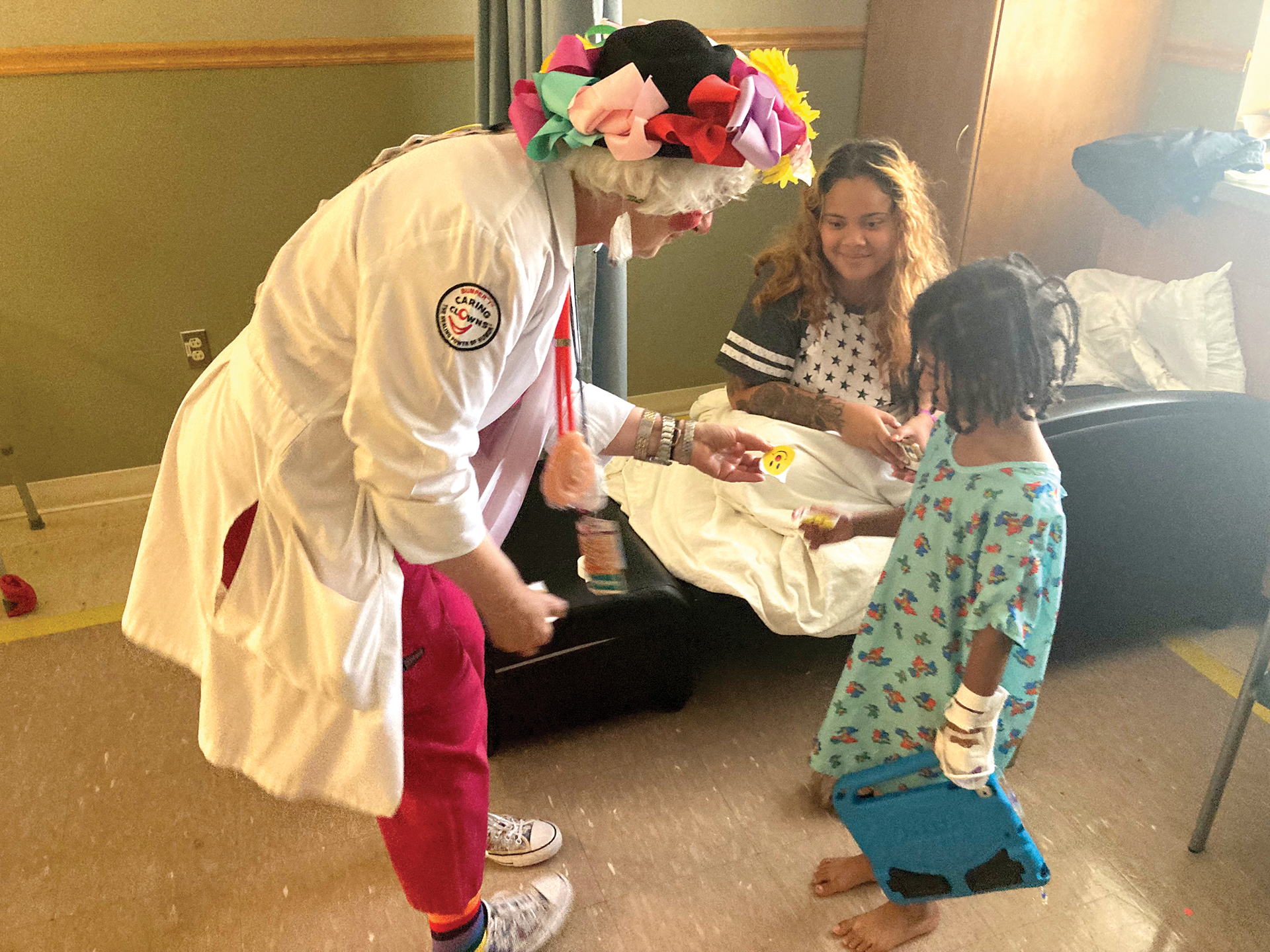
DR Marebow — many style their clown names thus to distinguish themselves from physicians — and other therapeutic clowns serve up levity, often in short supply in medical settings. “Hospital clowns are a cross between improv comedians and social workers,” Marilyn says. “You don’t have a memorized script. You respond to the moment. Sometimes people just want a listening ear.”
Even after years, medical clowning can still spring surprises on Marilyn. She was lunching in Jefferson University’s cafeteria one day when a woman ran up to her. “She told me, ‘My mother wants to see you,’” Marilyn remembers. “‘She’s dying, and she wants a clown to be the last person she sees.’”
Hospital clowns’ empathy can soothe patients from elders to infants. A 2017 study found that clowning can help people with dementia because humor can calm them and strengthen their social bonds.
Likewise, babies also respond to clowns’ compassion. “With patients two to three months old you could hum a lullaby, just create a presence,” says James Ofalt, a clown at Children’s Hospital of Philadelphia (CHOP) for seven years. A slew of studies show that interaction with clowns can ease children’s anxiety, improve their sleep and shorten their hospital stays.
Hospital clowns are a cross between improv comedians and social workers.”
— Marilyn D., medical clown
Hospital clowning in the United States began in the early 1970s with Hunter “Patch” Adams, M.D., who incorporated humor in caring for patients near his West Virginia home. This dimension of care reached the Delaware Valley some 35 years ago when George W. Edward, aka DR Bumper “T” Clown, donned outlandish clothes to visit his father in Cooper University Hospital’s cardiac unit. A smash hit with patients and staff, he ended up staying for hours. The first Bumper “T” Caring Hospital Clown training took place in September 2001. Today, Bumper “T” Caring Clowns has grown into a nonprofit that teaches therapeutic humor.
Nonprofits like New York City-based Healthy Humor train professional performers, like CHOP’s Ofalt, for healthcare settings.
“If one would like to volunteer as a medical clown, the first step is to contact the Volunteer Department,” says Dina Melchiorre, St. Christopher’s director of volunteer services. Pennsylvania Act 153, the Child Protective Services Law, requires a rigorous background check, she notes.
With clearances in hand, volunteers start training. At St. Christopher’s and Thomas Jefferson, this step involves, in part, shadowing an experienced clown one day a week for eight weeks. “New clowns learn about hygiene, protecting patients’ privacy and other essentials,” says Tim Slattery, who retired from working in commercial credit years ago to do medical clowning. “I always loved clowns since … making others laugh is one of the best things you can do,” he says. “In training, you learn to use just enough makeup for people to recognize you as a clown. You don’t want to scare them. Your job is to get patients to focus away from their illness.”
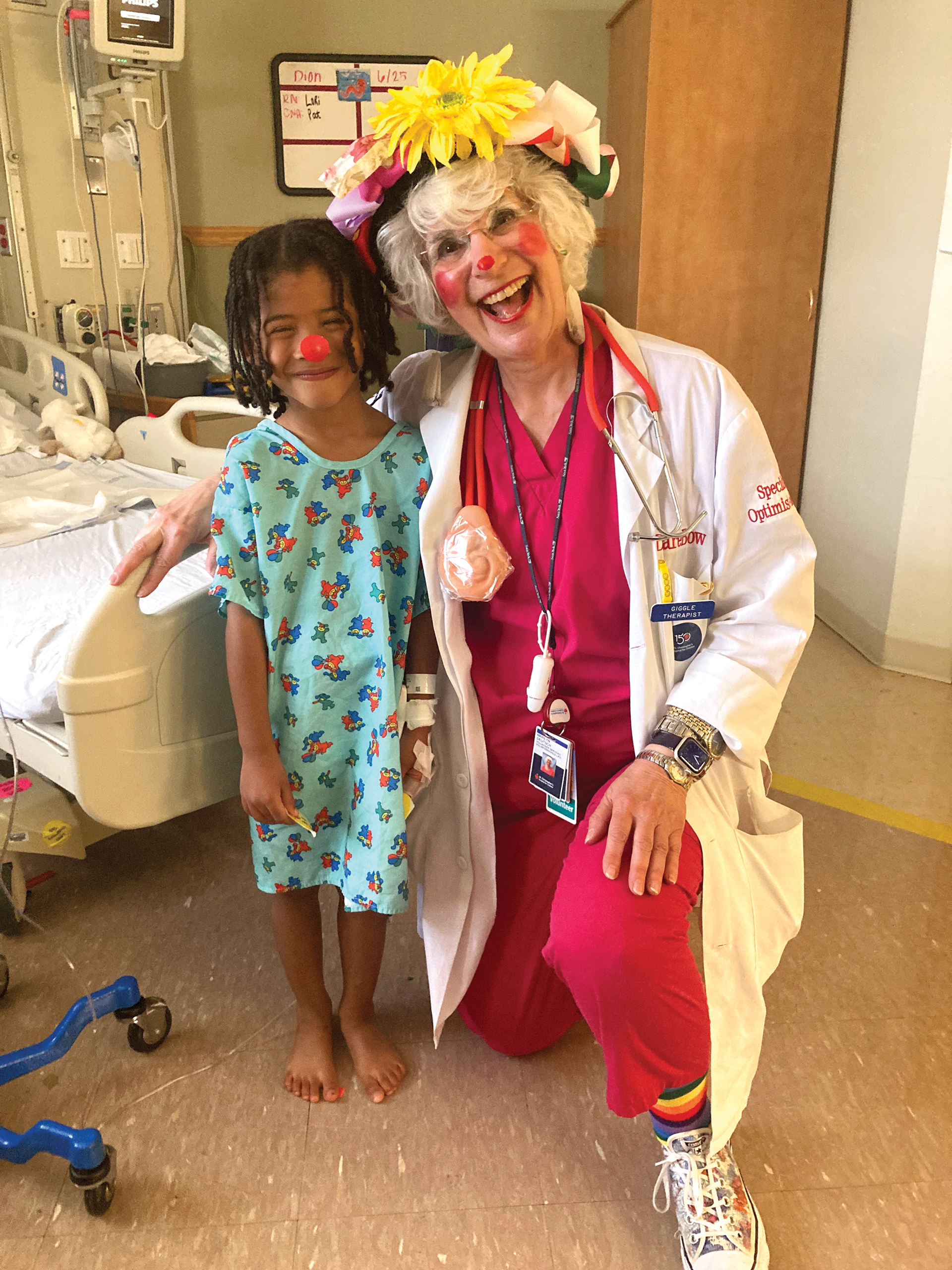
Marilyn D., a psychologist who began clowning because she enjoys volunteering, emphasizes learning to “read” patients’ body language: Do they look welcoming, glance away from you, seem to be in pain, offer a smile?
“Patients can tell us no,” Ofalt says, noting that accepting or declining a clown is a rare opportunity for a patient to make a unilateral decision during a hospital stay. “It gives them a sense of power,” he says.
Clowns may see a patient only once or twice, but repeated encounters can ripen into deeper connections. “In chemo, you see people over and over again,” Slattery says. One woman in chemo, a former seamstress, offered to make Slattery a clown suit. She finished one suit but kept on making them. “I finally told her that I was the best dressed clown in town, that I didn’t need more,” Slattery says. “She said, ‘That’s all right. I enjoy what you do’ and kept right on making them.”
Clowns raise the spirits of not only patients and their families but the staff too. “Say, there’s a debriefing after a difficult incident,” says Heather Lavella, St. Christopher’s director of nursing. “Clowns can brighten up everyone’s day.”
Rapport between clowns and staff benefits the patient. In a case recounted in a 2000 book, “The Joyful Journey of Hospital Clowning,” a doctor wanted to look at the lower part of a girl’s eyes to evaluate her for a possible concussion. The girl refused to cooperate. A nearby clown began blowing bubbles toward the ceiling. When the child looked up at the bubbles, the doctor was able to complete his examination.
Sometimes, emotional attunement can prove hard work. “What do you tell a child with serious burns or one who is awaiting an amputation?” asks Ofalt. “What do you tell their family?”
Some clowns bring skills like puppetry, juggling or playing the kazoo to medical settings, but even these abilities don’t guarantee a smile. “You don’t always succeed,” Slattery says.
On the other hand, clowns may succeed too well. “My partner and I had a kid laughing so hard that it started pulling on his stitches,” Ofalt says. “We had to leave the room.”
The number of medical clowns in Greater Philadelphia dropped during COVID-19 and has yet to return to pre-pandemic levels, Marilyn D. says. More clowns are needed nationwide, according to the North American Federation of Healthcare Clown Organizations. For details about medical clowning, call the hospital you’ve chosen or visit bumpertcaringclowns.org.




Thank you for a great article Constance and Grid. You really captured the fun and science behind humor and health.