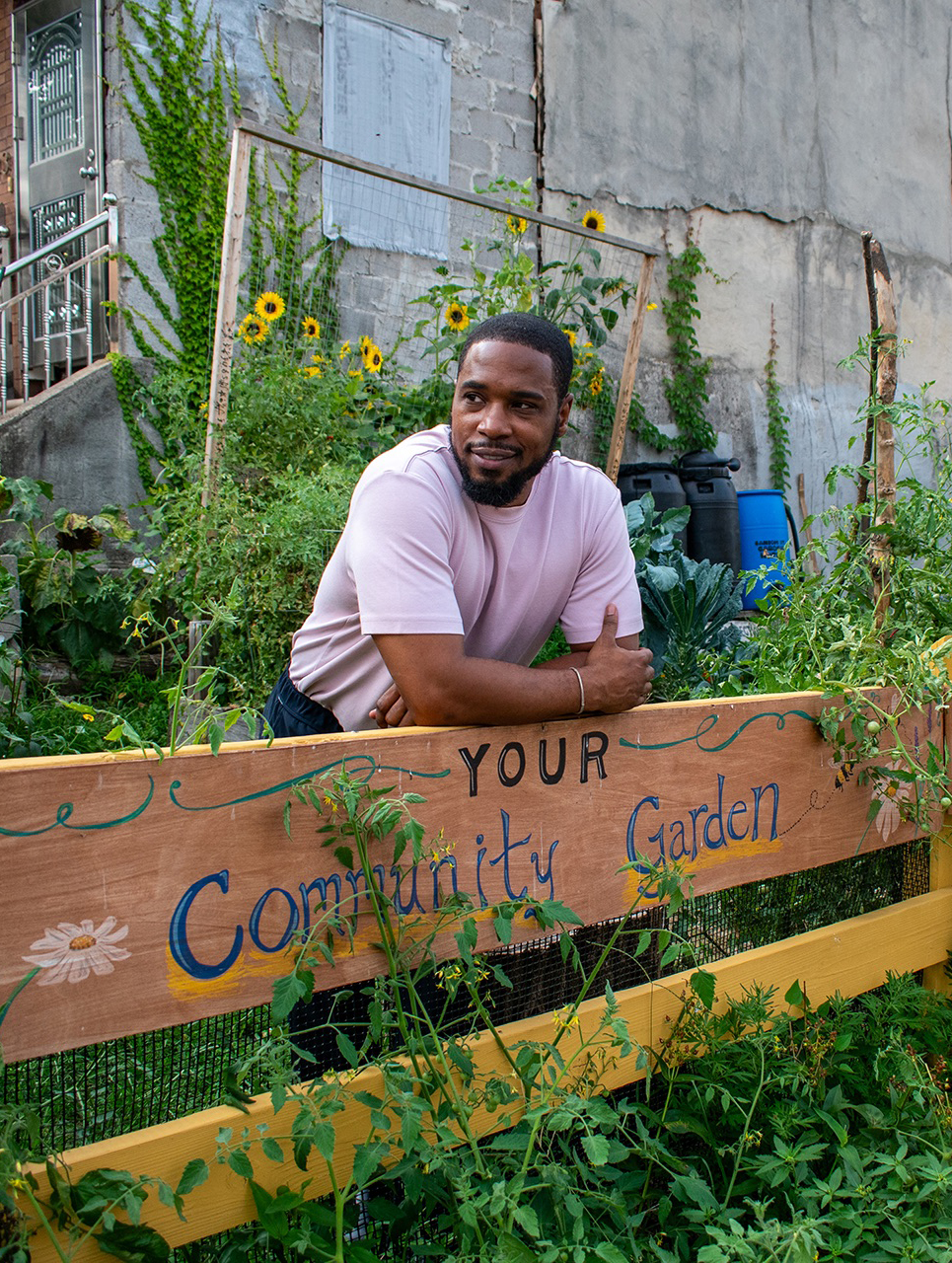
When Shuja Moore was growing up, the corner of 47th and Sansom was his safe space. The northwest lot was a neighbor’s garden, and the southwest corner was the Walnut Hill Community Playground, where he played with his brothers.
But when Moore came home in 2016, after being incarcerated since 2004, the playground equipment was broken — and the former garden lot was a long-forgotten eyesore, overgrown and littered with trash.
The neighborhood had changed around him too. A 2016 Pew Charitable Trusts report found that from 2000 to 2014, Walnut Hill’s share of Black residents fell from 77% to 34% as its share of white residents nearly quadrupled, from 14% to 54%.
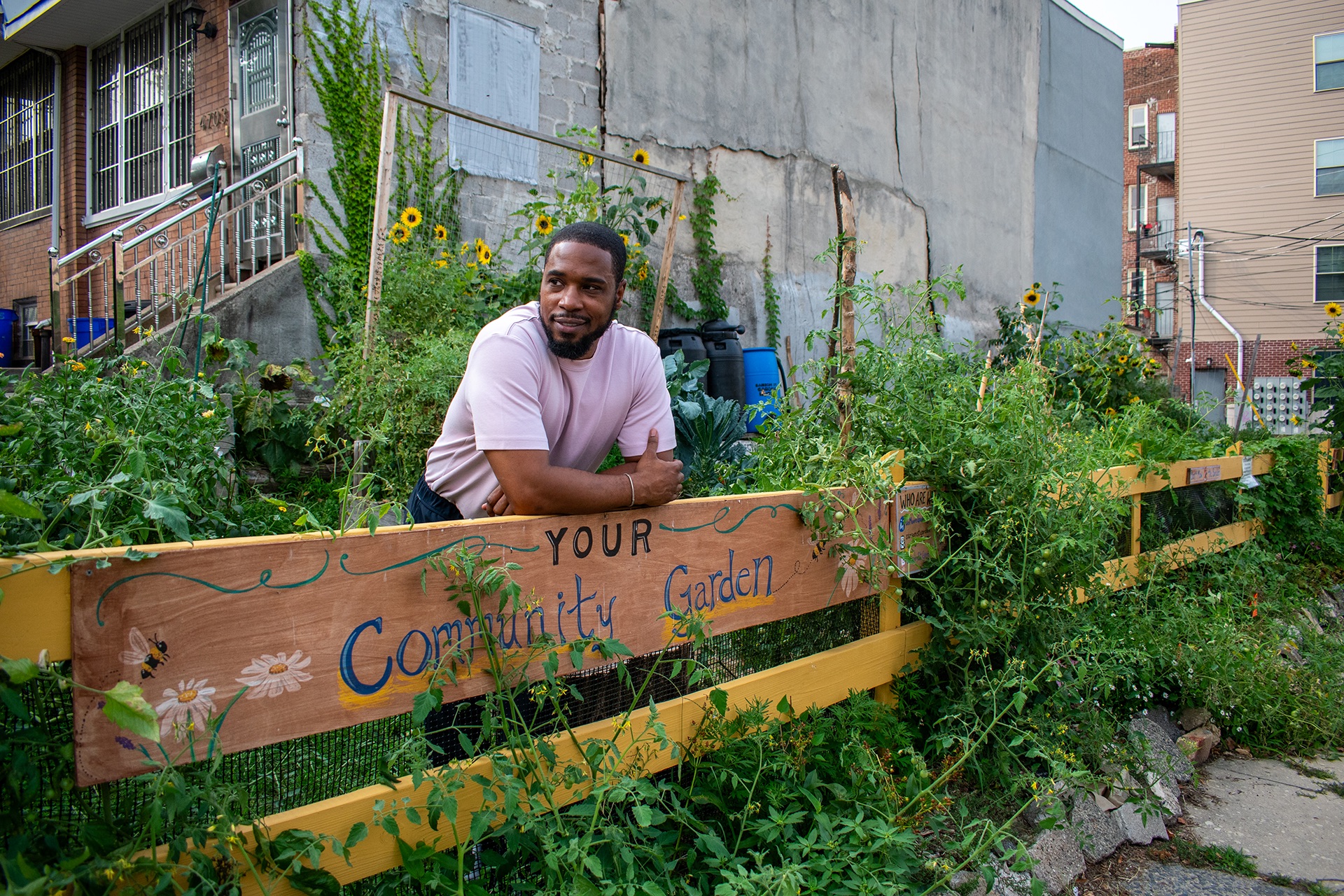
Moore says he’s “on a redemptive path,” and so is that once-neglected lot. Since 2021, Moore and his neighbors have turned it into a community garden. On a Grid visit in July, sunflowers towered over raised beds brimming with kale and cucumbers, and a “pollinators welcome” sign on the fence was well-heeded: bees and butterflies patrolled the perimeter.
“It’s still not where I want it to be, where the full vision is, but it’s totally different,” Moore says.
The garden is a project of Moore’s nonprofit Do Moore Good, which focuses on restorative justice and community stewardship in West Philly. Moore, also a filmmaker, is a fourth-generation West Philadelphian and a fourth-generation community leader in Walnut Hill. His great-grandmother,
Alice Jones, rallied her neighbors to establish the playground years before he was born; a sign out front bears her name.
Returning to my neighborhood allowed me to see what it felt like my absence may have caused.”
— Shuja Moore
“Returning to my neighborhood allowed me to see what it felt like my absence may have caused,” Moore says. “Because this neighborhood represents my family and my family’s legacy, for it to be in disrepair, I felt like, was a result of not having the new generation step up as leaders.”
Founding gardener Nina Ryser moved to the block with her husband in 2020 and met Moore one night while walking their dog. Moore shared his idea for the lot, Ryser offered to help, and with a few neighbors they set out on their “epic task.”
Ryser says there’s no denying that starting a community garden is a gentrifying activity. “It was definitely a delicate-feeling project for me because a lot of people in this neighborhood, specifically on this block of Sansom Street, not only grew up on this block, but their parents grew up on this block. It’s multiple generations,” she says. She and Moore didn’t want to draw developers’ attention, she adds, but wanted a space where longtime and new residents alike could grow their own food. That mattered to Moore, whose family still lives on the block.
The lot is still City-owned. After several bureaucratic hurdles in attempting to acquire it, the group partnered with the Pennsylvania Horticultural Society to establish the site as a community garden. After PHS cleared the site of debris, Ryser and her husband built raised beds, and the first official growing season began in 2023. Now, all 17 plots are full, with 12 people on the waitlist.
Heeyoung Yim, who has lived on the block for over eight years, has gardened there since the first season. She’s often interrupted by curious passersby while tending her flowers. “People who’ve been in the neighborhood for a while, they’ve seen the transformation,” Yim says.
The reality of neighborhoods is that they change, Moore says; the question is how to continue building community as they do. For him, the garden is about “preserving neighborhood history and welcoming new neighbors into that shared responsibility.”