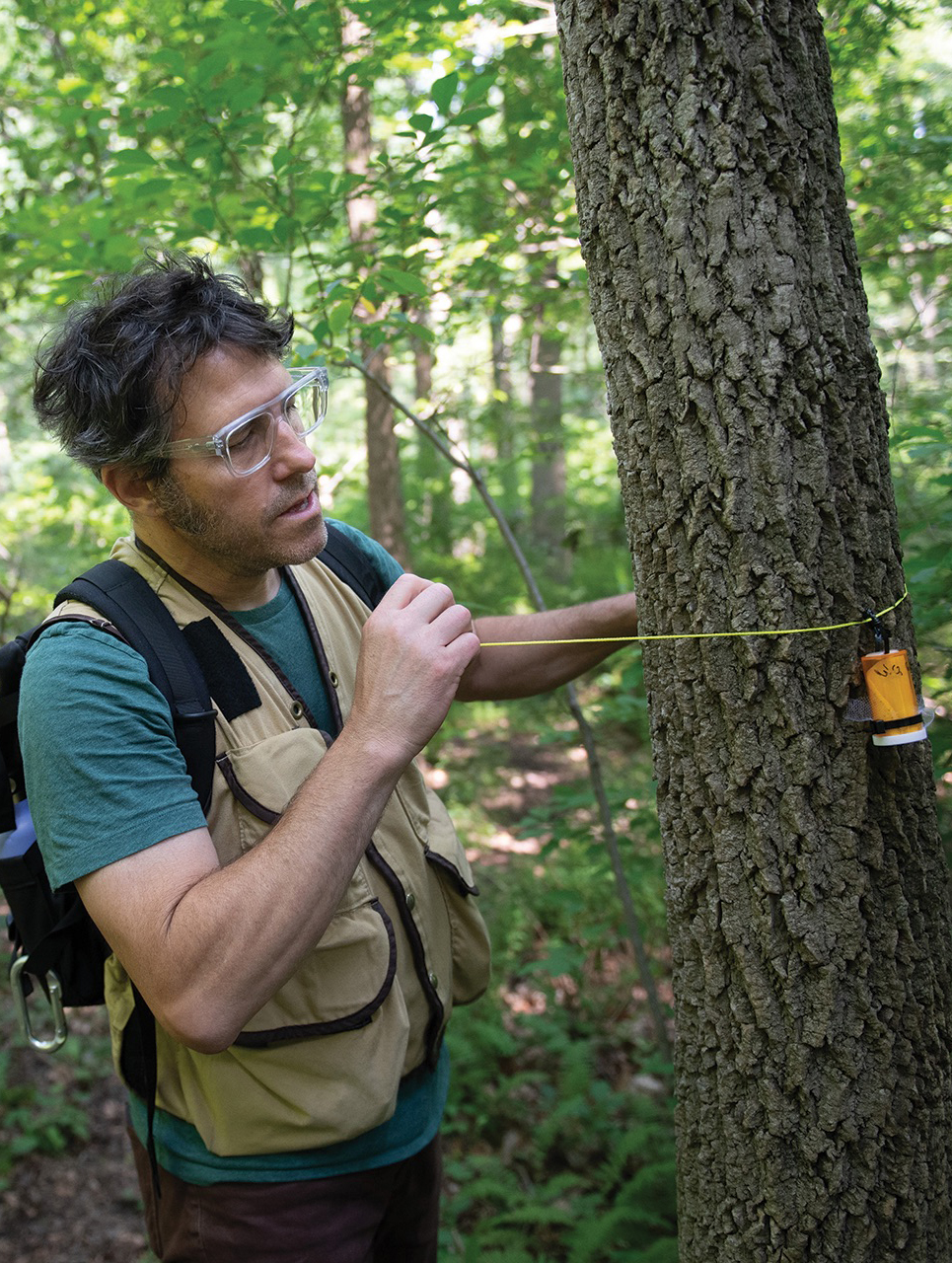
Will Ryan faces a half-dead (yet half-alive) ash tree deep in the woods of Tyler Arboretum and ties a plastic pill bottle around its trunk. Inside is a folded white paper dotted with tiny black specks that look like poppy seeds. He ties the bottle to the tree and takes off the cap. Those tiny specks are emerald ash borer (EAB) eggs containing parasitoid wasp pupae.
The invasive bright green beetles have devastated the region’s ash trees. Scientists have pinned their hopes on what they’ve dubbed “Oobinators,” pill bottles containing miniscule, stingless wasps (Oobius agrili). Once the wasps emerge from the Oobinators and find their beetle hosts, they could kill enough of them to save this ash tree and the next generation sprouting from seeds left behind.
“They have to be placed near where emerald ash borers likely will be, which means they’re no good after all the trees are dead,” says Ryan, the arboretum’s director of horticulture and land stewardship. The arboretum has cut down about 1,600 dead and dying ash trees in Tyler’s 550 acres of natural areas. Ryan’s team flagged about 25 of the dying trees to serve as release sites for the tiny, stingless wasps.
The half-alive ash tree that will host the parasitoid wasps stands in sight of taller deceased relatives, whose trunks and thick branches still stand, waiting for enough of their roots to rot away and a strong gust of wind to knock them over. Others have already fallen. Now they are long logs that make it difficult to walk off trail, and that prospect has been made more challenging by the dense, thorny Japanese barberry thickets that have taken advantage of the sunlight streaming through the new gap in the canopy.
Emerald ash borer was first detected in North America in 2002 in southeastern Michigan and has since spread to 38 states and the District of Columbia, according to the USDA. In the process, the beetle has killed virtually all the ash trees in its wake. Emerald ash borers start off as larvae (grubs) eating the inner bark of ash trees. Over the course of a few years, as thousands of the larvae eat away at the tree, it weakens and dies.
The goal is to get enough parasitoids out there that they can reproduce and be self-sustaining.”
— Ron Weeks, entomologist, USDA
Soon after the EAB appeared, the USDA began searching for their enemies in East Asia, where the catastrophic beetles are native. The goal was to find some that could serve as biocontrol for the emerald ash borers. Though the search continues, says Ron Weeks, an entomologist with the USDA, four species of parasitoid wasps have been cleared for release as biocontrol agents.
Parasitoids are midway between parasites and predators. Usually wasps or flies, they live on or inside their hosts and kill them in the process. About a fifth of all insect species could be parasitoids. Of the four EAB parasitoids released in the States, three develop on or inside the EAB larvae, one inside the eggs. Since emerald ash borers are only a half inch, the wasps that develop inside their larvae and eggs are downright miniscule.
It isn’t easy to vet and raise the wasps. Potential biocontrol agents have to be evaluated at secure laboratories to avoid accidentally releasing a species before they confirm that it won’t cause problems of its own, Weeks says. Researchers had to make sure that the parasitoids successfully kill EABs without wiping out related native beetles. “The process to get the release permit can take anywhere from five to 10 years,” Weeks says.
The tiny wasps can only develop inside EAB larvae and eggs, and the beetles only reproduce once per year. Since the beetle larvae only eat the inner bark of ash trees and the adults eat ash leaves, the labs need a steady supply of both.
The USDA has ramped up releases, meaning they continue to need to source EAB and their food to sustain the indoor colonies of parasitoids. But in the meantime, the emerald ash borers have killed nearly all the trees near the labs. “It is getting more difficult,” Weeks says. “They’re having to go farther to get the ash logs.” They also have to source ash leaves from California and Puerto Rico to help maintain the colonies through the winter.
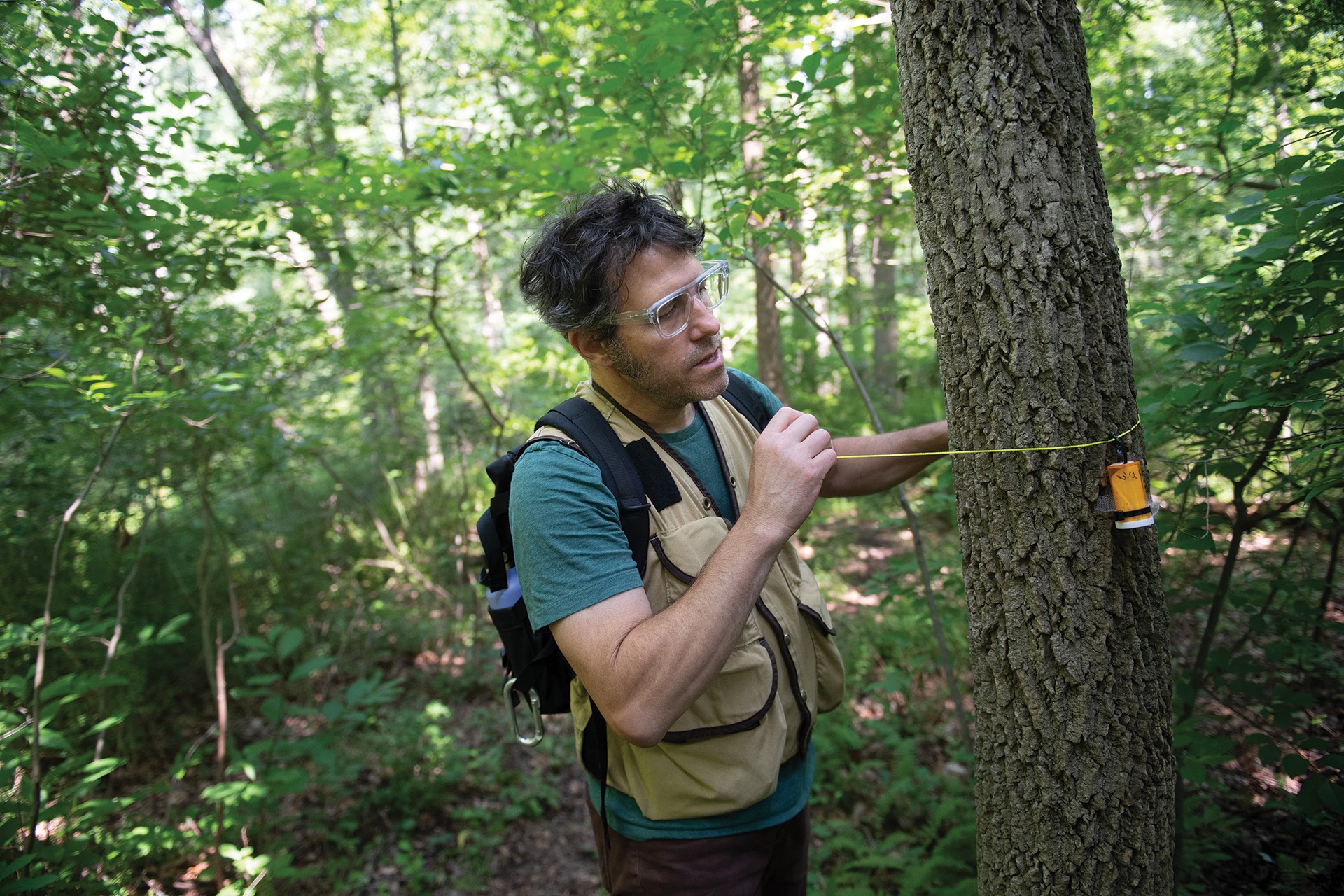
Tyler, one of three sites chosen in Pennsylvania, released its first round of EAB parasitoids in 2025. The releases, which employ multiple species of the biocontrol wasps, have continued this year. In addition to the wasps shipped in pill bottles, some arrive as adults in plastic cups, and others in small sections of ash wood (“bolts”), which Ryan also ties to ash trees.
“The goal is to get enough parasitoids out there that they can reproduce and be self-sustaining,” Weeks says. The tiny wasps have begun spreading out from earlier release sites, an indication that the strategy is working. Weeks stresses that this kind of biocontrol is one of multiple tools to recover the trees, along with treatments for particularly valuable individual trees and propagation of ashes that are naturally resistant to the beetles.
Success won’t happen overnight. “What it looks like if it works is a slow recovery of ash species as components of our forest,” Ryan says.
And if the threat to ash trees wasn’t enough, Tyler’s beech trees are now suffering from beech leaf disease. Parasitic nematodes (microscopic worms) cause the leaves to shrivel and die. It typically kills beeches within 10 years. Ryan says the arboretum is experimenting with two approaches to helping 250 of the afflicted trees: a treatment to kill the nematodes as well as nutrient supplements. But so far, there is no solution for the disease at the scale of the forest.
The parasitoid wasp releases and the beech tree experiments are part of a broader strategy to maintain Tyler’s forest canopy long-term, as important components fade and (hopefully) return. “This is just one piece of a tree conservation program at Tyler, where we look at how to support all of the native canopy species.”