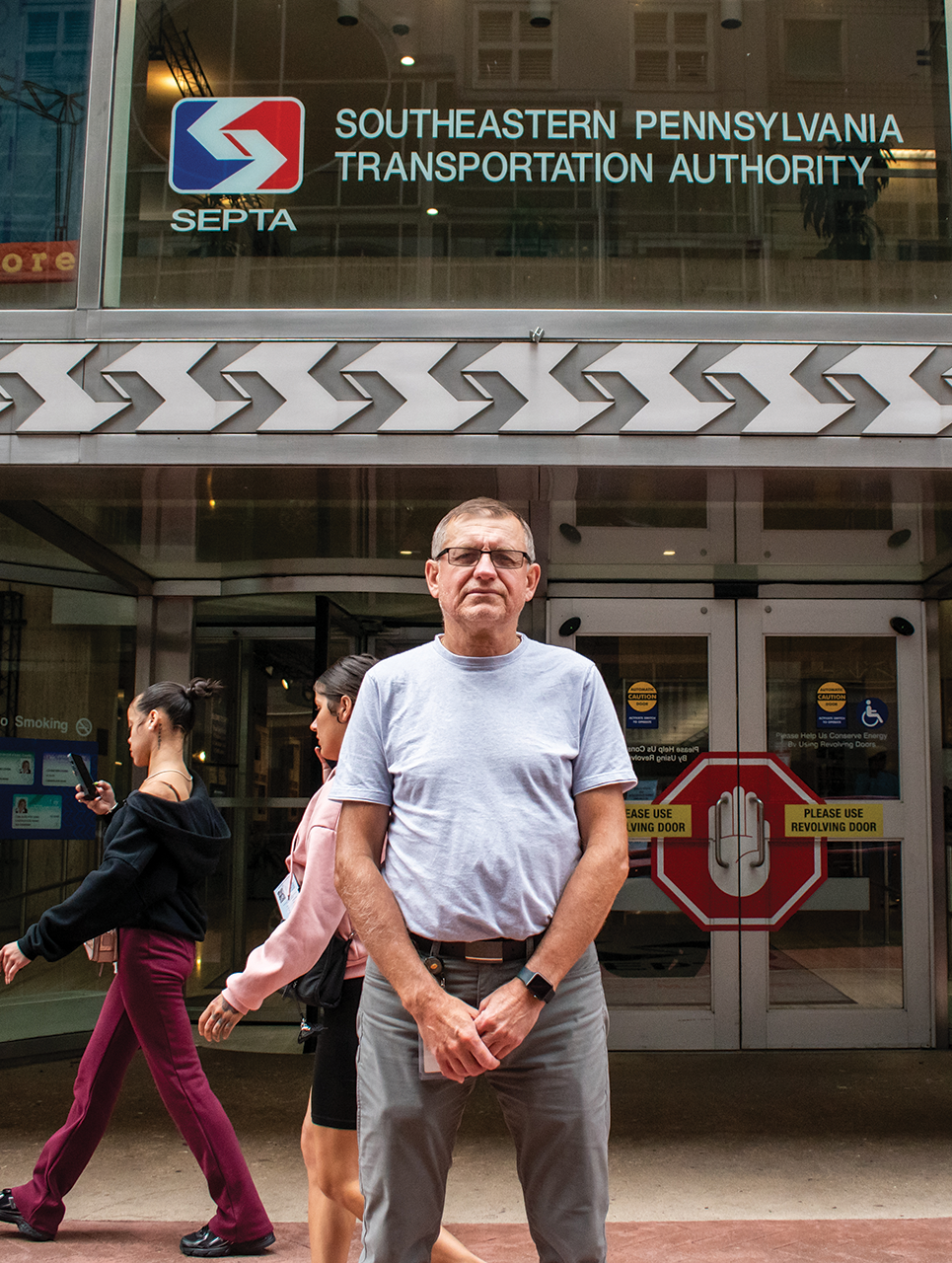
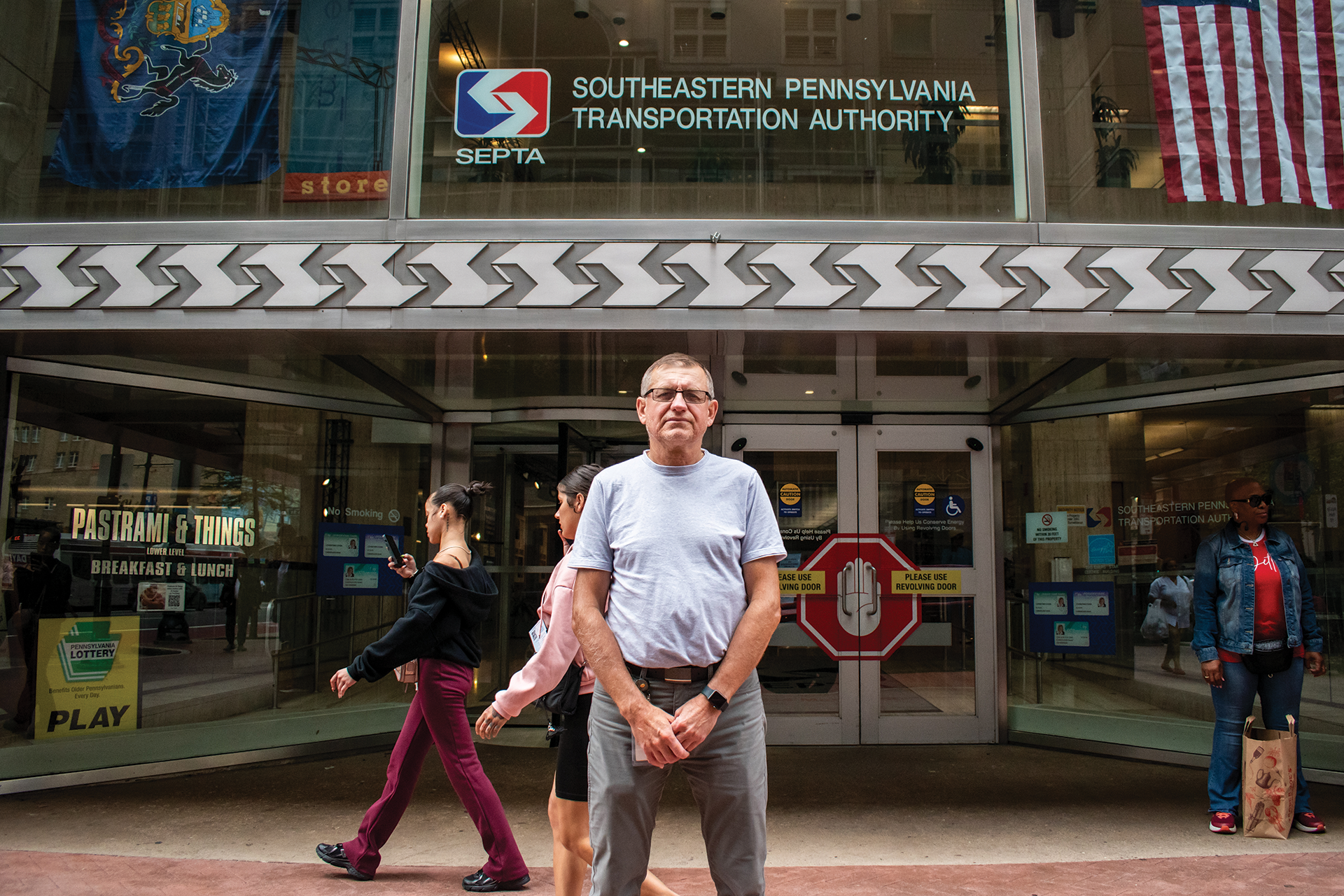
Like many deaf Americans, Igor Khmil usually uses American Sign Language (ASL). But when he is helping another deaf individual access public transit information — about routes or fares or schedules — he cannot communicate with SEPTA staff in ASL, as there are typically no interpreters in the transit authority’s stations. Instead, he has to write back and forth with SEPTA staff in English, which can — thanks to mistranslations and logistical complications — lead to service delays.
For many deaf and hard of hearing Philadelphians, these miscommunications with public transit staff are a regular occurrence. But one local nonprofit says that bringing ASL interpretation to SEPTA could be as simple as scanning a QR code.
Liberty Resources, a Center for Independent Living supporting individuals with disabilities, is advocating for SEPTA to invest in video remote interpretation (VRI) services at its 1234 Market Street headquarters.
VRI uses video conferencing technology to provide a live ASL interpreter when an in-person interpreter is not available.
Liberty Resources advocates for the independence of disabled people through a combination of peer support, information and referral services, and both individual and system-wide advocacy.
Khmil, a deaf advocacy and independent living specialist at Liberty Resources, leads a deaf advocacy peer group. On “probably about 10” occasions, he has helped deaf SEPTA riders who have had difficulties communicating with SEPTA staff when attempting to apply for a reduced fare card or locate route information.
We’re wanting the VRI so that … the deaf individual can understand without having to write back and forth.”
— Igor Khmil, Liberty Resources
“We’re wanting the VRI set up there, so that if the people there are speaking, the deaf individual can understand without having to write back and forth,” says Khmil.
Using written English can lead to miscommunications and frustrations for deaf riders, Khmil says. Writing or typing out questions and waiting for the staff member to respond in kind takes a long time and creates gaps in the conversation, whereas VRI would offer a live ASL interpreter, making the conversation more efficient and effective.
“ASL is its own unique language. It’s not like English. Completely different verbiage, sentence structure,” says Morgan Hugo, senior independent living specialist at Liberty Resources.
As with any technology, VRI has limitations, namely that it relies on a high-speed internet connection to visually display interpreters’ signs clearly and without freezing or lagging.
Khmil first reached out to SEPTA about setting up VRI access in 2022 and was in talks with the agency about setting up a tablet with VRI access, but the installation has yet to take place.
Earlier this year, New York City’s Metropolitan Transportation Authority (MTA) began piloting VRI at its customer service centers with the help of deaf-owned company Convo, which allows riders to scan a QR code and connect to live ASL interpreters anytime.
Khmil saw a news story about New York’s program. “I was thinking, that’s what they need in Philadelphia. That’s the same thing I’ve been reaching out to them for.”
Khmil says that SEPTA has been “dragging out” the process of setting up VRI. He hopes to see the agency follow the MTA’s lead and explore the possibility of a QR-code based system that relies on riders’ phones instead of a tablet or laptop for VRI use.
In an emailed statement to Grid, SEPTA did not comment on the possibility of a QR-code system as an alternative to tablets. Agency spokesperson John Golden wrote that the agency’s funding crisis “has halted any IT enhancements regarding the implementation of new technologies.” But with the recent fare hike, plus service cuts and quick rollbacks in September, access to updated route information and reduced fares is more essential now than ever.
“Regardless of if they have the money or not, it’s just things that should be provided. Accessibility, communication for the deaf is just something that’s necessary,” says Khmil.
With the city poised to host the FIFA World Cup and many other events in 2026, Khmil and Hugo would like to see VRI in place at SEPTA HQ at 12th and Market streets as soon as possible and expand to other places — like 30th Street Station, Philadelphia International Airport and other major transportation hubs — by next summer.
“As a city of brotherly, sisterly love, no matter how our visitors come in here, and what modes of transportation that they use, if it’s SEPTA, Amtrak — all of those modes of transportation should be accessible to those who are deaf and hard of hearing,” says Hugo.
 This special section is a part of Every Voice, Every Vote, a collaborative project managed by The Lenfest Institute for Journalism. The William Penn Foundation provides lead support for Every Voice, Every Vote in 2024 and 2025 with additional funding from The Lenfest Institute for Journalism, Comcast NBC Universal, The John S. and James L. Knight Foundation, Henry L. Kimelman Family Foundation, Judy and Peter Leone, Arctos Foundation, Wyncote Foundation, 25th Century Foundation, Dolfinger-McMahon Foundation, and Philadelphia Health Partnership. To learn more about the project and view a full list of supporters, visit