
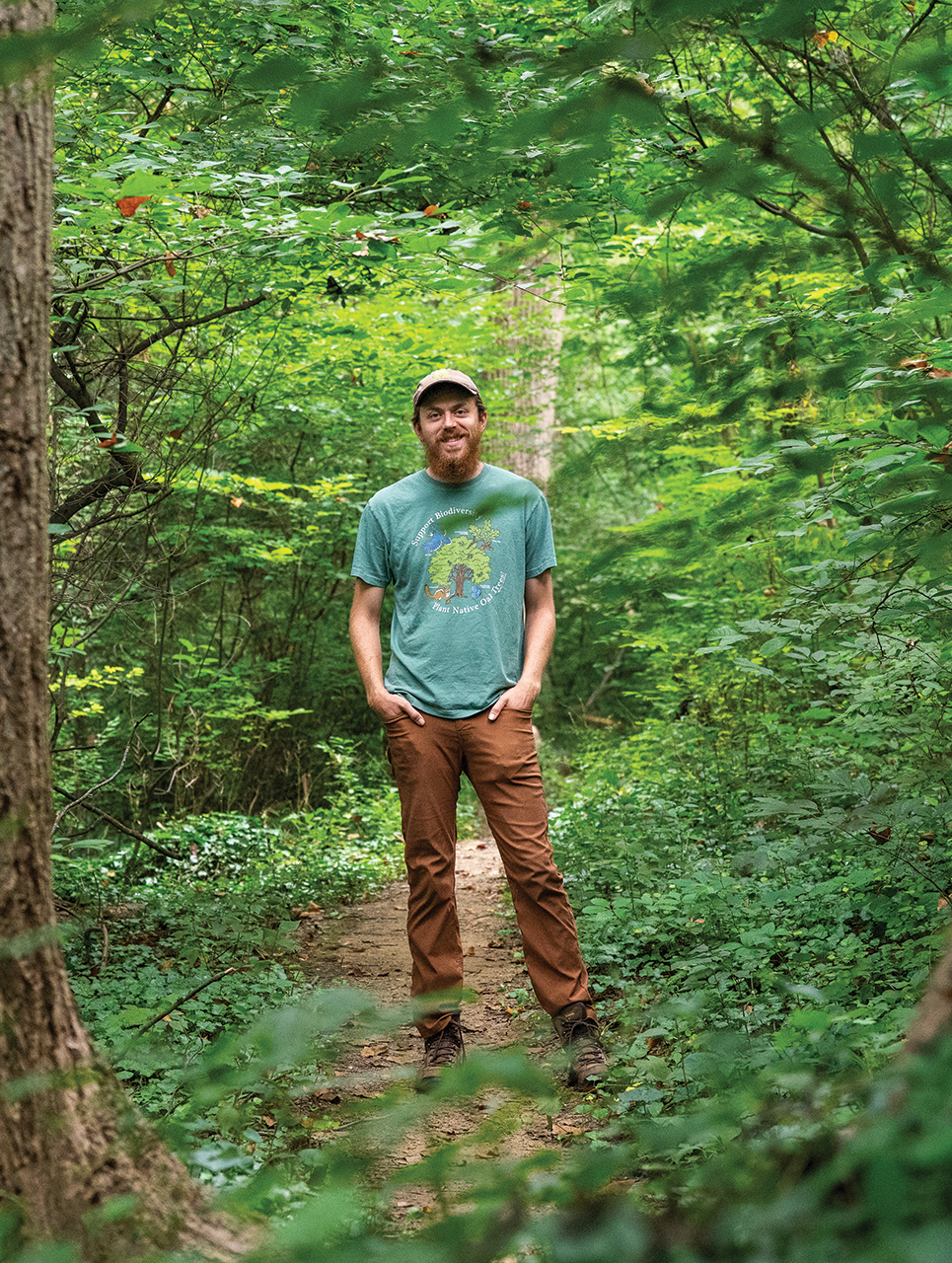
In June 2023, I followed my friend Josh Ferguson from Keystone Permaculture past old, arching oaks and tall tulip poplars along a path in Carpenter’s Woods in Wissahickon Valley Park in search of a rare and intriguing pair of trees he had heard about. We eventually arrived at two initially normal-looking trees: a 45-foot tree that was growing towards a gap in the forest canopy, and a smaller 20-footer nearby. The taller tree’s blooms were on the wane, and long, fragrant stalks of creamy white flowers littered the forest floor. I took a closer look. We had found what we were after — two healthy, apparently blight-resistant American chestnut trees. These were the largest ones I’d ever seen.
Just over a century ago, the American chestnut (Castanea dentata) dominated much of the woodlands east of the Mississippi River. The trees provided an abundance of nuts to wildlife and humans alike and supported pollinators with their plentiful summer flowers. The species was essentially wiped out in the early 1900s by an introduced pathogenic fungus called chestnut blight (Cryphonectria parasitica).
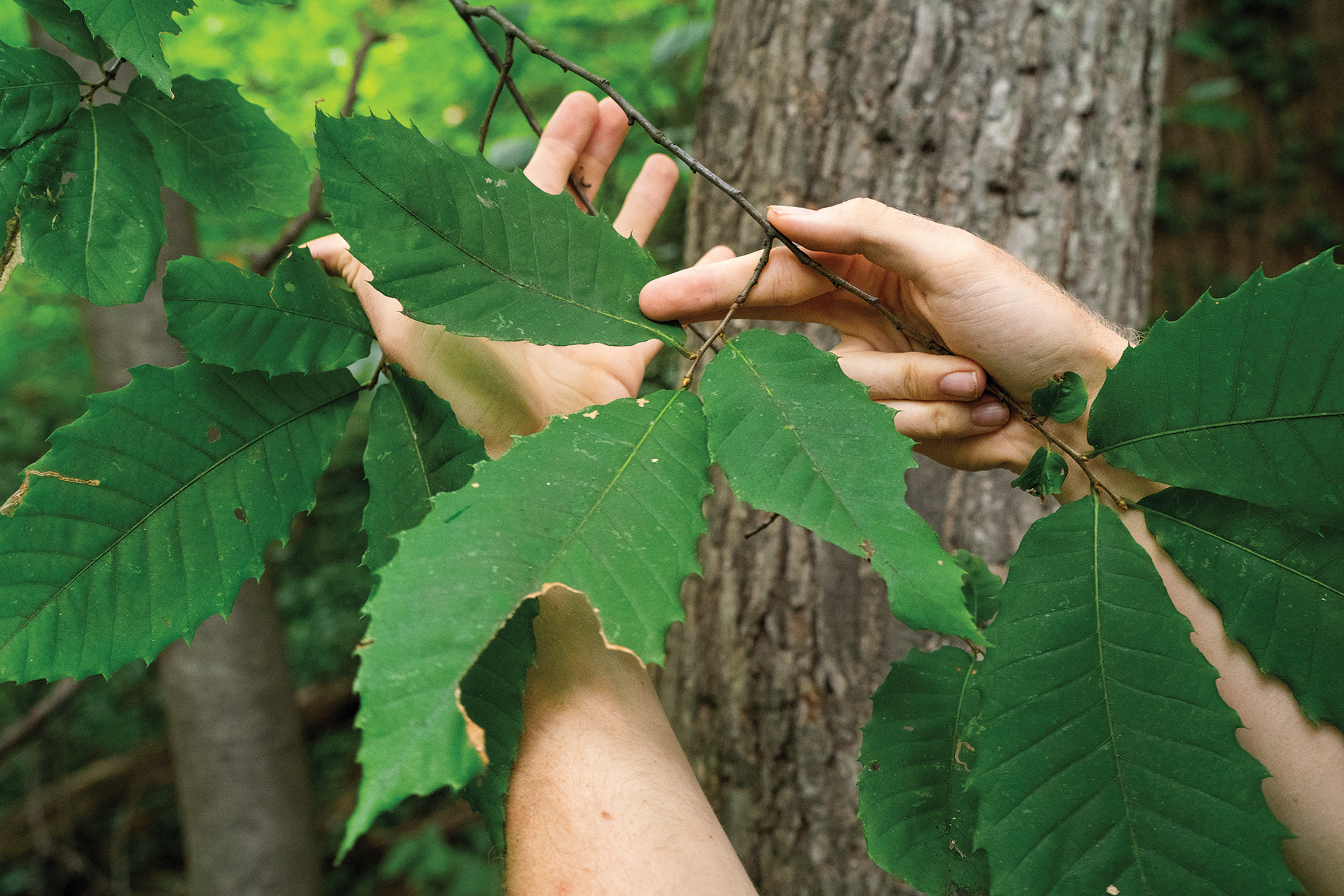
The Carpenter’s Woods chestnuts are puzzling for a few reasons. First, it’s unclear if they are resistant to the fungal pathogen and thus considered “survivor trees,” or if they have somehow avoided being infected in the first place. Chestnuts that have been infected usually bear scars. Even resistant trees have cankers (patches of dead tissue) caused by the fungus. Josh and I didn’t see any cankers, though, which may suggest that the trees have never contracted the fungal infection. But this is quite unlikely, since the pathogen not only is spread far and wide by birds, insects, other animals, wind and rain but also can persist on oak trees, which are abundant in Carpenter’s Woods. American chestnuts found elsewhere in Wissahickon Valley Park exhibit the growth patterns typical of trees susceptible to the blight; after dying back from the fungal canker, an infected chestnut uses any stored energy to resprout at its base. And if the Carpenter’s Woods specimens are indeed resistant survivors, questions about their origin arise. In the middle of the woods with no trees known to be resistant nearby, how did they get there?
The Carpenter’s Woods chestnuts are puzzling for a few reasons.
In late 2023, I sent leaf and twig samples from both trees to the Pennsylvania-New Jersey chapter of the American Chestnut Foundation for testing, and both were confirmed to be pure American chestnuts. This exciting result ruled out the possibility that the trees could be resistant hybrids of Castanea dentata and Castanea mollissima (Chinese chestnut).
I revisited the trees in the fall of 2023 to see if the larger tree had yielded any nuts that could be grown, shared or perhaps used for research plots. The findings were a bit disappointing but not unexpected: chestnuts develop inside husks, and most of the tree’s husks contained only shriveled, unfertilized nuts. An American chestnut needs to cross-pollinate with another chestnut tree to produce fruit. Although mostly unable to self-fertilize — the male and female flowers on a given tree mature at different times — a few fertilized nuts will appear on a standalone tree on occasion. I found one apparently viable nut — it appeared plump and healthy — but my attempts to germinate it failed.
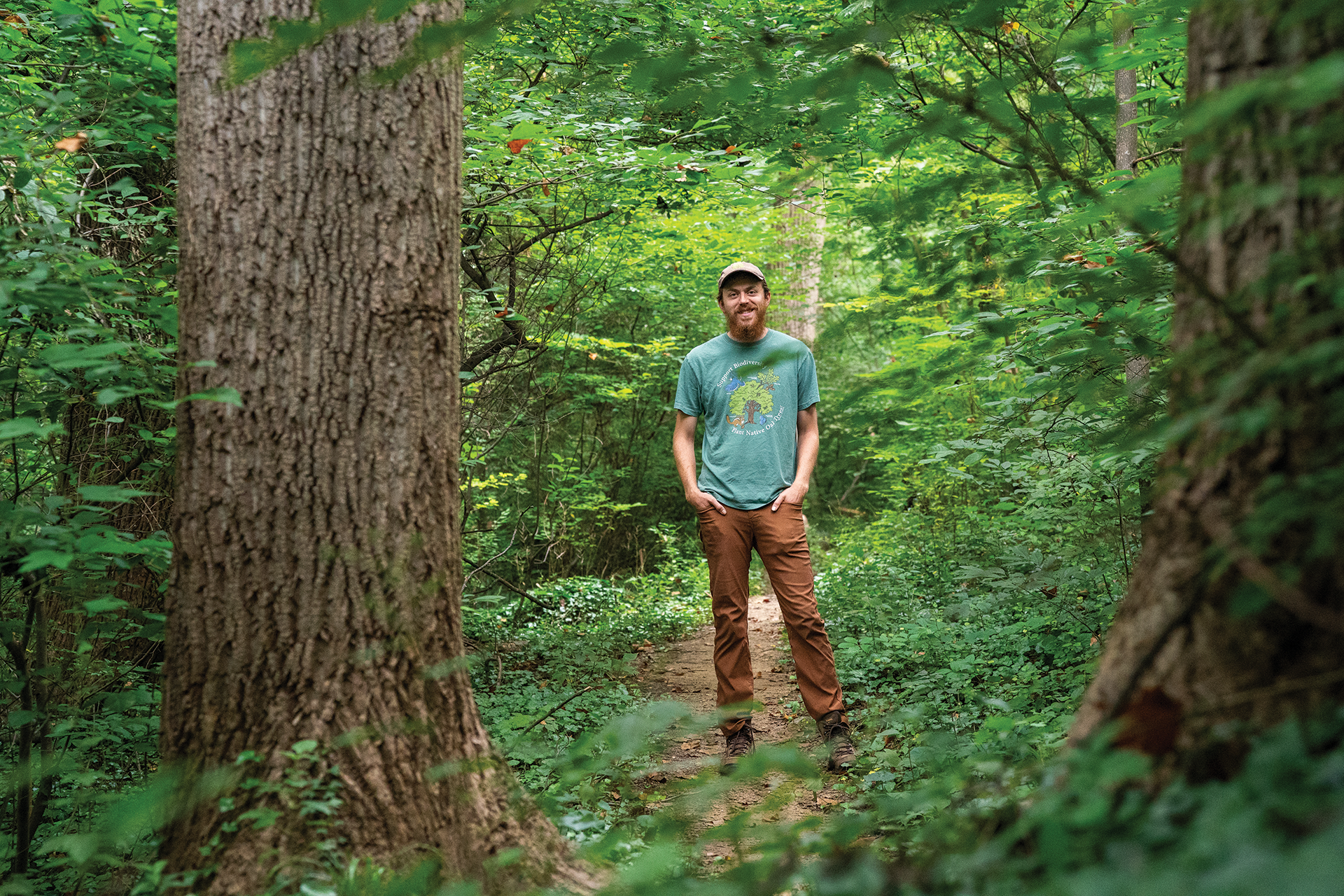
I’ve been checking on the trees each year to see if the younger one will begin to flower. If it does, that could allow the two trees to cross-pollinate. Another option is to manually pollinate the flowers of the larger tree with the pollen of a known survivor tree from another location. This would require coordination, some tree climbing and careful hand-pollination skills. If anyone is interested in helping to pollinate the tree next spring, send me a message on Instagram @andrew_the_arborist.



Andrew ,
I would consider this venture but need to know a lot more to coordinate with you. Please send me your initial plans and thoughts on all that you have so far. Thank you.
Terrific story. I’ve been fascinated by the Chestnut Tree story since being a kid in North Jersey. There was a neighborhood section with tree names. Where were the Chestnuts I wondered?
Congratulations Andrew, on this remarkable find! Can the trees be propagated with tissue culture means? I am so excited about the possibility of naturally resistant trees (as are so many of us tree huggers). Based on the size of the trees how old do you suppose they are, and how does that match up with the timing of the blight in the local woods? Thank you.
I live in California, but I visit elkins Park Pennsylvania every six or seven weeks to visit grandkids. I would love to meet up and see this Tree if anyone is interested and knows how to find it. I’ve recently planted healthy American chestnuts, survivors from the 1860s near Auburn California, in Woodland city parks. One of them now has chestnuts on it!
I am local in ROX. Might be a couple of these trees on 300 Hermitage Street, on the grounds adjacent to stands of RHS football field. From the street, check across from 347 .Might be another one further up that hill, more accessible from the track. Because of a recent, tragic accident at the track, there was removal of some wooden light standards that MAY have included some nearby tree pruning, and this maintenance included the area near the second tree I mentioned, up the hill close to track., on the turn closest to stands.
Might also be a smaller one by traffic light in ShopRite parking lot at Paoli. Saw an older Asian lady gathering the fallen nuts at ShopRite and at Hermitage Street a few times over the years.
Hi Andrew. This is really interesting to me because when I was a boy, hunting with my dad in the Philly burbs, we found a native American Chestnut tree growing in the woods. It was young relative to the massive oaks around it, but mature enough to bear fruit. It likely was a seedling when the blight hit in the 1900s. Under it was a 2 year old sapling. Dad dug it out and planted it on his property in upstate PA. Its now 50yrs old, 60ft tall, and bearing fruit and has offspring of its own. I am unaware of other American Chestnut trees nearby, but several Chinese Chestnuts are present. You could get a look at it, as it appears in one of my videos on YouTube entitled: “Introducing the Flopper Knot”. I would love to chat more. Incidentally, the original tree and it’s a forest here in the burbs are gone due to development.
Anytime you want to see C. dentata in bloom and fruit drop me a note. I have been studying them for many years and have 3 in our yard from nuts I collected locally. We live just south of Shartlesville in Berks County. I have located and documented over 10,000 stems along the Appalachian Trail and other places.
Right now they are dropping the burrs , which appear to need a high humidity day or light rain to burst open – the physics of what happens in this process is fascinating.
I have an MS Ecology with non-native invasive plants being my general area of focus.
I don’t climb trees but I’d love to come and photograph the event. And to look for Curculio caryatrypes.
A very simple thing to do would be to take a few cuttings, grow them to a sufficient size, and inoculate them with blight fungus spores to see how they react. I saw a similar article to this about a population of trees in Maine. Once again, they should do the same thing. Many years ago, I saw an ~ 50 Am. Chestnut that was very healthy looking. This was in Pasadena, MD along a busy highway. I went back a number of years later and couldn’t find it. My guess is that it probably succumbed to the blight.