Please be sure to check the event organizer’s website for any last-minute changes or cancellations prior to attending.
Have an event that will fit well on our calendar?

- This event has passed.
Profs & Pints Philadelphia: Fake News and War of the Worlds
Profs and Pints Philadelphia presents: “Fake News and War of the Worlds,” a look at an infamous Orson Welles broadcast as an early lesson on mass media’s dangers, with Daniel H. Foster, associate professor and chair of liberal arts at Johns Hopkins University’s Peabody Institute.
On the evening of October 30th, 1938, somewhere between 6 and 12 million Americans tuned in the radio version of New York City’s experimental Mercury Theater. It was a decision that some, no doubt, came to regret. What they heard was an all-male chorus of talking heads—scientists, journalists, politicians, and military experts—repeatedly telling them that New Jersey was being invaded by Martians.
The ensuing hours were alarming ones for those who did not realize they were listening to Mercury Theater on the Air’s adaptation of the classic H.G. Wells science fiction novel War of the Worlds. The performance, directed by and starring Orson Welles, pushed the still young medium of radio drama further than many had pushed it before. Its masterful use of music, sound effects, and especially silence showed how radio could ignite the imagination and make listeners fear the worst.
Revisit that classic moment in media history, and learn what lessons it holds for us today, with Professor Daniel Foster, who over the years has taught the “War of the Worlds” broadcast as part of courses in radio, theater, and sound studies at several universities.
His talk will go beyond the trivia and urban legends surrounding the broadcast and focus on the broadcast itself, to reveal what really happened and why it mattered. He’ll look at the broadcast not just as a moment of public panic, but a daring work of art.
Aired during a period of rapid modern change, marked by the rise of dictators in Europe to the recent fiery destruction of the Hindenburg, the “War of the Worlds” broadcast tapped into widespread anxiety about new technologies and invading forces. Often labeled as an early case of “fake news,” it exposed deep questions about the institutions listeners trusted: education, the media, government, and the military.
To emphasize the mischief radio can bring to the world, Orson Welles, at the end of the broadcast and in person, compared the radio to a jack-o-lantern and warned us to beware this “invader of the living room.”
Answering questions about the performance, its historical context, and radio as a medium—new, blind, and global— isn’t merely an academic exercise. It can help us better understand how fake news works today and how to detect such lies before they cause irreparable harm. (Advance tickets: $13.50 plus processing fees. Doors: $17, or $15 with a student ID. Doors open at 3:30 pm. Talk starts at 4:30.)
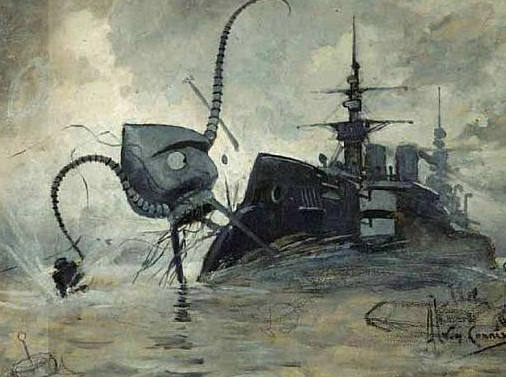
Image: A Henrique Alvim Corrêa illustration from a 1906 edition of War of the Worlds (Wikimedia Commons).