The air in the Delaware Valley’s industrial corridor doesn’t always smell nice. Major odor events assaulted the noses of Delaware County residents in 2019, 2020 and, most recently, last fall. During the 2019 event, Clean Air Council director of programs Eve Miari tried to check air quality readings from the Pennsylvania Department of Environmental Protection monitoring equipment in Marcus Hook. “When we went to access the data, it missed it by two hours,” she says. The monitor worked by capturing air in canisters at intervals, and whatever had caused the odor had leaked out between samplings. In early 2025, Clean Air Council launched an EPA-funded network of air quality monitors to ensure that no leak would go undocumented again.
The network stretches from Southwest Philadelphia through southern Delaware County, along an industrial corridor that dates back centuries. “Pretty much the entire waterfront is industry,” Miari says.
Miari and Clean Air Council’s Russell Zerbo rattle off a list of industrial facilities along the stretch, including the power plant in Eddystone, the Monroe Refinery in Marcus Hook and the Reworld (formerly Covanta) trash-burning power plant and Kimberly Clark paper mill in Chester. Additionally, highways intersect at multiple points (I-76, I-95, I-476), bringing tailpipe emissions from millions of cars and trucks into the surrounding communities. “We have more bad air quality days than good. These frontline communities are bearing the brunt of the impact,” Miari says.
Clean Air Council piloted air quality monitoring in this industrial corridor in collaboration with Johns Hopkins University, using two stationary monitors and mobile sensors mounted on a van. “We got some great data,” Miari says, “but it was just one month.”
The grant to fund a larger network was approved by the Biden administration’s EPA, but the Trump administration’s early efforts to cancel funding for environmental justice programs left the follow-up monitoring network in doubt, forcing Clean Air Council to race to set up monitors last winter while they still had the grant money.
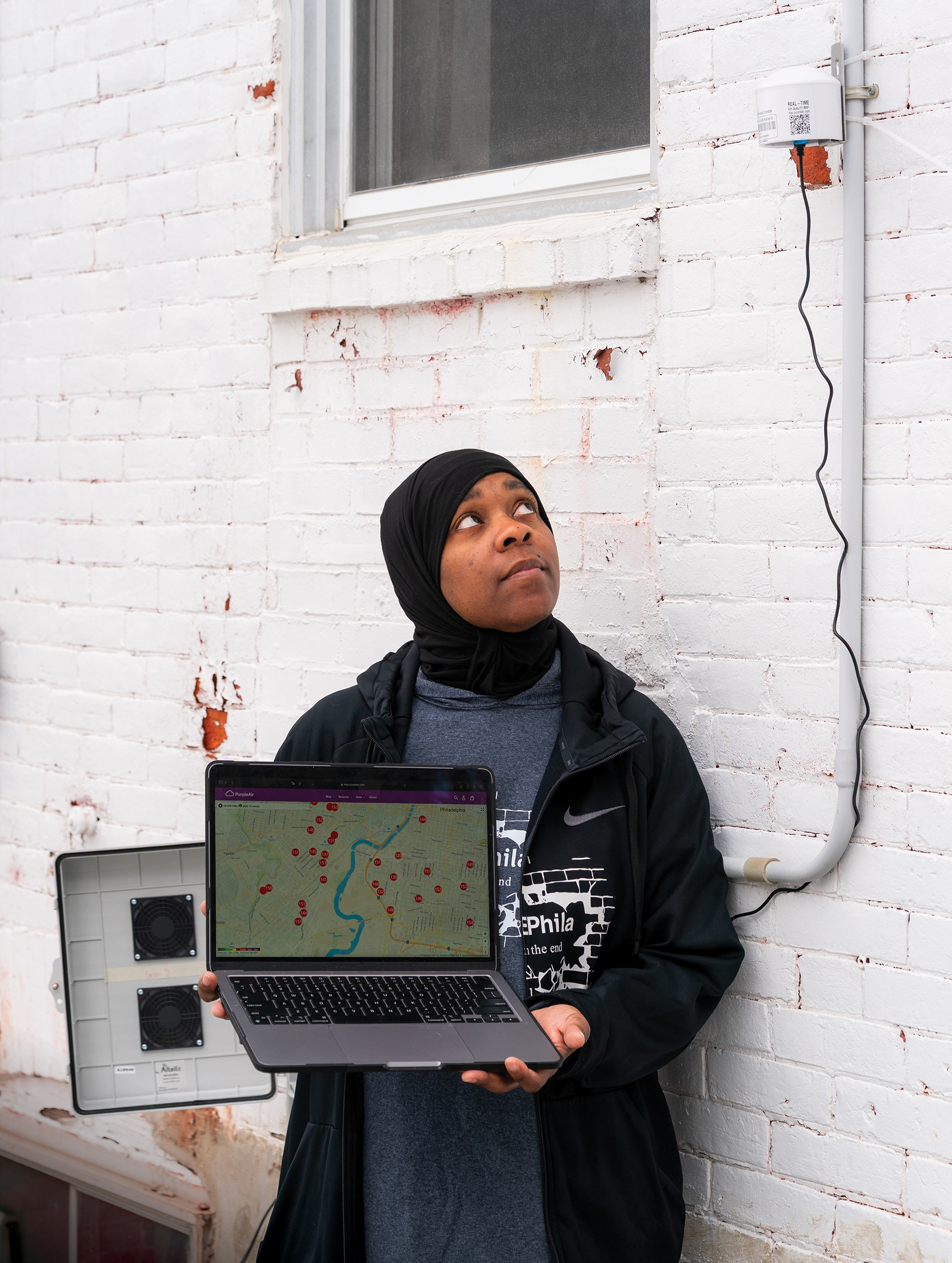
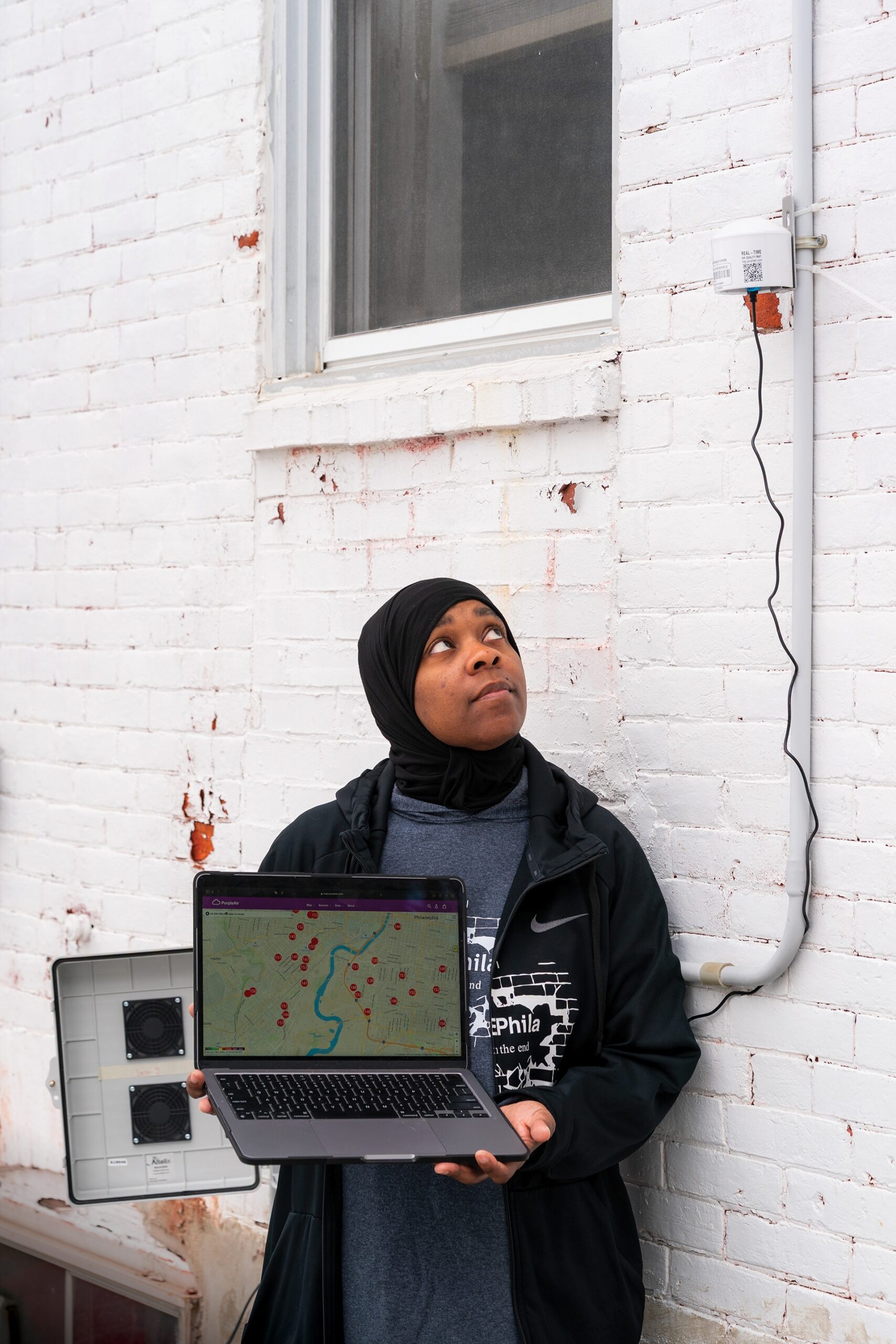
Olivia Collier found out about the monitoring program at a block captain event over the summer and was eager to get an air quality monitor on her block. Living in Southwest Philadelphia qualifies her to host a monitor, but she has a pollution source to deal with even closer to home.
Collier has been struggling with neighbors who park and maintain construction vehicles, which is illegal on a property zoned as residential. “I wake up to the smell of fumes and diesel,” Collier says. “I have a youth program. I could do so much in my yard, but can’t do it because I’d put people at risk.”
Her calls to 311, Licenses and Inspections (L&I), district council member Jamie Gauthier’s office, and other City officials have yet to resolve the problem. Last March, L&I did find that the neighboring property owner was operating without the right use permit, which could result in a fine of $300 per day. Grid reached out by email to L&I for comment. “Code Enforcement Inspectors will return to the property for an updated inspection and issue a Cease Operations Order if the conditions remain the same. Immediately after, we will ask that the case be elevated to court-ordered enforcement,” a City representative said. For now, though, Collier says the fumes still waft across her fence.
Ultimately, the EPA did not cancel the grant (though another EPA-funded Clean Air Council program to monitor a refinery in Delaware was defunded), and the network now stands at 10 volatile organic compound sensors and 60 PurpleAir monitors. Miari and Zerbo say that the program has been extended from two years to three



Great idea and initiative!
We need this for noise pollution too. I am sick of having my hearing assaulted by loud cars. Research shows this is terrible for the health of people that live here.