In the nine years Julia Jackson lived in Manayunk, just a few streets from the Leverington Avenue bridge, she witnessed her fair share of flooding — and Venice Island residents using the bridge to evacuate from their homes during floods. When she saw that the paper mill site at the island’s northern tip had been sold to a construction company and the mill demolished, she, like many other Manayunk residents, wondered: Is there going to be more real estate development there, leaving residents stranded on Venice Island when the rains come?
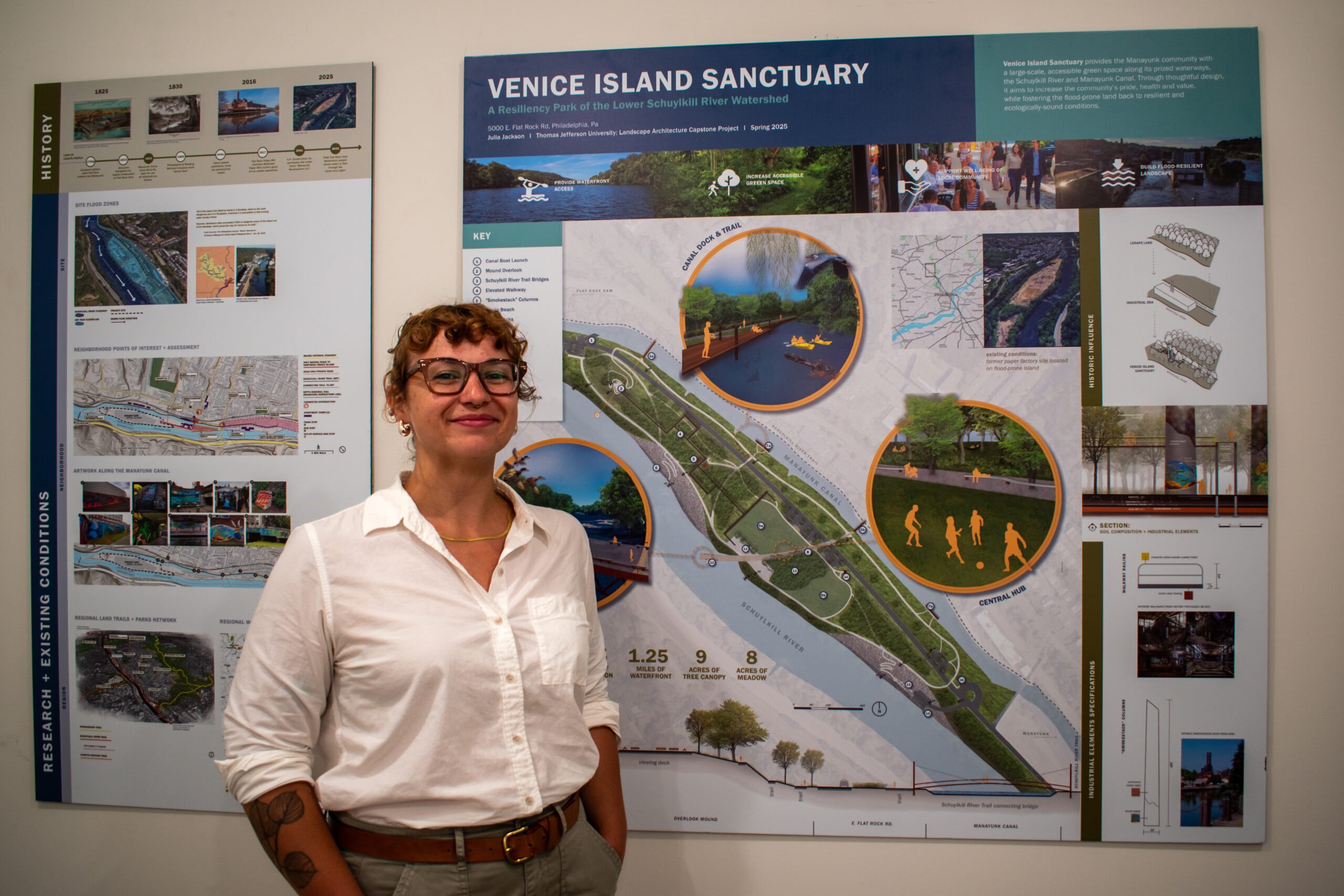
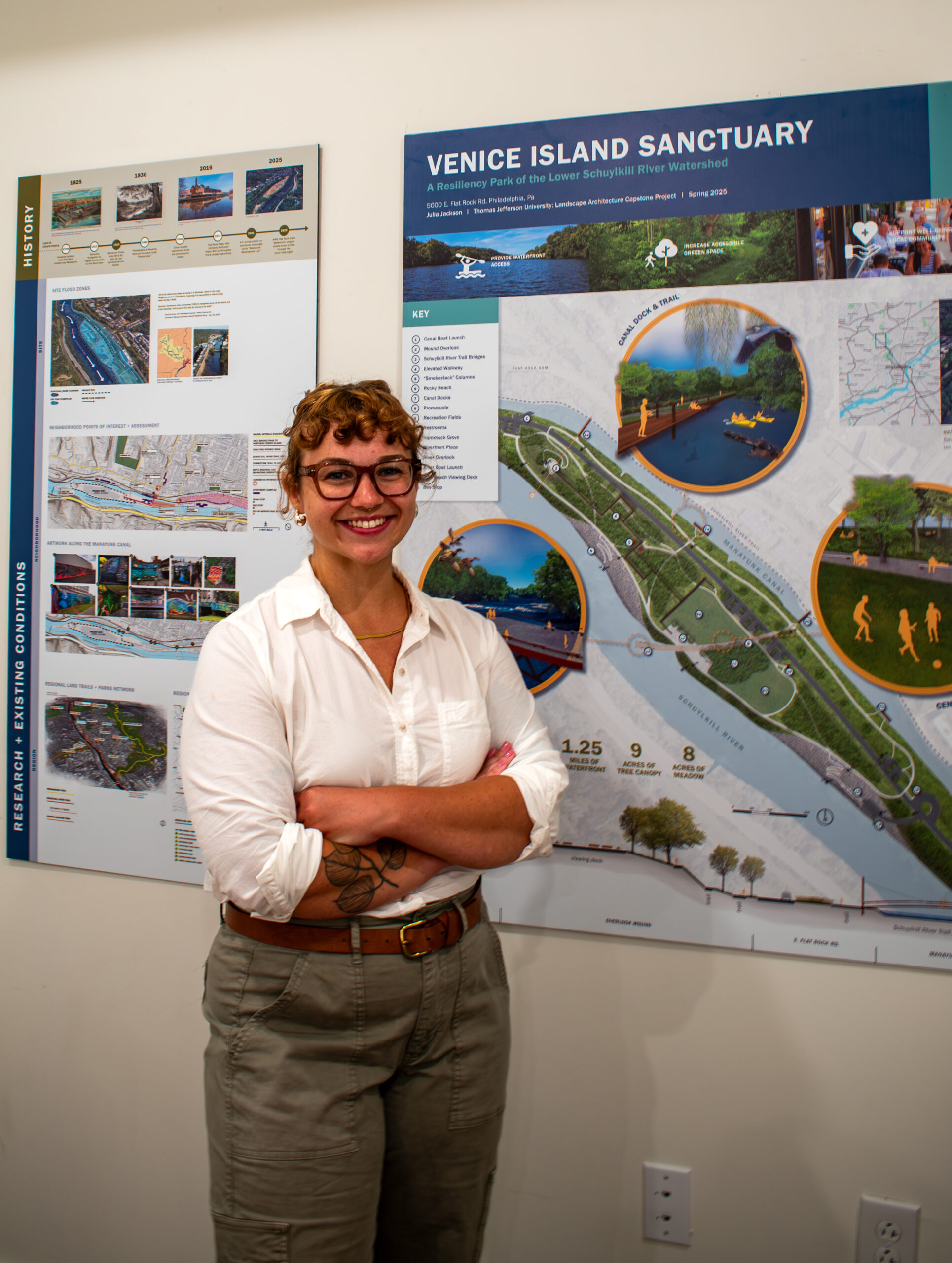
For her landscape architecture degree at Thomas Jefferson University, Jackson designed Venice Island Sanctuary, a 30-acre resiliency park at the former PaperWorks mill site. Her proposal outlines implementation of a topographic and landscape design to reduce flooding impacts downstream.
“These resiliency parks are so important,” says Jackson, “especially on this northern end of Venice Island where the water is going to hit first before it comes down to Manayunk and becomes a bigger problem.”
In July, Grid reported on the idea of a resiliency park on the southern end of Main Street, as an alternative land use to the real estate developments that have been proposed along the Schuylkill. This spring, the Manayunk Development Corporation (MDC) Welcome Center exhibited resiliency park designs by students in Thomas Jefferson University’s landscape architecture program. When that exhibition ended, MDC elected to follow up with a solo showcase of Jackson’s resiliency park design.
A key element of the design is regrading the banks to a gentler slope, which would both decrease the velocity of flash flood waters and provide “beach” access to the river for park visitors. The park design also includes 2.75 miles of trails and a resilient planting palette to include native plants that can withstand high heat, drought and the unique conditions of the site.
“All the trees are either going to be highly regenerative, so they’ll sprout back up quickly, or they have sturdy root structures,” says Jackson, who adds that these plants would also hold onto soils, encouraging regrowth of vegetation and preventing erosion.
The site of the former paper mill, which was active from its construction in 1825 until 2017, was bought in 2021 by a subsidiary of A.P. Construction. Although no proposals for development are publicly available, the property was capped with fill, which Jackson says elevated the grade to be above the floodplain. The Locks, a townhome complex that neighbors the 5000 E. Flat Rock Road site where the mill once stood, was built on a similar fill cap, where developers raised the level by as much as 10 feet.
“It’s just dangerous and irresponsible to put homes out here if people can’t evacuate safely because they’re so far out,” Jackson says. “And yes, they’re raising the grade. But if that site is raised and the road isn’t, then what?”
Another concern of Jackson’s — and a motivation for a public park design as an alternative to residential development — is that a private residential building could cut off public access to the waterfront at Venice Island.
The paper mill site is one of the only undeveloped riverfront parcels remaining in Manayunk, Jackson notes, so if the land is privatized and made available only to residents of the new building, nonresidents lose out. “That’s it for our access to the waterfront,” she says.
Jackson hopes her vision for Venice Island Sanctuary generates conversation among Manayunk community members about the possibilities for the site. Jackson’s designs are now on display in the MDC Welcome Center, with a happy hour event on August 21 at 4 p.m. during which Jackson will present her proposal.